Chișinău National Botanical Garden Glasshouses
Chișinău

Sources checked September 2026
- Year
- 1951
- Style
- Tropical glasshouses of an academic botanical garden
- Dimensions
- Tropical glasshouse section of ≈2,500 m²
- Status
- Open to the public
Established on 1 September 1951 in the Botanica district on the edge of Chișinău, the 'Alexandru Ciubotaru' National Botanical Garden holds around 2,550 tropical, subtropical and regional species. Its covered glasshouse section extends over about 2,500 m² and is open several days a week. In April 2017 a late heavy snowfall damaged much of the garden's outdoor trees and shrubs. The site also includes a medicinal plant display covering nearly a hectare.
Affiliate links — booking through Verrière helps fund our research, at no extra cost to you.
History
The 'Alexandru Ciubotaru' National Botanical Garden grew out of the botany section of the Academy of Sciences, which became an independent research body in the early 1950s; its founding date is given as 1 September 1950 or 1 September 1951. The first garden, however, stood on poor ground with a high water table, and the institution soon looked for a new site.
In 1965 it was allotted 104 hectares on the south-eastern edge of Chișinău, near the 'City Gates'. Between 1966 and 1971 a Leningrad-based design institute drew up the master plan, which was approved in September 1971, and work began in the spring of 1972. From the outset the plan included a central glasshouse for tropical and subtropical plants. The project was steered by the botanist Alexandru Ciubotaru, who led the institution for decades; the garden became a research institute in 1975 and has borne Ciubotaru's name since 2019, two years after his death.
In late April 2017, exceptionally heavy late snow fell across Moldova. In the garden, hundreds of trees snapped under its weight, the site had to close for a time, and around 80 per cent of the ornamental trees and shrubs were reported lost. Recovery has continued since, on budgets that the Moldovan press has often described as inadequate.
Architecture and engineering
The garden's overall plan is attributed to a Leningrad institute.
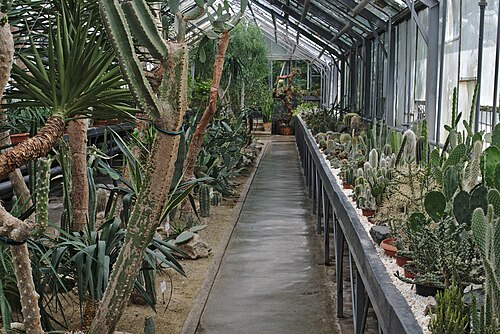
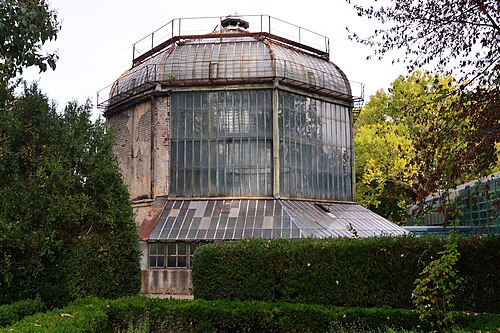
The garden describes a glasshouse complex with 2,160 m² of cultivated space, while another of its pages puts the tropical section at about 2,500 m². An article in the magazine Natura refers to seven separate houses, each tended by long-serving staff. The space falls into three main groups: succulents, which alone take up 720 m²; subtropical plants, divided between humid and arid regions; and tropical plants, including a rainforest section of epiphytes and climbers. These protected volumes keep frost-tender species from Africa, Asia, the Americas and Australia alive in a country with a continental climate and hard winters.
Plant collections
The collection under glass numbers around 2,500 taxa (2,504 in the inventory published by the institute), spread across 133 families and 614 genera. Succulents account for about half: Mammillaria alone is represented by 165 taxa and Astrophytum by 20, alongside Echinocactus grusonii and the old man cactus, Cephalocereus senilis.
Other major groups include aroids (137 taxa), bromeliads (124 taxa in 23 genera), pelargoniums (130 taxa), ferns (76 taxa), some fifty figs, around forty begonias, 46 peperomias, 36 palms and 27 orchids. Some specimens are more than fifty years old, among them a Cycas circinalis and a Consolea rubescens. One part of the houses is given over to useful plants: coffee, banana, citrus, avocado, papaya and pomegranate.
Visiting
The glasshouses lie within a 104-hectare park crossed by the Valea Crucii valley and punctuated by four lakes stepped in a cascade. The main entrance, from Dacia Boulevard, leads along an avenue of blue spruces; a secondary entrance on Pădurii Street opens onto lime-tree alleys.
A visit to the houses pairs well with the rose garden to the left of the main entrance, the water lilies on the lakes in summer, the rock garden and the hydrangea collections, which start flowering in June. In winter, when the park is dormant, the glasshouses hold most of what is in active growth.
46.97° N, 28.89° E
Greenhouses nearby
Do you have a good photo of this greenhouse? Suggest it for this page →
Sources (9)
- gbni.usm.md/?page_id=2391&lang=en
- gbni.md/ru/node/112
- idcgb.usm.md/?page_id=14
- en.wikipedia.org/wiki/Chi%C8%99in%C4%83u_Botanical_Garden_of_the_Academy_of_Sciences
- visit.chisinau.md/en/obiective_turistice/gradina-botanica/
- natura.md/gradina-botanica-nationala-in-prag-de-sarbatoare
- europalibera.md/a/28457712.html
- moldpres.md/rom/societate/vara-in-gradina-botanica-trandafiri-nuferi-si-colectii-unice-de-
- openstreetmap.org/node/10002211201
Affiliate links — booking through Verrière helps fund our research, at no extra cost to you.