Greenhouse Complex of the “Anastasie Fătu” Botanical Garden (Complexul de sere)
Iași, Iași County

Entry updated on October 5, 2026
- Year
- 1974 (Palmarium)
- Architect
- Unknown
- Style
- Greenhouse complex; circular glazed metal-framed Palmarium
- Dimensions
- 5,500 m², 21 compartments; Palmarium 15 m in diameter and 17 m high
- Status
- Open to the public (8 compartments permanently); Palmarium rehabilitation put out to tender in 2026
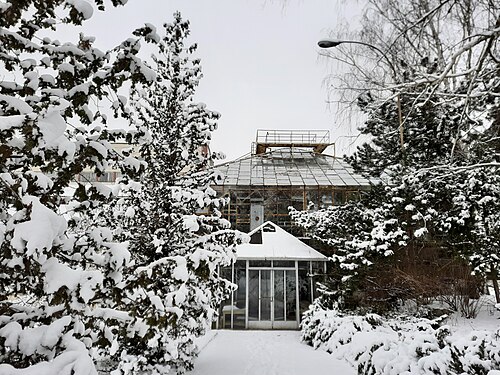
Set in the middle of Alexandru Ioan Cuza University's “Anastasie Fătu” Botanical Garden on Copou Hill, the greenhouse complex covers 5,500 m² divided into 21 compartments, eight of which are permanently open to visitors. It shelters some 2,210 tropical, subtropical and Mediterranean taxa, from cacti to figs and palms. Its centrepiece, the circular Palmarium built in 1974, rises to 17 metres; in 2026 the university launched a tender for its rehabilitation.
Affiliate links — booking through Verrière helps fund our research, at no extra cost to you.
History
1 min
Botany in Iași goes back to 1856, when the physician Anastasie Fătu (1816-1886) laid out a first garden near the place called Râpa Galbenă. After his death his heirs sold the property and the collections were lost. In 1921 Professor Al. Popovici founded a new garden of about one hectare behind the university's new building, already equipped with a small group of greenhouses for tropical plants.
The present garden was created in 1963-1964 on Copou Hill under the direction of Professor Emilian Țopa, and took the name of its distant founder. The greenhouses were grouped in the central part of the ornamental sector. The Palmarium, the tallest building of the ensemble, went up in 1974.
This landmark structure has been the subject of two repair programmes. In 2020 a project funded by UEFISCDI through the Institutional Development Fund was to renew its heating, electrical installation, irrigation and interior access, with reopening announced for the following winter. At the end of September 2026 the university launched a design-and-build tender, estimated at 3.8 million lei, for a heavier rehabilitation dealing with water infiltration, the metal frame, glazing, sealing, gutters and floors. As early as 2020 the garden's director, Cătălin Tănase, presented such works as a way of strengthening the institution's role in ex situ conservation.
Architecture and engineering
1 min
The complex brings together about twenty greenhouse units, 20 according to the Agerpres news agency and 21 compartments according to the garden, with a total area of 5,500 m². The compartments are run at warm, temperate or cool settings, and plants are grouped by geographical origin and ecological needs. Eight compartments are permanently open; three more can be visited only at certain times of the year.
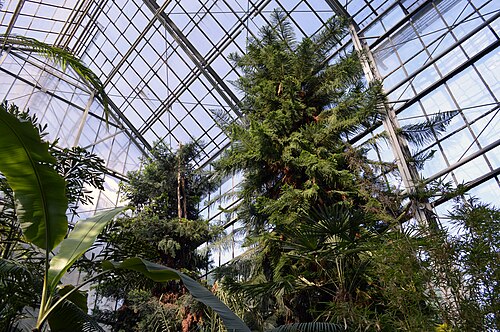
The Palmarium, built in 1974, stands out for its circular plan, 15 metres across, and its maximum height of 17 metres. Its glazed surface reaches 787 m² over a floor area of some 187 m². An interior staircase and a railed catwalk allow visitors to move around at height. The 2020 programme provided for 545 m² of cast-iron radiators, 910 metres of heating pipes and an irrigation network with 24 spray nozzles. The 2026 contract covers the metal structure and its corrosion protection, new glazing, doors and windows, and an automated control system for temperature and humidity that gives priority to natural ventilation.
Plant collections
1 min
The greenhouses hold about 2,210 taxa according to the garden (2,600 according to Agerpres), drawn from subtropical, tropical and equatorial regions. The Mediterranean and xerophytic spaces gather olive, pomegranate, carob, oleander and rosemary. Figs are represented by more than 150 specimens of over 20 taxa, alongside many palms, including date palms. One section is devoted to cycads, among them Cycas revoluta and African species, another to useful tropical plants such as coffee, cacao, avocado and mango. Succulents are a particular strength: the genus Mammillaria alone counts more than 500 specimens, with agaves, aloes and euphorbias. The Palmarium houses palms, bananas, figs, araucarias and magnolias. From December to March, hundreds of azaleas from some 25 cultivars and camellias from 15 cultivars are shown in flower.
Visiting
1 min
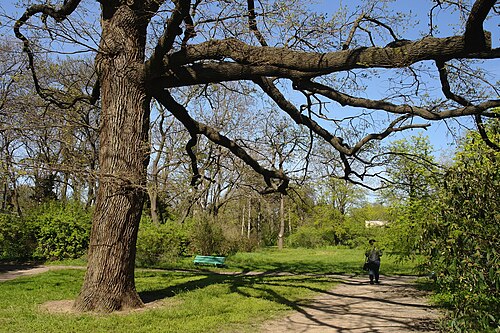
The complex sits at the centre of the garden's ornamental sector, within grounds of nearly 90 hectares on Copou Hill (89.55 ha according to Agerpres, about 100 according to other sources), with entrances on the Copou and Păcurari sides. Allow about an hour for the open compartments and much longer for the rest of the garden. Winter, from December to March, is the season for azaleas and camellias; orchids, tulips and roses follow one another from February to August, then chrysanthemums and ornamental vegetables from September to November. The garden receives more than 290,000 visitors a year.
47.19° N, 27.56° E
Greenhouses nearby
Do you have a good photo of this greenhouse? Suggest it for this page →
Sources (5)
- botanica.uaic.ro/sector_sere_detalii.html
- ro.wikipedia.org/wiki/Grădina_Botanică_„Anastasie_Fătu”_din_Iași
- agerpres.ro/documentare/2023/06/07/timp-liber-gradina-botanica-anastasie-fatu-din-iasi--11
- apix.ro/sera-cu-palmieri-de-la-gradina-botanica-iasi-va-fi-reabilitata-a-fost-lansata-lici
- newsmoldova.ro/ultima-ora/sera-palmarium-a-gradinii-botanice-iasi-va-fi-renovata-si-se-va-