Vlinderparadijs Papiliorama (Havelte tropical butterfly greenhouse)
Havelte (Westerveld), Drenthe

Sources checked October 2026
- Year
- 1998
- Style
- Tropical butterfly greenhouse
- Dimensions
- About 950 m² (tropical greenhouse)
- Status
- Open to the public; entrance, shop and restaurant under renovation (2026)
Opened on 21 December 1998 on the edge of Havelte, next to the Holtingerveld nature area, the Vlinderparadijs Papiliorama is a tropical butterfly garden housed in a fully covered greenhouse of more than 900 m², which Dutch Wikipedia counts among the largest in Europe. A private, unsubsidised attraction holding a zoo licence since 2003, it flies hundreds of butterflies reared from pupae imported from Costa Rica, Uganda and the Philippines among plants chosen to feed both caterpillars and adults. The entrance, shop and restaurant are being renovated, and a semi-underground insectarium is planned.
Affiliate links — booking through Verrière helps fund our research, at no extra cost to you.
History
The Vlinderparadijs Papiliorama opened on 21 December 1998 after several years of preparation: finding the site, on the edge of the Holtingerveld nature area, and securing the zoning plan took a long time before building could start. The official history page recalls the first construction, the fitting-out of the lunch room and the planting of the first plants. The park is a private business that receives no subsidy and pays for its own renovations.
In 2003 it was among the first zoos in Europe approved under the EU zoo directive and obtained a Dutch zoo licence. Its pupae come from specialised breeding farms in tropical countries, and since 2004 the park has backed a butterfly-rearing project run by a small community in Uganda, where more than eight families now earn what the park puts at about twelve times the average income. A foundation, Vrienden van het Vlinderparadijs, supports school education, research on insects and development cooperation. Dutch Wikipedia adds that the park itself supplies butterflies to several butterfly gardens in Europe.
A 2009 article in Vlinders, the magazine of the Dutch Butterfly Conservation, counted about ten tropical butterfly gardens in the Netherlands, Emmen having been the first, and listed Havelte among them. The park's first expansion was an outdoor walking garden, still being developed. All the walls and windows of the shop, greenhouse and restaurant have recently been renewed; the entrance is now under construction, with the shop and restaurant to follow. A large semi-underground insectarium, for which the zoning plan is ready, is to be built once this renovation is complete.
Architecture and engineering
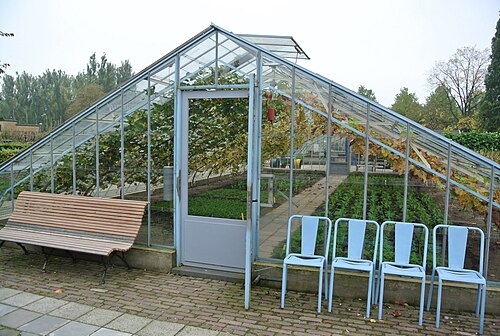
The attraction is a fully covered tropical greenhouse: Dutch Wikipedia gives the butterfly house more than 900 m², and the official site puts the tropical garden at 952 m². The Dutch buildings register (BAG), as carried in OpenStreetMap, records a single building at Van Helomaweg 14, dated 1998, which houses the greenhouse together with the shop and the lunch room La Chenille, with about a hundred seats and a summer terrace.
The air inside is warm and humid enough that the park advises photographers to let their cameras acclimatise for five minutes after entering. All paths are paved and suitable for wheelchairs and pushchairs. The park states that the greenhouse absorbs roughly 18,250 kg of carbon dioxide a year, more in summer, a figure it displays on a counter on its home page. The renovation now under way has already replaced every wall and window of the greenhouse, shop and restaurant, and work has moved on to the entrance. A semi-underground insectarium devoted to insects is planned as the next addition once the renovation is finished.
Plant collections
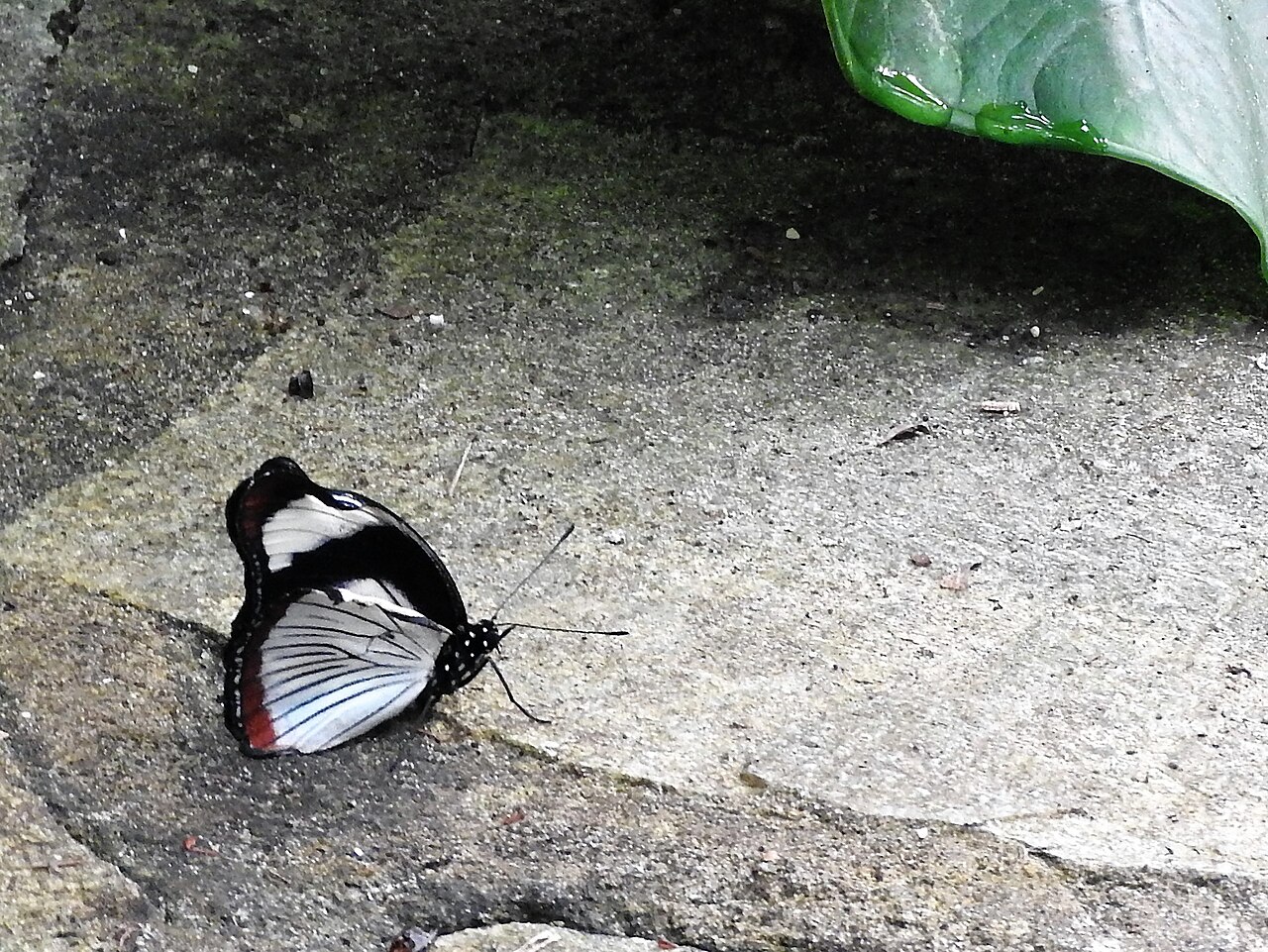
Hundreds of exotic butterflies live in the greenhouse, and dozens take wing each day from pupae supplied by sustainable breeding farms in Costa Rica, Uganda and the Philippines; 15 to 20 percent of the butterflies breed naturally on site, and the rest have to be imported again. The park singles out the bright blue morpho, the atlas moth, which it presents as the largest butterfly species, and the glasswing; the whole life cycle, from egg to pupa to adult, is on show.
Nearly every plant has a job to do for the butterflies, and few are merely ornamental. Caterpillars feed on banana (Musa), canna, Cestrum, soursop (Annona) and nettles planted on purpose, while the adults draw nectar mainly from Lantana camara, Pentas lanceolata, Asclepias curassavica and Stachytarpheta indica, among dozens of other species. Three kinds of banana, acacia, cacao, coffee, cherimoya and oleander make up the tree layer. The garden aims to have something in flower all year, so artificial flowers and extra feeding are rarely needed even in winter; dead leaves are left where they fall as shelter for eggs and caterpillars, which can make the planting look untidy.
Visiting
The greenhouse stands on the Van Helomaweg at the edge of Havelte, at the gateway to the Holtingerveld, with free parking on site. Being fully enclosed, it can be visited in any weather and any season, since flowering is kept up through the winter; allow about an hour, longer with the lunch room or one of the educational workshops announced on the website. Less than a kilometre away, a well-kept path leads to the hunebedden D53 and D54, the first of which, about 18 m long, is the second-largest megalithic tomb in the Netherlands; the heath, drifting sands and woods of the Holtingerveld are crossed by marked walking and cycling routes. In this catalogue, the Oranjestein orangery at Oranjewoud and the tropical glasshouse at Beetsterzwaag lie 25 to 30 km away, and Emmen's Rimbula about 45 km.
52.79° N, 6.22° E
Greenhouses nearby
More greenhouses — Netherlands
Do you have a good photo of this greenhouse? Suggest it for this page →
Affiliate links — booking through Verrière helps fund our research, at no extra cost to you.