Invernáculo of the Montevideo Botanical Garden
Montevideo, Prado district

Sources checked September 2026
- Year
- 1920s · restored 2022-2023
- Style
- Metal-framed greenhouse of French origin, painted yellow, clad in polycarbonate
- Status
- Open only for booked guided visits
In the Profesor Atilio Lombardo Botanical Garden, created in 1902 in Montevideo's Prado district to plans by the French landscape designer Carlos Racine, the invernáculo houses the tropical and subtropical plant collection: ferns, palms, orchids, aroids and bromeliads. According to the garden, its metal frame came from France, stood first elsewhere in the Prado and was moved here in the 1920s. Heated by hot water piped beneath the floor and clad in polycarbonate in place of its original glass, it was restored and repainted in its original yellow before reopening on 29 March 2023. It can be seen only on booked guided visits.
Affiliate links — booking through Verrière helps fund our research, at no extra cost to you.
History
Montevideo's Botanical Garden dates from 17 April 1902, when the Junta Económico Administrativa approved a proposal by its president, Juan L. Heguy. Honorary direction went to the naturalist José Arechavaleta and the botanist Cornelio B. Cantera. Work began under the head gardener Ernesto Racine, who died soon afterwards; his brother, the French landscape designer Carlos Racine, then drew up the plan and carried it out. According to the municipality, the first garden, set on part of the city nurseries, already had invernáculos and facilities for aquatic plants. The clearing of the neighbouring nurseries between 1917 and 1920 made way for a new garden, completed by 1924.
The present greenhouse's frame is said to have come from France and to have stood first elsewhere in the Prado, on the site later used by a weather station, before being moved to the Botanical Garden in the 1920s to grow tropical plants.
Its restoration was the first stage of the works announced for the garden in September 2022. Both interior and exterior were treated: the whole transparent roof and then the walls were reclad, the walls were repaired and the structure repainted in its original yellow. The greenhouse reopened on 29 March 2023 in the presence of Montevideo's intendant, Carolina Cosse; the city described it as a century old, and further repairs to pools and side walls were still planned.
Architecture and engineering
The greenhouse is built on a metal frame that the garden says came from France. It was once glazed, but the glass broke several times a year from knocks or storms, letting heat escape and putting visitors and staff at risk. It has been replaced by polycarbonate, chosen as light, durable and highly transparent, which is essential for the plants to receive enough light. Since the 2022–2023 restoration the walls combine solid sheets along their first metre with cellular polycarbonate above, 2.20 m of it according to the garden's description. The frame has been returned to the yellow chosen for it originally.
The house has been heated ever since it arrived in the garden. A boiler warms water that runs through galvanised iron pipes beneath the floor, and its fuel traces a century of technology: wood at first, then coke, fuel oil, diesel and now natural gas. Winter temperatures average 16 to 20 °C; in summer, with the boiler off, the interior can reach 42 °C in air saturated with moisture. The garden notes that plants must be kept away from draughts and sharp swings in temperature.
Plant collections
The greenhouse holds the garden's collection of tropical and subtropical plants, one of several collections arranged by habitat alongside xerophytes, aquatic plants, shade plants, medicinal plants and grasses. Visitors see ferns, palms, orchids, aroids and bromeliads, together with staghorn ferns, pandanus, peperomias and the plant known locally as palo de agua. They are chosen for ornamental value: large or coloured leaves, bold patterns, unusual shapes and textures. Guided visits also explain how the plants are propagated, from seed or vegetatively by cuttings, layering, division and grafting, and offer advice on growing them.
The gardeners' work inside covers watering, cleaning, feeding, repotting and the control of pests and diseases, as well as bringing in new species, replacing losses and acclimatising new arrivals. The house complements a garden of about a thousand species, including 1,761 trees and 620 shrubs, which exchanges seed with more than 500 botanical gardens around the world.
Visiting
The greenhouse stands in the Botanical Garden in the Prado district, whose main entrance is at 1181 Avenida 19 de Abril, with a second gate on Avenida Luis Alberto de Herrera. Entry to the park is free, but the enclosed greenhouse opens only for guided visits booked in advance through the museum, for small groups led by the technical staff. A visit takes about half an hour. On the Día del Patrimonio heritage weekend in October free visits are run on a first-come basis, and the house also opened to the public during the September 2026 plant fair. The botanical museum, with its herbarium and seed collection, and the 106 hectares of the neighbouring Prado park make natural additions.
34.86° S, 56.20° W
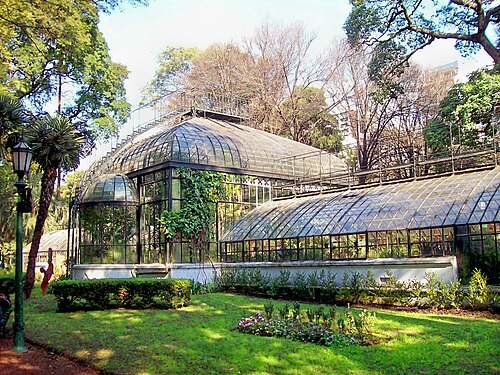
Greenhouses nearby
Architecture nearby
Do you have a good photo of this greenhouse? Suggest it for this page →
Sources (8)
- jardinbotanico.montevideo.gub.uy/node/10/coleccion/invernaculo
- montevideo.gub.uy/noticias/cultura/reabre-invernaculo-del-jardin-botanico
- montevideo.gub.uy/parques-de-montevideo/jardin-botanico
- jardinbotanico.montevideo.gub.uy/museo/historia
- jardinbotanico.montevideo.gub.uy/museo/manejo-de-las-colecciones-vivas
- montevideo.gub.uy/noticias/institucional/actividades-de-la-intendencia-en-el-dia-del-patri
- montevideo.gub.uy/noticias/ferias-de-libros-y-plantas-en-el-jardin-botanico
- es.wikipedia.org/wiki/Museo_y_Jard%C3%ADn_Bot%C3%A1nico_Profesor_Atilio_Lombardo
Affiliate links — booking through Verrière helps fund our research, at no extra cost to you.