Tropical Useful Plants Greenhouse, Medicinal Plant Garden of the Naito Museum of Pharmaceutical Science and Industry (内藤記念くすり博物館 熱帯有用植物温室)
Kakamigahara, Gifu Prefecture

Sources checked October 2026
- Style
- Glazed double-pitch greenhouse with a raised lantern, on a masonry plinth, with a lean-to under curved eaves
- Dimensions
- Medicinal plant garden of about 7,000 m² (about 700 species)
- Status
- Open to the public (free, open access during museum hours: 9 a.m.-4:30 p.m., last entry 4 p.m.; closed on Mondays and at year end)
Within the grounds of the Naito Museum of Pharmaceutical Science and Industry in Kakamigahara (Gifu), a glazed greenhouse grows useful tropical plants: cacao, vanilla, banana, sandalwood, frankincense and papaya. It forms part of the museum's medicinal plant garden of about 7,000 m², which also holds a herb garden, a medicinal tree garden, a potager and a healing garden. A sign at the greenhouse entrance announces free access, and the museum recommends it for winter.
Affiliate links — booking through Verrière helps fund our research, at no extra cost to you.
History
The greenhouse stands in the medicinal plant garden of the Naito Museum of Pharmaceutical Science and Industry in Kakamigahara, Gifu Prefecture. According to Japanese Wikipedia, the museum was founded on 12 June 1971 by Naito Toyoji, founder of the pharmaceutical company Eisai, under the name "Naito Kinen Kusuri Shiryōkan", within the grounds of Eisai's Kawashima plant, which opened in 1966. It took its present name in 1977, gained an exhibition building in October 1986 and a library in November 2005, and has been registered as a museum under the Museum Act since 31 May 2024. The English version of the official site presents the maintenance of the gardens as one of the museum's two main activities, alongside the preservation and display of its collections.
Also according to Wikipedia, the medicinal plant garden covers about 7,000 m² and combines five areas: a herb garden, a medicinal tree garden, a potager, a healing garden and the tropical greenhouse. The tree garden opened in 1990; in 2020, part of the herb garden became an English-style healing garden edged with stone walls. Wikipedia's remark that the herb garden and the greenhouse "open when the museum opens" means that they follow the museum's hours, not that they date from 1971.
Architecture and engineering
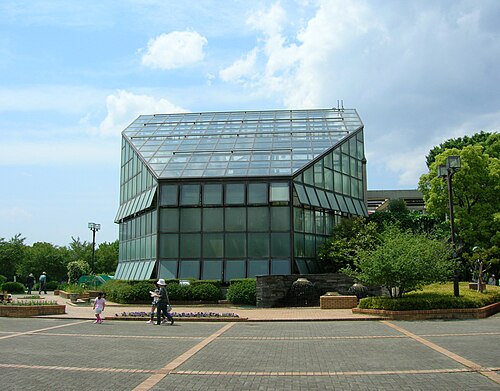
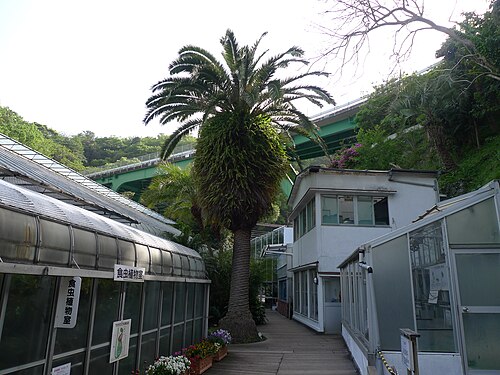
A photograph released into the public domain (CC0) on Wikimedia Commons, taken on 29 May 2021, shows the greenhouse as a rectangular volume with fully glazed walls, with white glazing bars, set on a low masonry plinth. The double-pitch roof is also glazed and rises in the centre into a lantern; a glazed lean-to under curved eaves runs along the volume on the side of the entrance sign, which reads "Tropical useful plants greenhouse" and "free to visit".
A second photograph by the same author, taken inside, shows behind a cacao tree a glazed partition with a white frame, pierced by a door, a sign of interior compartmentation. The area of the whole garden is about 7,000 m². The museum's planting plan, updated in September 2025, places the greenhouse, the exhibition building and the main building along the same edge of the garden.
Plant collections
According to Japanese Wikipedia, the greenhouse grows useful tropical plants: cacao, vanilla, banana, sandalwood (ビャクダン), frankincense (ニュウコウジュ) and papaya. A 2022 blog repeats the presentation of the garden: it holds medicinal plants, spices and fruit trees from tropical and subtropical regions, and cacao pods can be seen from the entrance. An August 2026 visitor confirms that large cacao pods greet visitors. In the 2021 interior photograph, a cacao tree bears yellow-orange fruit; a board shows cut pods and a label gives the plant's name.
The rest of the garden holds about 700 species according to the museum: medicinal plants, medicinal trees, aromatic herbs. Poisonous plants, such as datura and aconite, are grown behind fences closed to the public, according to Wikipedia. The museum's calendar highlights the useful tropical plants of the greenhouse for winter, when the outdoor garden is at rest.
Visiting
The greenhouse stands within the museum grounds themselves: an August 2026 visitor describes the medicinal plant garden that spreads out beyond the gate, with the tropical greenhouse. Entry is free and the greenhouse follows the museum's hours. The museum recommends it for winter; the rest of the garden is in flower from Golden Week to August or September, then the trees bear fruit in autumn.
The municipal Fureai bus (Kawashima line) stops at "Kusuri Hakubutsukan-higashi", three minutes' walk away; by car, allow about fifteen minutes from the Gifu-Kakamigahara and Ichinomiya-Kisogawa interchanges, with a car park of some sixty spaces. Most travellers report one to two hours for the whole visit. About 3 km away are the Aqua Totto Gifu aquarium and the Gifu Kakamigahara Air and Space Museum.
35.36° N, 136.84° E
Greenhouses nearby
More greenhouses — Japan
Do you have a good photo of this greenhouse? Suggest it for this page →
Sources (10)
- ja.wikipedia.org/wiki/%E5%86%85%E8%97%A4%E8%A8%98%E5%BF%B5%E3%81%8F%E3%81%99%E3%82%8A%E5%8
- eisai.co.jp/museum/information/facility/garden.html
- eisai.co.jp/museum/information/service/information.html
- eisai.co.jp/museum/english/
- museum.or.jp/museum/4216
- eisai.co.jp/museum/information/facility/garden06.html
- ameblo.jp/manabi5580/entry-12762430673.html
- jalan.net/kankou/spt_21301cc3290031892/
- flat-gifu.com/report-detail.php?1190
- commons.wikimedia.org/wiki/File:Nait%C5%8D_Museum_of_Pharmaceutical_Science_and_Industry_2
Affiliate links — booking through Verrière helps fund our research, at no extra cost to you.