Tropical Ecology Garden, Hibikinada Green Park (響灘緑地 熱帯生態園)
Kitakyushu (Wakamatsu Ward), Fukuoka Prefecture

Sources checked October 2026
- Style
- Large tropical hall with glazed façades
- Dimensions
- About 1,500 m² building footprint
- Status
- Open to the public, separate admission on top of the park's (closed Tuesdays, like the park)
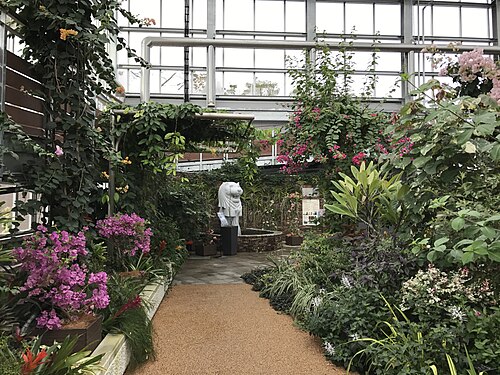
In Hibikinada Green Park, opened in 1992 in Kitakyushu on the site of a national urban greening fair, the Tropical Ecology Garden is one of the largest buildings: a glass-fronted hall of about 1,500 m² of built area. About 130 species and 4,000 tropical plants are counted there, from banyans to bottle palms, with flowering trees, fruit trees and water plants. Capybaras, small-clawed otters, toucans, reptiles, fish and some 500 ōgomadara butterflies live there too. Two small neighbouring glasshouses hold cacti, succulents and tropical fruit trees.
Affiliate links — booking through Verrière helps fund our research, at no extra cost to you.
History
Hibikinada Park (響灘緑地, also called Green Park), in Wakamatsu Ward, spreads around the large Tonda reservoir. It occupies the site of the 8th National Urban Greening Fair, "Green Renaissance Kitakyushu '91", and opened on 1 April 1992. The official site and the City of Kitakyushu's page list the tropical hall among the park's facilities, alongside the Urban Greening Center, the rose garden and the kangaroo enclosure.
It is known that its contents have changed. An online article of April 2014 notes the recent arrival of eighteen animal species, among them chameleons, piranhas and iguanas, and a 2023 blog recalls that iguanas once roamed free. Since 1 April 2014 the park has been run by a consortium of companies, the "Green Park Revitalization Joint Venture".
On 2 June 2023 a couple of the Japanese imperial family visited the hall and looked at the tropical trees, according to the Imperial Household Agency, which adds that the prince had already visited the park during the national urban greening ceremony of 1991.
Architecture and engineering
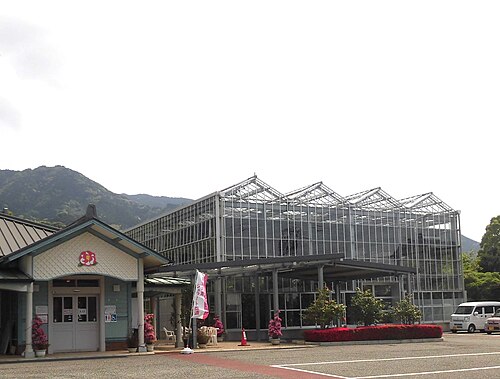
The hall is among the largest buildings in the park and stands out from afar for its glass façades, a local blog notes (2023); a 2019 report speaks of a glazed exterior that catches the eye. Garden Story gives a built area of about 1,500 m²; the outline mapped as "熱帯生態園" on OpenStreetMap, about 1,530 m², agrees. The Wikimedia Commons photograph (2008) shows a large rectangular volume with glass walls divided into panes by a regular grid, a taller end bay topped by a large arch with a gridded frame, and a base clad in light-brown facing.
Inside, the route moves from tropical trees to a rock wall planted with species that change with the seasons, as far as a cave; near the end, a cave-like space behind a waterfall holds tanks of aquatic animals. The air stays hot and humid in winter, the 2023 blog and the official site note, the latter presenting the hall as the one place in the park that is not freezing in that season. The smaller second and third glasshouses stand on the neighbouring plot, on the rose garden side.
Plant collections
The official site names the banyan (ガジュマル) and the bottle palm (トックリヤシ) as emblematic large trees, among brightly coloured flowers; Garden Story counts about 130 species and 4,000 plants: flowering trees, palms, fruit trees and water plants. According to an official post of February 2023, the rock wall carries guzmanias and anthuriums, renewed through the seasons. The flowering calendar of the April 2026 brochure names dombeya in January, Medinilla magnifica in March, brugmansia in April, heliconia in July and plumeria in September.
On the animal side, a 2023 blog lists capybaras, small-clawed otters, toco toucans, laughing kookaburras, spurred tortoises, bearded dragons, piranhas and red-tailed catfish. The hall also holds some 500 ōgomadara butterflies, which the park raises from egg to adult in about a month and a half. The second glasshouse gathers about fifty species of cacti, succulents and carnivorous plants and grows the caterpillars' host plant; the third shows tropical fruit trees, caterpillars, golden chrysalises and newly emerged butterflies. Entry to both is free.
Visiting
On the OpenStreetMap map, the hall stands about 150 m from the rose garden, near the Urban Greening Center; the two small glasshouses are next to it, on the rose garden side of the plot. The kangaroo enclosure, the great lawn and a circular swing of 163 m with a hundred seats, certified by Guinness as the world's longest, round off the day.
The official site recommends the hall in winter, when it is the least cold place in the park, and the brochure calendar lists a tropical bloom for every month. The 1.3-hectare rose garden, with 320 varieties, flowers mainly from mid-May to mid-June and again from mid-October to mid-November; an autumn rose fair is announced from 17 October to 15 November 2026. According to the reviews gathered by Jalan, visitors most often spend more than two hours in the park.
33.92° N, 130.73° E
Greenhouses nearby
More greenhouses — Japan
Do you have a good photo of this greenhouse? Suggest it for this page →
Sources (10)
- hibikinadagp.org/facility/%E7%86%B1%E5%B8%AF%E7%94%9F%E6%85%8B%E5%9C%92/
- hibikinadagp.org/guide
- gardenstory.jp/gardens-shops/21787
- kitakyuyoitoko.com/gp_tropical_ecological_garden/
- kunaicho.go.jp/watch/activity/schedule03/202306/21858.html
- hibikinadagp.org/creatures/%E5%86%AC%E3%81%AF%E3%81%82%E3%81%A3%E3%81%9F%E3%81%8B%E7%86%B1
- cheerdays.fcoop.or.jp/go-out/WplS6
- commons.wikimedia.org/wiki/File:Nettai_seitai_en_Greenpark.JPG
- ja.wikipedia.org/wiki/%E9%9F%BF%E7%81%98%E7%B7%91%E5%9C%B0
- city.kitakyushu.lg.jp/contents/924_00875.html
Affiliate links — booking through Verrière helps fund our research, at no extra cost to you.