Tokiwa Museum World-Travelling Plant House (ときわミュージアム 世界を旅する植物館)
Ube, Yamaguchi Prefecture

Entry updated on October 5, 2026
- Year
- 1995
- Architect
- Unknown
- Style
- Municipal tropical glasshouse, replanted as eight geographical zones (2017)
- Dimensions
- Tropical plant hall of 3,125 m² floor area
- Status
- Open to the public
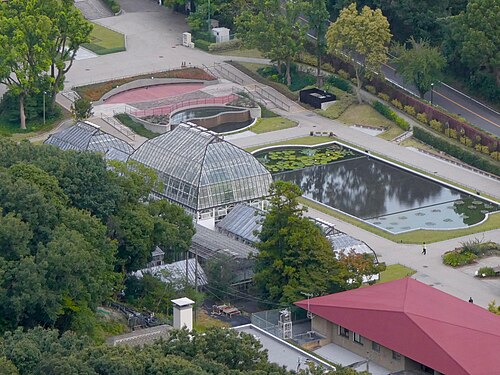
Opened on 1 April 1995 in Ube's Tokiwa Park, the city's tropical glasshouse now forms part of the Tokiwa Museum of greenery, flowers and sculpture. On 29 April 2017 it reopened as the 'World-Travelling Plant House', redesigned under the direction of plant hunter Seijun Nishihata: eight zones evoke the floras of tropical Asia, Africa, Europe, Oceania and other regions, each built around a symbolic tree chosen to suggest the vegetation of its native habitat.
Affiliate links — booking through Verrière helps fund our research, at no extra cost to you.
History
1 min
The tropical glasshouse in Tokiwa Park, the large municipal park of the city of Ube, opened on 1 April 1995 (Heisei 7). In 2007 the city built around it the Museum of Greenery, Flowers and Sculpture, known as the Tokiwa Museum, which combines the plant hall with outdoor sculpture displays; the park hosts the biennial UBE Biennale, the successor to an exhibition of contemporary Japanese sculpture.
After some twenty years of use, the city chose to reinvent the glasshouse. The redesign was entrusted to plant hunter Seijun Nishihata, who proposed turning the visit into a journey around the world. The glasshouse reopened on 29 April 2017 under its new name, Sekai wo tabisuru shokubutsukan. Moving the baobab from Senegal was one of the hardest parts of the project; at the reopening Nishihata reported that the tree was putting out new growth and taking root. The city of Ube remains owner and operator. The sources consulted do not name the architect of the 1995 building.
Architecture and engineering
1 min
According to Japanese Wikipedia, the tropical plant hall has a floor area of 3,125.22 m². Before the renovation, the glazed growing area itself, of about 1,470 m², was divided into three rooms: an orchid room of about 254 m², a cactus room of about 546 m² and a tropical room of about 670 m².
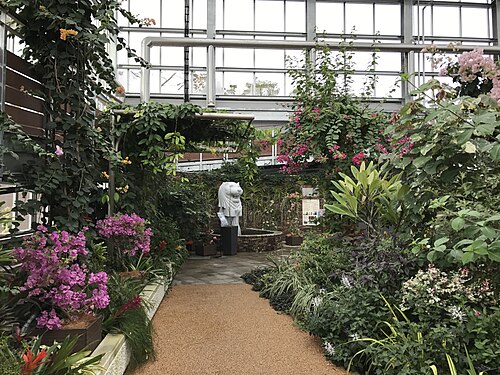
The 2017 renovation chiefly reorganised the interior. The old division by plant group gave way to eight linked geographical zones, each designed to suggest the vegetation of a region of origin and marked by a symbolic tree that acts as a landmark. The route is thus conceived as a sequence of landscapes rather than a systematic collection. Around the building, some 28,000 m² of outdoor space is given over to the display of sculpture.
Plant collections
1 min
The glasshouse displays 738 species. Its eight zones are devoted to tropical Asia, tropical America, Africa, South America, North and Central America, Europe, Oceania, and China and Asia. Among the symbolic trees are a banyan, a baobab, an olive, a bottle tree and a handkerchief tree. The baobab, brought from Senegal for the Africa zone, is described as one of the largest in the country, and a three-tonne giant tree stands in the tropical America zone.
Tokiwa Park has raised its own cacti with striking flowers, rarely seen elsewhere. The glasshouse also shows orchids, including phalaenopsis and cattleyas, carnivorous plants and tropical fruit trees such as papaya, mango and banana.
Visiting
1 min
The glasshouse belongs to the Tokiwa Museum in Tokiwa Park, in Ube; it charges admission, whereas the rest of the museum is free. Allow about an hour to walk through the eight zones.
The museum publishes a monthly flowering calendar and runs talks, for instance on roses. In the neighbouring gardens, trees linked to the history of science, a so-called Mendel's grape and a Newton's apple tree, extend the botanical visit. In UBE Biennale years, the sculptures displayed outdoors around the museum add a further reason to come.
33.95° N, 131.28° E
More greenhouses — Japan
Do you have a good photo of this greenhouse? Suggest it for this page →