Great Orangery, Fomin Botanical Garden
Kyiv
No freely licensed photo of this greenhouse yet. Do you have one? Suggest it for this page →
Sources checked September 2026
- Year
- 1970s · domed orangery 1984
- Style
- Soviet-era 30-metre orangery and domed orangery
- Dimensions
- 1,100 m², a palm tree there touches the glass roof at about 32 meters
- Status
- Open to the public
Kyiv University's botanical garden, founded in 1839 and named after the botanist O. V. Fomin, replaced three old 16-metre glasshouses after 1974 with a 30-metre orangery, then presented as the tallest in Europe; an 18-metre domed orangery followed in 1984. The 2007 catalogue listed more than 4,200 tropical and subtropical taxa, whose emblem is a Livistona australis the garden presents as Ukraine's oldest and tallest palm. Since 2022, power cuts have forced staff to protect the collections through winter with wood stoves.
Affiliate links — booking through Verrière helps fund our research, at no extra cost to you.
History
Kyiv University's botanical garden dates its foundation to 22 May 1839, when the botanist R. E. Trautvetter made the first plantings; the architect V. I. Beretti had proposed the site on adjoining land. The first collections came from the Kremenets Lyceum, from which 513 plants of 34 species were registered as early as 1833. At the end of September 1847 an orangery complex of seven sections was completed, together with terraces that still survive. By 1884 the garden was growing 1,169 species of glasshouse plants.
Directed from 1914 until his death in 1935 by the botanist O. V. Fomin, who greatly enlarged the collections, the garden was afterwards named after him. During the Second World War the staff managed to save the collections, while the director M. V. Dubovyk was killed in action.
In 1974 the city council adopted a programme to improve and rebuild the garden. Under V. F. Lapchyk, three old 16-metre orangeries gave way to a single 30-metre orangery, described at the time as the tallest structure of its kind in Europe. A domed orangery 18 metres high followed in 1984. In 2015 the collection of tropical and subtropical plants under glass was granted the status of a scientific object of Ukraine's national heritage. Since 2022, power cuts and heating shortages have forced staff to see the collections through winter with wood-burning stoves.
Architecture and engineering
The great orangery, 30 metres high with a floor area of about 1,000 m², stands on the site of the three 16-metre houses it replaced. According to the garden, its height made it the tallest glasshouse in Europe when it was built.
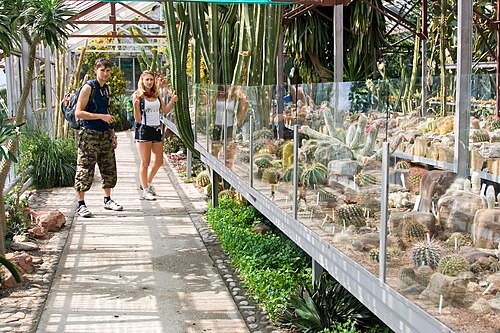
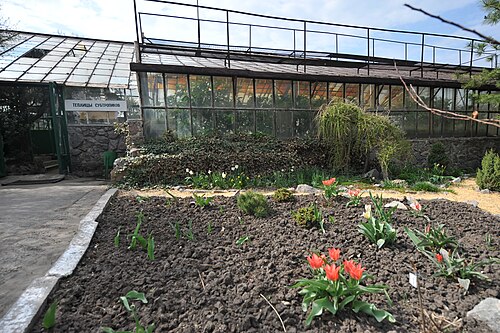
It is part of a larger ensemble. The domed orangery completed in 1984, 18 metres high and covering more than 500 m², was designed by V. I. Severyn, a researcher at the garden. The other glasshouses are organised by plant group: archegoniates (ferns and their allies), tropical plants, subtropical plants, succulents, monocots, and aquatic, marsh and carnivorous plants. The terraces laid out in 1847 for the first orangery complex can still be seen.
Plant collections
The catalogue published in 2007 under V. A. Solomakha listed 4,214 taxa of tropical and subtropical plants, out of more than 9,000 species, forms and cultivars grown across the garden. The collections of succulents and cacti, aquatic and marsh plants, archegoniates and monocots are among the best known, and a number of species on international, national and regional red lists are represented.
The emblem of the glasshouses is an Australian palm, Livistona australis, which the garden describes as the oldest and tallest in Ukraine. In 2021 a small bronze sculpture dedicated to it was installed on the facade of a residential building opposite the garden.
Visiting
The garden covers 22.5 hectares of sloping ground, between 139 and 178 metres above sea level, beside Taras Shevchenko University in central Kyiv. Its park section is open to the public, while 9 hectares are reserved for research. The orangeries complement a walk across the terraces and through the arboretum; allow one to two hours for the whole garden. Opposite the garden, the bronze miniature of the Livistona makes a small addition to the visit. Access to the glasshouses depends on wartime conditions and the heating season, so it is wise to check the garden's announcements before going.
50.44° N, 30.50° E
Greenhouses nearby
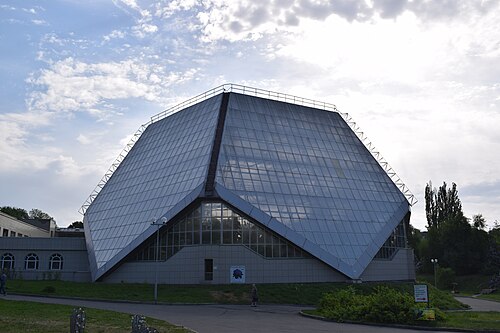
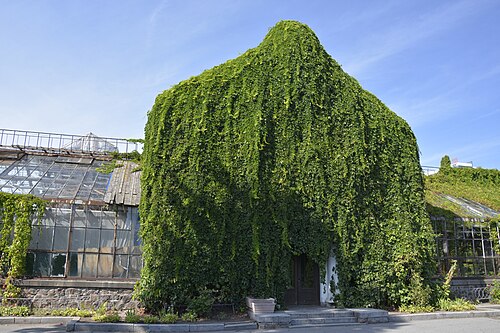
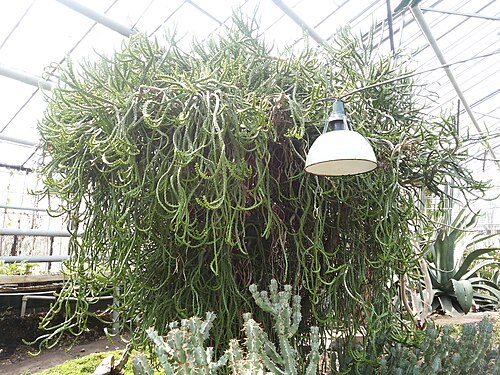
More greenhouses — Ukraine
Do you have a good photo of this greenhouse? Suggest it for this page →
Affiliate links — booking through Verrière helps fund our research, at no extra cost to you.