Palm House and Greenhouses of Kozel Château (palmový skleník)
Šťáhlavy, Plzeň Region

Sources checked October 2026
- Style
- Glasshouses of a château nursery; palm house is the oldest part
- Status
- Open with the park ticket since the 2024 season; check current access with the château
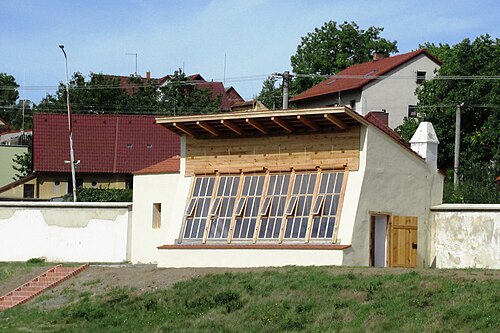
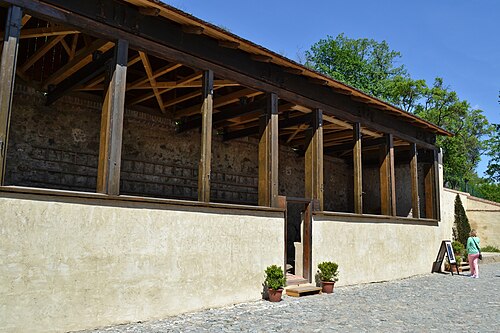
In the nursery of Kozel Château, a hunting lodge raised in the 1780s for Count Jan Vojtěch Černín, a group of glasshouses appears among the components of the monument in the Czech heritage catalogue. Its oldest part, the palm house (palmový skleník), has been open to visitors since the 2024 season on the park admission ticket. Château staff grow banana and mandarin trees there; the distinctive feature is palms and figs several metres tall, and some of the plants are remnants of the nobility's collection.
Affiliate links — booking through Verrière helps fund our research, at no extra cost to you.
History
Kozel Château dates from the 1780s, when Count Jan Vojtěch Černín of Chudenice had a hunting lodge built, designed and supervised by the Prague architect Václav Haberditz; the château's own website dates its completion to 1789. A gardener's house was raised soon afterwards. The estate then passed to the Waldstein (Valdštejn) family, who reshaped the park: it took its form from the second half of the nineteenth century under the gardener František Xaver Franz (1838-1910), trained at Hluboká and Schönbrunn. After 1945 the estate belonged to the state.
The nursery and its glasshouses lie, according to the coordinates of the 2021 survey, about a hundred metres south of the château. A landscape-architecture diploma thesis (Czech Technical University, 2021) states that the nursery buildings appear on a view of 1808 and that the adjoining glasshouses were added only about 120 years later; this statement, from a student work, is not confirmed by any other source.
The head of park maintenance presents the palm house as the oldest part of the glasshouse complex. Until 2024 the public had no access to it: the 2024 season introduced a paid park ticket that opens the palm house and the château chapel to visitors for the first time.
Architecture and engineering
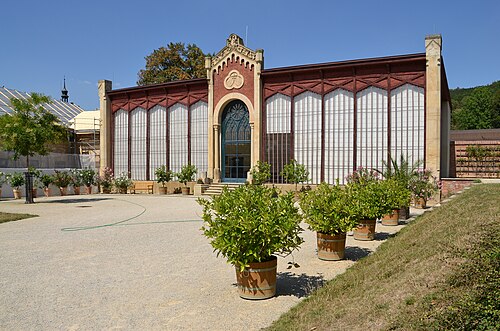
The 2021 survey of historic Czech orangeries and glasshouses, carried out by the horticulture faculty of Mendel University (Lednice) for a Ministry of Culture programme, classes the Kozel glasshouse among glasshouses in the strict sense (type 4: at least one wall and the roof glazed). It describes a building adjoining the gardener's house and forming part of the nursery, whose façade has a distinct, emphasised central section. Its condition is rated "modified" (upravená): all the main parts of the original structure are preserved or well restored, but some details were lost in adapting it to its present use. The survey also records national cultural monument status, and the heritage catalogue lists "skleník" among the eleven components of the château, without describing it.
A Wikimedia Commons photograph geotagged less than ten metres from the survey's point, and the collaborative OpenStreetMap, where two glasshouse buildings are drawn at the same spot, confirm the location.
Plant collections
According to the head of park maintenance, the palm house holds plants that are remnants of the nobility's collection: banana and mandarin trees are grown there, but the distinctive feature of the place is palms and figs several metres tall.
The nursery to which these glasshouses belong still produces plants for the estate, according to the 2021 thesis cited above. Outside, the park has 50 species of conifers and 111 of broadleaved trees, including a spruce collection near Franz's ponds, a beech collection on Homolka hill and a tulip tree about 150 years old and 27 m tall beside the riding hall, which flowers in June. The park's area is about 30 ha according to the château, 40 ha according to the Czech Wikipedia.
Visiting
The palm house is visited on the paid park ticket of the château; according to the 2024 season announcement, the ticket is required from Easter to the end of October. The park itself is open all year, but the present access arrangements for the glasshouse are worth checking with the château before travelling.
The rest of the outing is naturally built around the park: Franz's cascade of four ponds (Paví, Rusalčino, Vodníkovo and Růžové), viewpoints at several heights, the tulip tree by the riding hall, then the château itself, once the Černín hunting lodge, and its chapel, also open on the park ticket since 2024. Allow an hour or two for the park, in addition to the glasshouse.
49.67° N, 13.53° E
Greenhouses nearby
More greenhouses — Czech Republic
Do you have a good photo of this greenhouse? Suggest it for this page →
Sources (7)
- plzensky.denik.cz/zpravy-region/zamek-kozel-sezona-2024-novinky-vstup-park-altan-sklenik/
- zamek-kozel.cz/cs/o-zamku/zamecky-park
- zamek-kozel.cz/en/about/historical-park
- pamatkovykatalog.cz/zamek-kozel-14264650
- ubz.zf.mendelu.cz/wcd/w-zf-ubz/projekty/naki-dg18p02ovv007/nmap-historicke-oranzerie/nmap0
- cs.wikipedia.org/wiki/Zámek_Kozel
- commons.wikimedia.org/wiki/Category:Greenhouse_at_Kozel_Castle
Affiliate links — booking through Verrière helps fund our research, at no extra cost to you.