Červené Poříčí Château Orangery (oranžerie)
Červené Poříčí, Plzeň Region

Sources checked October 2026
- Style
- Baroque orangery with a sloping glazed front and a monopitch roof
- Status
- Restored (2022-2024); in the château garden, open April to October, with a visit ticket
Built against the north wall of the Červené Poříčí château garden, in the south of the Plzeň Region, this small baroque building was designed for overwintering exotic plants. Run down for lack of upkeep, it ended up as a shed for the forestry administration before a full restoration carried out between 2022 and 2024. It now has a sloping glazed front with timber frames under a monopitch roof. Figs grow there again and citrus trees spend the winter in it; it is the only orangery of the estate to survive. The château garden is open from April to October.
Affiliate links — booking through Verrière helps fund our research, at no extra cost to you.
History
The orangery stands against the north wall of the Červené Poříčí château grounds, in Klatovy District. The château's official website describes it as a small baroque building, put up originally to overwinter exotic plants. The château itself, built in 1611 for Mikuláš Šic z Drahenic, later passed to the dukes of Bavaria and then to the Habsburgs, before becoming property of the Czechoslovak state; the heritage administration took over its management in 1997. According to the kastelán (the monument's manager) quoted by iDNES, the garden once had several orangeries and glasshouses, but only one building of this kind survives; figs and pineapples were grown there for the owners' table, at great expense.
Unused for a long time, the structure had decayed for lack of maintenance, and the forestry administration used it as a shed. A project funded by the Integrated Regional Operational Programme (IROP) provided for a complete restoration of the orangery and of the neighbouring gloriette; the end date is 30 June 2022 according to the château website, 30 June 2023 according to the heritage institute's page, for a cost of about 3.4 million crowns. The Kudy z nudy portal dates the works to 2022-2024. According to iDNES (March 2025), the Ministry of Culture granted 7.5 million crowns to the orangery, of which 5.1 million went on rebuilding the glazed structure; the remaining 2.4 million were to fund a second stage on the surroundings in 2025. Czech public television presented it in March 2025 as the smallest orangery in Bohemia, seen by the public for the first time.
Architecture and engineering
The building has a rectangular plan under a monopitch roof; to the west, a service room of nearly square plan is attached under a gabled roof. The works notice lists a complete restoration: repair of structural faults and damaged load-bearing elements, joinery, renders, a drainage strip at the foot of the walls, electrical installation, and connection to water and heating. The Czech heritage register, the Památkový katalog, lists the structure among the château's components under the word "skleník", meaning glasshouse.
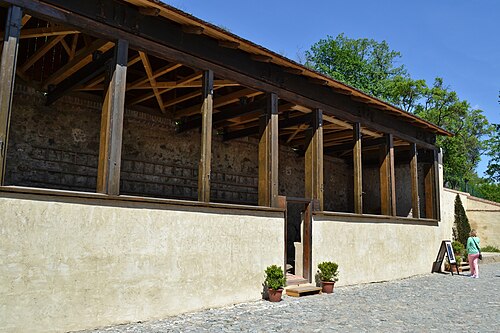
The photographs show how the building works: between two rendered masonry wings, a large sloping glazed front made of timber frames with small panes, some of which are openable, topped by a band of timber cladding under the overhang of a roof with exposed rafters. Roll-up blinds hang in front of the glazing. Inside, according to images on the château's website, a timber ceiling and benches run along the glass.
Plant collections
The orangery has returned to its original function. According to the Kudy z nudy portal, it is used to overwinter citrus and other exotic plants, and figs grow there again; citrus trees were formerly displayed along the park paths from spring to autumn and then brought under cover. According to iDNES, plants that could not survive the Czech winter spend the cold months there; in summer, once the pots have been taken out, for example into the château courtyard, aubergines, peppers or tomatoes take their place. Photographs on the official site show plants in terracotta pots beneath the glazing.
According to iDNES, the glazed building is also to serve as an exhibition space on the purpose of orangeries and their history in noble residences.
Visiting
The orangery stands in the château's outer garden, against the north wall, near the gloriette restored under the same project. The official website states that both buildings can be found in the garden, open from April to October, and that entry to the grounds is tied to a visit ticket: the exhibition "Cestovní horečka" (Travel Fever), set up in the outer château, can be walked through freely. The garden is wheelchair-accessible, without paved paths.
The orangery is small, but the château deserves a longer stay: it belongs to the Saxon Renaissance and has been a national cultural monument since 2010. The orchard of old varieties, planted in 2014-2015, rounds off the walk. The water castle of Švihov lies nearby, according to Kudy z nudy.
49.50° N, 13.29° E
Greenhouses nearby
More greenhouses — Czech Republic
Do you have a good photo of this greenhouse? Suggest it for this page →
Sources (9)
- zamek-cerveneporici.cz/cs/obnova-a-rozvoj/obnova-staveb-v-zamecke-zahrade
- npu.cz/cs/o-nas/organizacni-schema/povinne-zverejnovane-informace/dotace-z-evropskych-zdro
- kudyznudy.cz/aktivity/oranzerie-na-zamku-cervene-porici
- idnes.cz/plzen/zpravy/cervene-porici-pamatky-sezona-turisticka-klatovsko-oranzerie-gloriet
- ceskatelevize.cz/porady/15334114383-udalosti-v-regionech-jih-a-zapad/225411000180306/cast/
- pamatkovykatalog.cz/zamek-cervene-porici-14214569
- zamek-cerveneporici.cz/cs/fotogalerie/137616-gloriet-a-oranzerie
- cs.wikipedia.org/wiki/Z%C3%A1mek_%C4%8Cerven%C3%A9_Po%C5%99%C3%AD%C4%8D%C3%AD
- wikidata.org/wiki/Q136654620
Affiliate links — booking through Verrière helps fund our research, at no extra cost to you.