Great Vivarium (Grand Vivarium), Montréal Insectarium
Montreal, Quebec

Entry updated on October 5, 2026
- Year
- 2022
- Architect
- Kuehn Malvezzi, Pelletier de Fontenay and Jodoin Lamarre Pratte architectes; landscape: atelier le balto
- Style
- Contemporary glazed greenhouse with a sawtooth roof
- Dimensions
- ≈3,600 m² for the whole Insectarium
- Status
- Open to the public
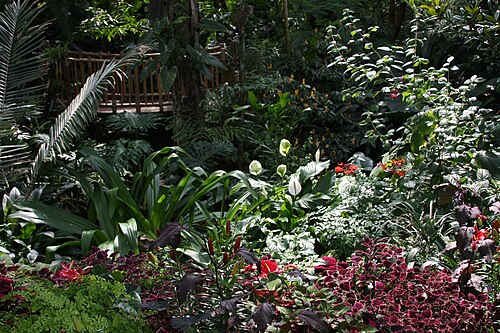
Opened on 13 April 2022, the Grand Vivarium is the greenhouse at the end of the visitor route through Montreal's rebuilt Insectarium, a museum founded in 1990 around the collection of the entomologist Georges Brossard. Designed by Kuehn Malvezzi, Pelletier de Fontenay and Jodoin Lamarre Pratte architectes after an international competition won in 2014, this south-facing glazed house with a sawtooth roof holds about 150 plant species, among which butterflies, caterpillars and leafcutter ants move freely beside glass vivaria of beetles and scorpions.
Affiliate links — booking through Verrière helps fund our research, at no extra cost to you.
History
1 min
The Montreal Insectarium grew out of the enthusiasm of the entomologist Georges Brossard. In 1986 he put the idea of an insect museum to Mayor Jean Drapeau, and a first exhibition, 'Les plus beaux insectes du monde', drew more than 75,000 visitors. The following year Brossard gave the city his collection of more than 250,000 insects from some hundred countries. The Insectarium was opened by Mayor Jean Doré on 7 February 1990, next to the Botanical Garden, and became one of the largest museums in the world devoted to insects.
In 2014 Espace pour la vie, described as Canada's largest natural science museum complex, held an international competition to rethink the institution. It was won by the Berlin practice Kuehn Malvezzi together with the Montreal firms Pelletier de Fontenay and Jodoin Lamarre Pratte architectes, with the Berlin landscape architects atelier le balto. Known as the 'Metamorphosis of the Insectarium', the project had been planned for Montreal's 375th anniversary but opened five years later, on 13 April 2022. Canadian Architect puts its budget at C$31.78 million excluding museology, while the architects' press kit gives C$33.26 million. The Grand Vivarium, where insects and plants share the same space, is the culmination of the scheme.
Architecture and engineering
1 min
The scheme is built around three archetypal figures: a pollinator garden, a greenhouse and a dome topped by a planted mound. Most of the building, about 3,600 m² in all, lies underground, where the exhibition rooms draw on the thermal mass of the earth. The route first descends through the sloping garden, then along a dark corridor evoking an ants' nest and through six cave-like sensory rooms, before emerging into the daylight of the Grand Vivarium.
The glazed greenhouse has a sawtooth roof and a stepped volume naturally oriented towards the south. Motorised louvres provide natural cross-ventilation, and textile shades set just beneath the envelope can be deployed mechanically. Control systems normally found in commercial production greenhouses continuously adjust the bioclimatic parameters, and the architects chose to leave this equipment in view. At the centre, a glass-walled creative workshop looks into the greenhouse and into the adjoining production greenhouse, where plants for the habitats are grown. Geothermal wells, roof-water recovery and the redistribution of heat from the greenhouse complete a project that targeted LEED Gold certification. Structural engineering was by NCK and mechanical engineering by Dupras Ledoux.
Plant collections
1 min
The Grand Vivarium holds about 150 species of plants, some 3,000 specimens in all, arranged in several microclimates along a gently undulating path. Butterflies and caterpillars move freely, with no barrier between visitors and insects, and an emergence cage shows butterflies leaving their chrysalises. Leafcutter ants carry leaves and food along a long, root-like route. Set into the planting, glass vivaria display other species, including giant beetles, scorpions and giant centipedes.
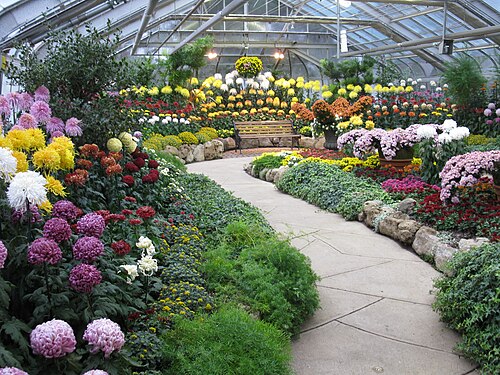
Butterflies, once shown each winter during the 'Papillons en liberté' event in the Botanical Garden's large exhibition greenhouse (Grande Serre), can now be seen all year in the vivarium, which brings together species from around the world, some living freely and others in semi-confinement, under a single roof.
Visiting
1 min
The Insectarium stands at 4581 rue Sherbrooke Est, on the edge of the Montreal Botanical Garden, whose exhibition greenhouses lie about 450 metres to the south. The visit follows a set sequence: the sloping pollinator garden, the underground rooms and finally the Grand Vivarium, where the air suddenly turns hot and humid, a contrast that is especially striking in the depths of a Montreal winter. A custom app helps visitors identify the insects they see. The visit combines naturally with the Botanical Garden and its exhibition greenhouses, which used to host the butterflies each winter.
45.56° N, 73.56° W
Greenhouses nearby
More greenhouses — Canada

Do you have a good photo of this greenhouse? Suggest it for this page →
Sources (6)
- espacepourlavie.ca/faq/levenement-papillons-en-liberte-t-il-encore-lieu
- fr.wikipedia.org/wiki/Insectarium_de_Montr%C3%A9al
- canadianarchitect.com/museum-metamorphosis-montreal-insectarium-montreal-quebec/
- v2com-newswire.com/en/newsroom/categories/institutional-architecture/press-kits/2275-04/me
- metalocus.es/en/news/metamorphosis-montreal-insectarium-kuehn-malvezzi-pelletier-de-fonten
- openstreetmap.org/way/46866398