Centennial Botanical Conservatory
Thunder Bay, Ontario
Entry updated on October 3, 2026
- Year
- 1967
- Style
- 1960s three-room municipal conservatory, almost entirely rebuilt in 2024–2025
- Status
- Open to the public, free admission; renovated in 2024–2025
Given to the people of Fort William as a project for Canada's centennial, the conservatory was built from 1965 and opened to the public on 10 November 1967. It combines a large central tropical house, an east wing for seasonal shows and a west wing devoted to plants from arid regions. Temporarily closed in 2012 when panes fell from the roof, and recommended for closure by a consultant in 2020, it was instead renewed in phases: new production greenhouses from 2020, then an almost complete rebuilding of the main building in 2024–2025. Admission is free.
Affiliate links — booking through Verrière helps fund our research, at no extra cost to you.
History
1 min
The conservatory began as a project for the centennial of Canadian Confederation, intended as a legacy to the people of Fort William and opened by the city's parks board. Construction started in 1965 and was largely complete by 1966, leaving a full year for seeding and growing the plants. The building opened to the public on 10 November 1967, and the official opening ceremony followed on 18 November. In 1968 the Canadian Daughters Assembly 34 donated a large banana plant.
In February 2012 glass falling from the ceiling forced a temporary closure and opened eight years of uncertainty: the wings stayed closed to the public for a long time, and in 2020 an external consultant recommended shutting the facility because of its operating cost. City council chose instead to reinvest, on the strength of a report showing that having city staff grow the flowers for the parks saved 83,000 dollars a year; the Friends of the Thunder Bay Conservatory backed the effort.
Renewal began in 2020 with the production greenhouses. In May 2023 council approved funding for work on the public building costing just over 5 million dollars, about 2.2 million of it from the city's Renew Thunder Bay fund with other funding coming from the federal and provincial governments. Construction started in 2024; this second phase was completed at the end of 2025, with a full reopening announced for January 2026, ahead of a third phase devoted to the grounds.
Architecture and engineering
1 min
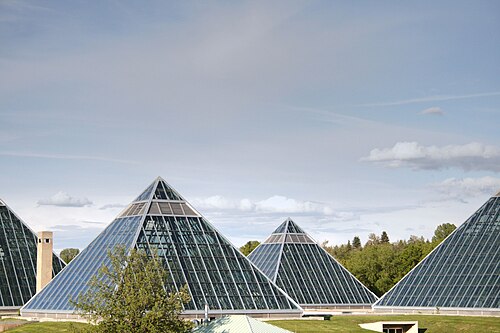
The building is arranged in three volumes. At the centre, the largest room holds the tropical house, a humid arboretum; on either side, the east wing hosts seasonal flower shows and the west wing, home to the cactus room, a permanent display of plants from arid regions. It is not a designated heritage building, but in 2012 its design was described as unique in the region. The sources consulted do not name its architect.
The 2024–2025 works were radical: according to the city's landscape architect, almost the entire main building was demolished and then rebuilt. The programme approved in 2023 included refinishing parts of the tropical house's steel structure and piping, replacing the heating, ventilation, air-conditioning and electrical systems, and adapting the east wing as a multipurpose space. Heating, lighting and sound systems were modernised. The edging, curbing and retaining walls are built of reclaimed granite cobblestones, taken from the Kaministiquia River about a century ago and formerly used in industrial works and roads.
Plant collections
1 min
The large central house gathers tropical flowers, trees, shrubs and other plants from around the world, along paths set with benches and around a wishing pond, rebuilt during the latest works to make it easier to reach. The west wing shows cacti and succulents from arid regions, while the east wing changes with the seasonal flower shows.
Behind the public rooms, the production greenhouses play a key role: staff grow annuals, perennials and native species there for the city's parks, flower beds and landscaped shorelines. City managers say that buying these plants in from southern Ontario would cost thirty to forty times as much as growing them on site, and it was this business case that made it possible to fund the renewal of the tropical display, which earns no revenue since admission is free.
Visiting
1 min
The conservatory stands on Dease Street in the south of Thunder Bay, and admission is free all year; about an hour is enough to see the tropical house and both wings.
It comes into its own in winter: in a city with a long, cold season, it offers one of the few green spaces open during the snowy months, a point stressed by the city and by the conservatory's supporters alike. Schools and groups can arrange tours, and the space can be booked for ceremonies and wedding photographs. The third phase of the project is to add outdoor event venues, a marketplace, paths and stormwater ponds around the building.
48.39° N, 89.26° W
Greenhouses nearby

More greenhouses — Canada
Do you have a good photo of this greenhouse? Suggest it for this page →
Sources (7)
- web.archive.org/web/20091002003332/http://www.thunderbay.ca/Living/recreation_and_parks/Pa
- en.wikipedia.org/wiki/Centennial_Botanical_Conservatory
- yourthunderbay.ca/thunder-bay-to-reopen-centennial-botanical-conservatory-in-january/
- cbc.ca/news/canada/thunder-bay/falling-glass-forces-conservatory-s-closure-1.1282904
- cbc.ca/news/canada/thunder-bay/thunder-bay-conservatory-two-reports-1.5755694
- cbc.ca/news/canada/thunder-bay/conservatory-overhaul-1.6837579
- openstreetmap.org/way/373068836