Central Siberian Botanical Garden Glasshouses
Novosibirsk (Akademgorodok)
No freely licensed photo of this greenhouse yet. Do you have one? Suggest it for this page →
Sources checked September 2026
- Year
- 1972
- Style
- Soviet scientific glasshouse complex
- Status
- Open to the public
The Central Siberian Botanical Garden, part of the Siberian branch of the Russian Academy of Sciences, built its glasshouses when it relocated to Akademgorodok in the 1960s, the main ones opening in 1972. They now hold more than 7,000 species, forms and varieties of tropical and subtropical plants from Europe, Asia, Africa, Australia and the Americas, with notable collections of cacti and succulents (close to 800 species), ferns, begonias and aroids. A seventh glasshouse devoted to phytodesign opened to the public in spring 2024. The garden sits in the Akademgorodok science district of western Siberia.
Affiliate links — booking through Verrière helps fund our research, at no extra cost to you.
History
The Central Siberian Botanical Garden was founded in 1946 within the Biological Institute of the West Siberian Branch of the USSR Academy of Sciences, in Novosibirsk's Zaeltsovsky district. In 1964 the Presidium of the Academy's Siberian Branch decided to move it to Akademgorodok, the fast-growing science town, where it could better serve botanical research and the landscaping of the new centre.
Work on a collection under glass began in 1969, led by the botanist Yevgenia Lvovna Kuzmina-Medova, who gathered tropical and subtropical plants, and the glasshouses opened in 1972. New displays have followed. Work on a cactus and succulent exhibit began in November 2012, and it was formally established in 2013. In 2016 the tropical display was substantially renovated and relocated. In spring 2024, glasshouse No. 7, devoted to phytodesign, opened to the public.
Architecture and engineering
The complex is a set of numbered glasshouses attached to a research institute, with display houses alongside growing houses. The displays follow scientific rather than purely decorative logic. Since 2016 the tropical exhibit has been arranged on botanical-geographic lines, and the cactus house groups its plants by region, covering South, Central and North America and Africa. The phytodesign house opened in 2024 has sub-sections for aquatic plants, living walls and florariums, intended to show how plants can be used indoors.
Plant collections
The garden cites more than 7,000 species, forms and varieties of tropical and subtropical plants from Europe, Asia, Africa, Australia and the Americas. Ferns, begonias and aroids are among the strongest collections. The new tropical display shows more than 800 taxa, including a much-loved Friendship Tree, a citrus over forty years old grafted with several varieties that still bears fruit.
The cactus and succulent exhibit holds some 800 species, forms and varieties, around 300 of them cacti and 495 other succulents, and the garden describes it as the only one of its kind east of the Urals. Occasional demonstrations, for instance when the orchids are in flower, add to the programme.
Visiting
The garden covers several hundred hectares on the edge of Akademgorodok, south of Novosibirsk, and can be reached on foot along Zolotodolinskaya Street. The glasshouses are seen on guided tours booked in advance, with several themes: tropical plants, cacti and succulents, spice and aromatic plants, and indoor horticulture and phytodesign. In summer a visit can continue into the arboretum of about 25 hectares, the bonsai park, the heather garden or the topiary garden; in winter the glasshouses make a striking contrast with the Siberian climate.
54.82° N, 83.10° E
Greenhouses nearby
More greenhouses — Russia
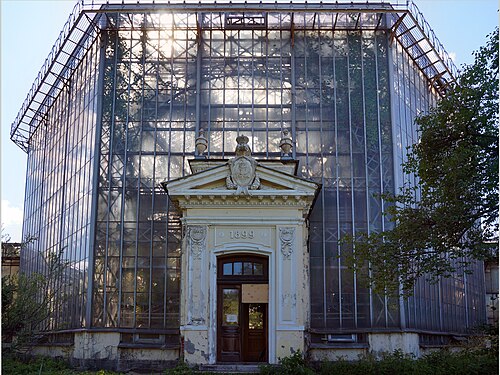
Do you have a good photo of this greenhouse? Suggest it for this page →
Affiliate links — booking through Verrière helps fund our research, at no extra cost to you.