Flower Dome, the large greenhouse of Nagasaki Bio Park (長崎バイオパーク フラワードーム)
Saikai, Nagasaki Prefecture

Sources checked October 2026
- Architect
- Unknown for the dome (park designed by Nihon Sekkei)
- Style
- Glazed dome on a metal rib frame, on a stone base, with a lantern
- Dimensions
- About 1,200 m² (official website)
- Status
- Open to the public with the park (open every day, including at year end)
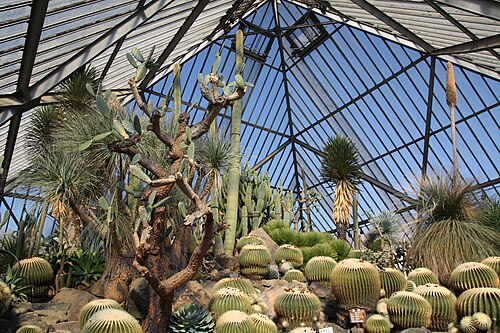
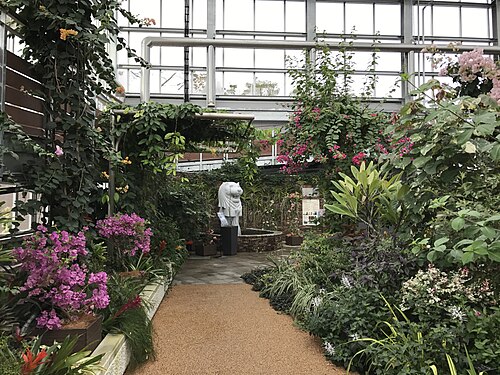
At Nagasaki Bio Park, a zoological and botanical park opened in 1980 in the hills of Saikai, the Flower Dome is the large greenhouse on the route: a dome of about 1,200 m² reached by climbing the slope after the "Inca" stone staircase that follows the entrance. The official site describes bougainvilleas in flower all year, tropical fruit trees and Indian flying foxes hanging from branches without fencing; orchids and butterflies are shown there during exhibitions. A photograph shows a cupola with metal ribs and large panes of glazing.
Affiliate links — booking through Verrière helps fund our research, at no extra cost to you.
History
Nagasaki Bio Park opened on 15 November 1980 in Saikai, built from a tourist orchard opened in 1973 on land in the former town of Seihi, now part of Saikai. Japanese Wikipedia explains that the park was built from 1975 under the direction of Professor Kondō Norio of the Tokyo University of Agriculture, founder of Izu Shaboten Park, on the theme of "harmony between people and nature"; the official site says the design is by Nihon Sekkei and that Kondō supervised it. The principle is "ecological display": the animals live, mostly without cages, in an environment close to their natural habitat.
The Flower Dome (フラワードーム) is the large greenhouse on the route. The official history records a "renewal with expansion" in October 1986, and Japanese Wikipedia dates the opening of a tropical house (熱帯館) and an Arctic house to March 1986, without explicitly linking the former to the dome. A 2007 post on the official blog mentions the 1,200 m² dome and an exhibition of orchids and butterflies, "Ran-ran Paradise Dome", running until 1 July that year.
The park is run by Biopark Co., which dates its creation to May 2004, and it was registered in March 2025 as a museum under the museum law revised in 2022.
Architecture and engineering
The Flower Dome is a dome whose radiating metal ribs carry large rectangular transparent panes, topped by a lantern. It rises on a base of stone walls pierced by an entrance, continued by the stone staircase of the "Inca" area; this is what a 2011 photograph on Wikimedia Commons shows. The official site calls it a "large greenhouse in the form of a large dome" (大温室) and gives 1,200 m²; on aerial imagery from the Geospatial Information Authority of Japan, the cover is a disc about 38 metres across, an area of the same order.
A prefectural tourism portal speaks of a dome that recreates the tropical climate, and the official 2007 blog describes plants hung in the air in a display using natural materials. A second, smaller dome, the Live Dome (ライブドーム), adjoins the first; it houses rock hyraxes on an artificial cliff with a six-metre drop and is not the subject of this entry.
Plant collections
The official site describes a dome where bougainvilleas and other brightly coloured plants flower all year, with tropical fruit trees, and where Indian flying foxes sleep hanging from branches without fence or netting; it also lists freshwater turtles (minami-ishigame, semaru-hakogame, sasori-dorogame) and the two-toed sloth in the dome's area. Japanese Wikipedia mentions South American rainforest plants and many orchids.
Seasonal shows have followed one another there: in 2007, a route of orchids (denpare, or Dendrobium phalaenopsis, Vanda, Paphiopedilum) and about 500 live butterflies, among them the ōgomadara and the asagimadara; in 2010, fifteen varieties of denpare and three of Cattleya, with Grammatophyllum, Miltonia, Vanda, Dendrobium and small Phalaenopsis. The official site says the tropical butterflies feed on the nectar of lantana and bougainvillea, and that rare fruits are shown there. The park as a whole holds about 1,000 species of cultivated plants and 30,000 specimens.
Visiting
On the loop route of twelve zones the dome is the third: it is reached by climbing the slope after the stone staircase that follows the entrance, and the path continues to the Live Dome. The thirty-hectare park practises ecological display and lets visitors feed several species; it opens every day of the year, apart from exceptional bad-weather closures.
By car, the official access page counts thirty to forty minutes from the Sasebo-Ōtō interchange on the western Kyūshū expressway, and about twenty from Huis Ten Bosch; a free shuttle on reservation links Huis Ten Bosch station (three round trips a day, forty-five minutes), and buses run from Nagasaki. The Saikai Bridge, about twenty minutes away by car, is a neighbouring stop. Entry tickets can also be bought online in advance.
32.99° N, 129.79° E
Greenhouses nearby
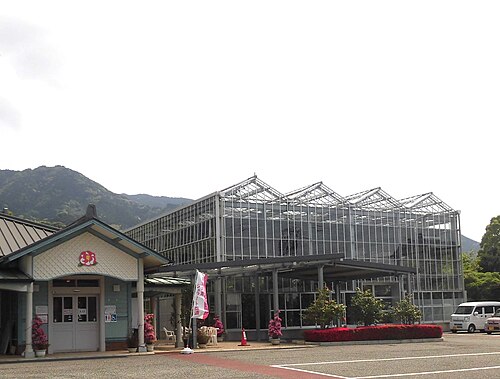
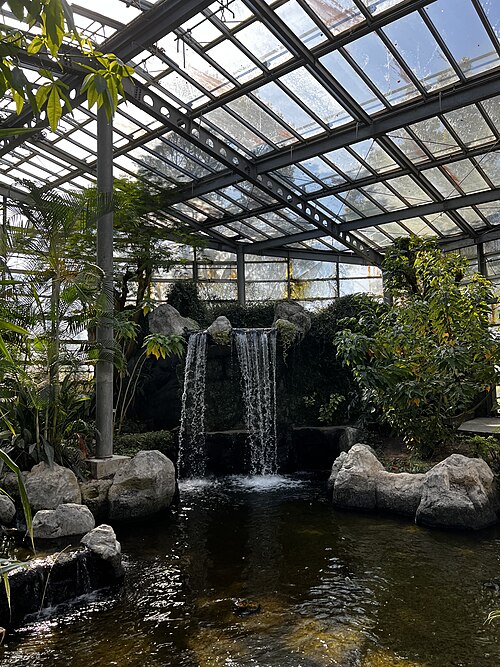
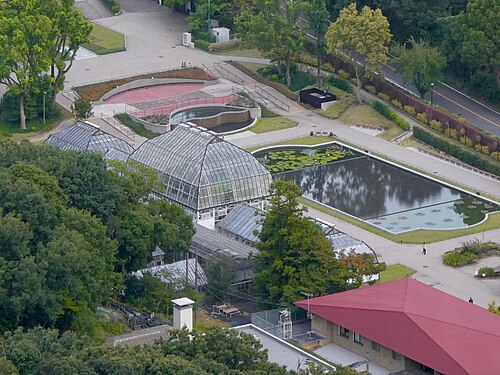
More greenhouses — Japan
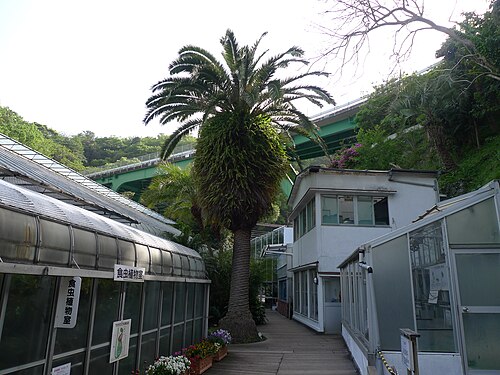
Do you have a good photo of this greenhouse? Suggest it for this page →
Sources (8)
- biopark.co.jp/animals/area/flower/
- biopark.co.jp/staff/2007/04/post_90.html
- biopark.co.jp/info/schooltrip/
- biopark.co.jp/info/overview/
- biopark.co.jp/corporate/
- biopark.co.jp/info/admission/
- biopark.co.jp/info/access/
- ja.wikipedia.org/wiki/%E9%95%B7%E5%B4%8E%E3%83%90%E3%82%A4%E3%82%AA%E3%83%91%E3%83%BC%E3%8
Affiliate links — booking through Verrière helps fund our research, at no extra cost to you.