Gaiser Conservatory (Manito Park)
Spokane, Washington
Entry updated on October 5, 2026
- Year
- 1912 · rebuilt 1974, dome 1988
- Architect
- Lord & Burnham (1974 building)
- Style
- Central dome and glazed wings on an aluminium frame
- Dimensions
- Display conservatory ≈280 m² (3,000 sq ft); growing houses ≈930 m² (10,000 sq ft)
- Status
- Open to the public
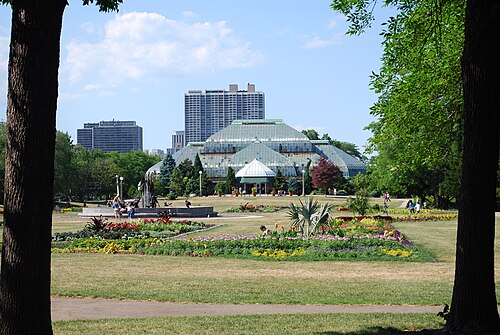
North of Duncan Garden in Manito Park, a greenhouse was built in 1912 to raise plants for the park; heated with coal, it admitted the public only on rare occasions such as Christmas and Easter. Once its redwood rafters had rotted, it was replaced in 1974, on the same site, by an aluminium conservatory designed by Lord & Burnham and opened to visitors for Expo '74. In 1988 the central dome was enlarged and the building was named after the surgeon David Gaiser. The dome and two wings display tropical plants, cacti and seasonal shows.
Affiliate links — booking through Verrière helps fund our research, at no extra cost to you.
History
1 min
Manito Park passed to the City of Spokane in 1904. The Olmsted Brothers were engaged as landscape consultants, but they offered recommendations rather than a design. The first greenhouses, small structures moved from Liberty Park, stood near Grand Boulevard in the northern part of the park; sources place them at 18th or at 20th Avenue.
In 1912 a conservatory and new growing houses were built on the present site, above Duncan Garden, which was laid out the same year. Their purpose was practical: raising seedlings and storing plants and tools, with coal-fired heating through the long winters. Visitors were admitted only on special occasions such as Christmas and Easter. During the Great Depression the greenhouse came close to closing; according to the Spokesman-Review, the park's zoo was shut instead, by a single vote.
By the 1960s the redwood rafters had rotted and repairs were constant. In 1974, ahead of Expo '74, a new aluminium conservatory and growing houses designed by the New York firm Lord & Burnham were built on the same spot, and the southern section opened to the public. According to Wikipedia, 100,000 dollars were raised, including an anonymous gift of 50,000 dollars, and the Comstock Foundation added 30,000 dollars when costs ran over.
In 1988 the central dome was redesigned and enlarged, and the conservatory was named after David Gaiser, a Spokane surgeon and civic leader who had presided over the park board and had died in 1985. The 1999 parks bond later paid for automatic curtains and energy-saving work. The Friends of Manito marked the conservatory's centenary in 2012.
Architecture and engineering
1 min
The conservatory is made up of a central dome framed by glazed wings. The dome and the two southernmost wings form the public section; the three northern wings remain production houses, where plants for the rest of the park are grown. In 2009 the Spokesman-Review put the display conservatory at some 3,000 square feet (≈280 m²) and the growing houses at some 10,000 square feet (≈930 m²).
The present structure dates from 1974, when Lord & Burnham replaced the original redwood framing with aluminium. Redesigned and enlarged in 1988, the dome contains a waterfall, a fish pond and a small bridge set among tropical plants. Automatic energy curtains have cut utility costs by about 70 percent, according to the same newspaper.
The building crowns a low rise immediately north of Duncan Garden, which it overlooks: a formal three-acre garden in the European Renaissance manner, laid out symmetrically around a large granite fountain and 63 flower beds.
Plant collections
1 min
The dome holds the tallest plants: a Norfolk Island pine several decades old, palms, ficus and citrus trees. The public wings show tropical and desert plants that could not survive Spokane's winters, orchids, and a permanent collection of succulents and cacti, among them species known as pencil plant, Mexican snowball and cub's paw.
The displays follow the seasons: bulbs in early spring, Easter lilies, begonias, impatiens and fuchsias in summer, chrysanthemums and cyclamen in autumn, then poinsettias in December, framed by tens of thousands of lights. Behind the scenes, the growing houses produce nearly 8,000 plants a year for the conservatory and some 60,000 annuals for Manito Park, Riverfront Park, neighbourhood parks and the municipal golf courses.
Visiting
1 min
The conservatory overlooks Duncan Garden in Manito Park, a 90-acre (≈36 ha) park in the Manito/Cannon Hill neighbourhood at 17th Avenue and Grand Boulevard. The dome and the two wings can be seen in under an hour. The December display, with its poinsettias and lights, is the busiest: it drew 6,500 visitors in a single season, the Spokesman-Review reported in 2009.
A visit easily extends to the park's other gardens: the Joel E. Ferris Perennial Garden (1940), the Nishinomiya Tsutakawa Japanese Garden (1974) with its koi pond, the Rose Hill rose garden (1950), with more than 1,500 rose bushes, and the Lilac Garden (1941), which holds more than 100 named cultivars.
47.64° N, 117.41° W
Greenhouses nearby
More greenhouses — United States
Do you have a good photo of this greenhouse? Suggest it for this page →
Sources (6)
- my.spokanecity.org/parks/gardens/gaiser-conservatory/
- en.wikipedia.org/wiki/Manito_Park_and_Botanical_Gardens
- spokanehistorical.org/items/show/66
- spokesman.com/stories/2009/may/07/gaiser-conservatory-holds-much-of-manitos-beauty/
- spokesman.com/stories/2012/jun/14/a-century-of-conservation/
- openstreetmap.org/way/389464459