Jewel Box (Forest Park)
St. Louis, Missouri
Entry updated on October 3, 2026
- Year
- 1936
- Architect
- William C. E. Becker (city engineer)
- Style
- Art Deco; vertical glass walls in five stepped tiers with clerestories
- Dimensions
- Main room 144 × 55 ft (≈44 × 17 m), 50 ft (≈15 m) high; about 7,500 sq ft (≈700 m²) of floor
- Status
- Open to the public (also rented for events)
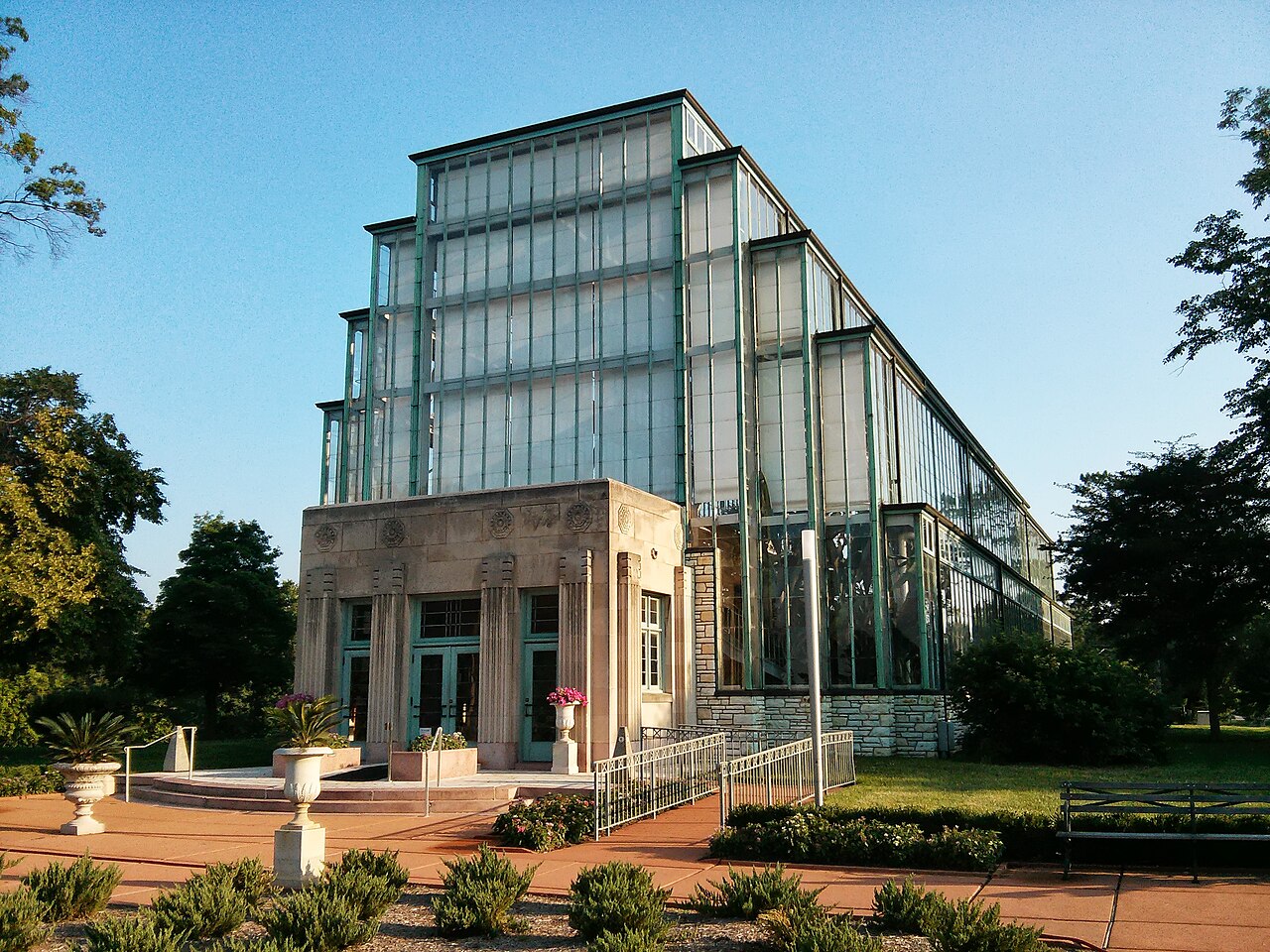
Dedicated on 14 November 1936 in Forest Park, the Jewel Box was designed by the city engineer William C. E. Becker and partly funded by the Public Works Administration. Breaking with the curved roofs of traditional glasshouses, it stacks five tiers of vertical glass walls lit by clerestories, 144 feet long and 50 feet high. Listed on the National Register of Historic Places in 2000 and restored in 2002 for 3.5 million dollars, it shows tropical plants and seasonal flower displays.
Affiliate links — booking through Verrière helps fund our research, at no extra cost to you.
History
1 min
The story of the Jewel Box begins before the building. In the winter of 1916-1917 John Moritz, head gardener of Forest Park, turned part of an existing greenhouse into a floral display with water features and seating. At a time when smoke and pollution threatened the city's plants, he also used it to show species able to withstand them. Seasonal exhibitions grew through the 1920s, and in 1926 the display took the name Jewel Box.
In 1933 Mayor Bernard Dickmann set aside 75,000 dollars for a permanent greenhouse. The city's chief engineer, William C. E. Becker, drew up the design and the Robert Paulus Construction Company built it in 1936. The work cost about 117,000 dollars, some 45 per cent of it from the Public Works Administration; according to the Conservatory Heritage Society, only unskilled and unemployed workers were hired. First named the St. Louis Floral Conservatory, the building was dedicated on 14 November 1936 to national acclaim, the Post-Dispatch calling it the latest word in display greenhouses. About 416,000 people visited in 1938-1939.
Decline set in during the mid-1970s as budgets shrank. On an application by the Landmarks Association of St. Louis, the Jewel Box was listed on the National Register of Historic Places on 14 March 2000 as an outstanding Art Deco greenhouse. An eleven-month restoration costing 3.5 million dollars, backed notably by Forest Park Forever and Bank of America, was completed in 2002.
Architecture and engineering
1 min
Becker broke with the tradition of curved glass roofs. The Jewel Box stacks cantilevered vertical glass walls in five stepped, flat-roofed tiers, each level lit by a clerestory. The arrangement was meant to limit damage from the frequent hailstorms of the Midwest, and the Conservatory Heritage Society counts it among the first modernist interpretations of the conservatory. Eight fixed arches carry the walls and roofs, their profile recalling that of the Eads Bridge, completed in 1874.
The main display room is 144 feet long, 55 feet wide and 50 feet high (about 44 × 17 × 15 m), with roughly 7,500 square feet (≈700 m²) of floor space. More than 4,000 panes, over 16,000 square feet of plate glass, are set in a frame of wood and wrought iron. Visitors enter through a limestone vestibule; the foundation is of rock-faced ashlar, and wooden plank ceilings rest on iron joists.
The 2002 restoration replaced the mechanical systems, added heating and air conditioning, and created a catering area and restrooms for receptions.
Plant collections
1 min
The Jewel Box is less a collection garden than a floral exhibition hall. All year round it shows tropical trees, foliage plants and flowers around a large fountain and pool; big pots line the water and hanging baskets descend from the ceiling. During the 2002 restoration the old trees, which had grown to the roof and blocked the light, were removed and the beds moved to the sides, leaving the centre of the room open.
These permanent plantings are supplemented with seasonal flowers raised in the city greenhouses and set out by the Flora Conservancy of Forest Park, a volunteer gardening group, and by the horticulture section of the parks division. Six shows mark the year: Christmas, early spring, Easter, Mother's Day, summer and the autumn chrysanthemum show, with lilies and azaleas among the featured blooms.
Visiting
1 min
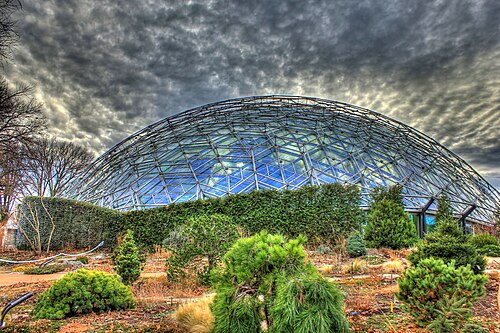
The Jewel Box stands at the junction of Wells Drive and McKinley Drive in Forest Park, on a 17-acre (about 7 ha) site run by the city parks department. South of the building, three reflecting pools with water lilies and flower beds along the paths extend the display outdoors. An hour is enough for the greenhouse and its surroundings; the calendar of shows, from Christmas to the autumn chrysanthemums, is the best guide to timing a visit. The building also hosts weddings and receptions, mostly in the evening and at weekends. Elsewhere in the city, the Missouri Botanical Garden holds the Climatron and the Linnean House.
38.64° N, 90.28° W
Greenhouses nearby
More greenhouses — United States
Do you have a good photo of this greenhouse? Suggest it for this page →
Sources (5)
- stlouis-mo.gov/government/departments/parks/parks/jewel-box.cfm
- stlouis-mo.gov/government/departments/parks/documents/upload/Jewel-Box-Rental-Information-
- en.wikipedia.org/wiki/Jewel_Box_(St._Louis)
- tclf.org/forest-park-jewel-box
- conservatoryheritage.org/historic-conservatories-library/20-century/the-jewel-box-conserva