Rotunda greenhouse of the Château des Ravalet
Tourlaville (Cherbourg-en-Cotentin), Normandy
Entry updated on October 1, 2026
- Year
- 1873-1875
- Architect
- René Clérel de Tocqueville (patron)
- Style
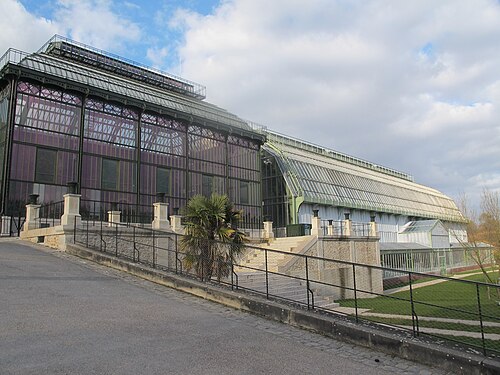
- Nineteenth-century iron-and-glass rotunda greenhouse
- Status
- In the château park, open to the public; greenhouse protected (historic monument)
At the Château des Ravalet in Tourlaville, René Clérel de Tocqueville laid out from 1864 a fourteen-hectare park with ponds, streams and a grotto. Between 1873 and 1875 he added a large rotunda greenhouse growing eucalyptus, bamboos, palms, tree ferns and camellias, and supplying the pineapples and bananas served to guests. Restored in 2001, the greenhouse has been protected as a historic monument together with the château since 1996, and the park has held the Jardin remarquable label since 2004.
Affiliate links — booking through Verrière helps fund our research, at no extra cost to you.
History
1 min
The greenhouse of the Château des Ravalet belongs to the ambitions of René Clérel de Tocqueville, who from 1864 set about renovating the château at Tourlaville and transforming its park. In 1872, according to Wikipedia, this fourteen-hectare park was redesigned and given two ponds and a grotto. The greenhouse was built between 1873 and 1875; some sources give 1872 for its origin, and the most widely cited range is kept here. Tocqueville grew exotic species there and had pineapples and bananas from his glasshouses served to guests, while a turbine supplied the estate with electricity.
The twentieth century changed the use of the place. In 1935 the widow of Paul Gosse ceded the château and about twelve hectares to the City of Cherbourg for 200,000 francs. The park opened to the public in 1960. The greenhouse was restored in 2001. The château, with several elements including the greenhouse, was listed as a historic monument by an order of 4 March 1996, the site has been registered as a natural site since 1983, and the park received the Jardin remarquable label in 2004.
Architecture and engineering
1 min
The sources consulted describe the greenhouse as a nineteenth-century iron-and-glass rotunda, one of the few of its kind still surviving in Lower Normandy. Its circular plan makes it a striking feature of a park designed in the manner of the landscape gardens of the period: streams, ponds and basins, a grotto, and a water turbine that generated electricity. The greenhouse is therefore not an isolated building but one of the devices of an estate composed entirely by Tocqueville.
None of the sources read names the greenhouse's builder or architect or gives its diameter, height or the detail of its metal frame; these are omitted, and René de Tocqueville is cited here only as the patron. The 1996 order explicitly lists "the greenhouse" among the protected elements of the château, confirming its heritage value. The restoration of 2001 is the only intervention documented in the texts consulted.
Plant collections
1 min
In René de Tocqueville's day the greenhouse held eucalyptus, bamboos, palms, tree ferns, camellias and geraniums. Tropical fruit was grown as well: summer guests could taste pineapples and bananas from the glasshouses. The greenhouse thus served a double role, ornamental and productive.
The texts consulted do not detail the greenhouse's present plantings. The surrounding fourteen-hectare park, according to Normandy's tourism presentation, brings together plants from North America, China, Australia and Europe, which carries on Tocqueville's taste for exotic introductions. It has held the Jardin remarquable label since 2004.
Visiting
1 min
The greenhouse stands in the park of the Château des Ravalet at Tourlaville, within the urban area of Cherbourg-en-Cotentin. The park has been open to the public since 1960 and is easily covered in a single walk, following the ponds, the stream and the grotto that form, with the greenhouse, the setting Tocqueville intended. The château itself can be visited on guided tours offered in season.
The visit can be combined with exploring Cherbourg, where Normandy's tourist offices also list the greenhouses of the Parc Emmanuel-Liais. It is prudent to check before travelling whether the greenhouse can be entered or only seen from the paths.
49.63° N, 1.57° W
Greenhouses nearby
More greenhouses — France
Do you have a good photo of this greenhouse? Suggest it for this page →