Greenhouses of the Jardin des plantes de Rouen (central greenhouse of 1842)
Rouen, Normandy
Entry updated on September 30, 2026
- Year
- 1839-1842
- Architect
- Unknown (central greenhouse); 2019 renovation: MVT Architectes
- Style
- Neoclassical cast-iron, wrought-iron and glass houses, central pavilion and lateral wings
- Dimensions
- About 4,000 m² of glasshouses across the garden; central house 85 m² with two 40 m² wings
- Status
- Open to the public; greenhouses renovated and reopened in May 2019
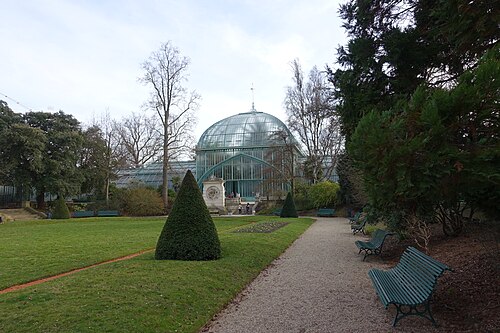
At the end of the long perspective of Rouen's Jardin des plantes stands the central greenhouse, built in 1839-1842 of cast iron, wrought iron and glass, with fluted columns and Ionic capitals. Listed as a historic monument on 15 January 1975 and restored in 1999, it is one of the oldest glasshouses of its type in France. It is completed by a group of seven houses built in 1883-1884, including a palmarium, and by tropical houses of 1936-1938 brought from Canteleu. Fifteen greenhouses were renovated for 2.2 million euros and reopened on 18 May 2019.
Affiliate links — booking through Verrière helps fund our research, at no extra cost to you.
History
1 min
The site of Rouen's Jardin des plantes began as a pleasure garden: Louis de Carel had a pavilion built there at the end of the 17th century, and the estate later became the Trianon. In 1832 the city bought it to move its botanical garden; the plans were approved in 1836 and the garden opened to the public in 1840. The great central greenhouse, finished in 1842, is the main element of that programme. Sources hesitate between 1837 and 1839-1842 for its date, and none of the pages consulted names a designer.
The garden then grew: seven houses were built in 1883-1884, including a palmarium house, and inaugurated in 1885; they were modified in 1957. The tropical houses arrived in 1936, when Mme Le Prévost de la Moissonnière gave the city three greenhouses that had stood at Canteleu, together with Eugène Boullet's orchid collection. They were extended in 1971 and altered in 1985. The central greenhouse was listed on the supplementary inventory of historic monuments on 15 January 1975 and restored in 1999.
In the 2010s the condition of the whole, where asbestos and lead paint were found, called for a renovation, whose programme was presented in 2016. The works, entrusted to MVT Architectes, covered fifteen greenhouses, lasted more than a year and cost about 2.2 million euros, including 100,000 euros of donations from individuals. The greenhouses reopened to the public on 18 May 2019; Wikipedia dates the reconstruction to 2020.
Architecture and engineering
1 min
The central greenhouse is a central pavilion with vertical facades organised in horizontal registers, flanked by lateral wings. It is built of cast iron, wrought iron and glass; fluted columns, which also serve as rainwater downpipes, carry Ionic capitals, and the masonry back wall is treated in rockwork style. The protection record places it in the cast-iron-and-glass architecture of the 19th century. The central pavilion covers 85 m² and each wing about 40 m², according to the 2016 renovation programme.
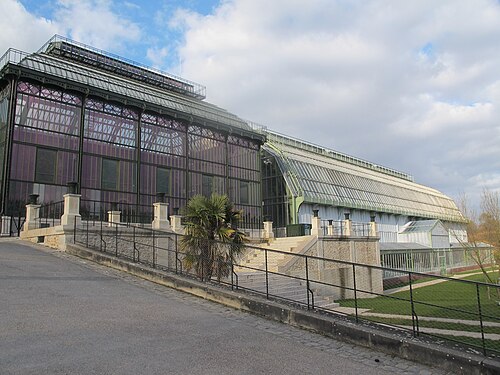
The seven houses of 1883-1884 form a larger group, with a palmarium, the largest and tallest of them. The tropical houses of 1936, partly from Canteleu, were modified in 1971 and 1985. The renovation programme planned to lower the temperature of the central greenhouse, formerly 19-22 °C, to a minimum of 12 °C to reconcile conservation of the fabric with the needs of the plants; a heating saving of about 50,000 euros a year, or 20%, was announced. The garden as a whole now has about 4,000 m² of glasshouses.
Plant collections
1 min
The central greenhouse, nicknamed the clock greenhouse, shows useful plants; depending on the presentation, it also holds plants of arid environments, useful Mediterranean species and carnivorous plants. Its lateral pavilions shelter, according to the sources, succulents and xerophytes on one side and carnivorous plants and medicinal Mediterranean plants on the other.
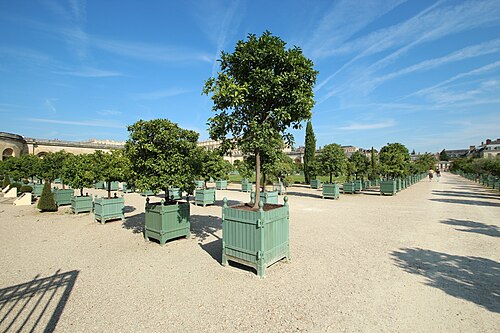
The seven tropical houses bring together ornamental plants, many lianas, orchids and aquatic plants; the palmarium is the largest and tallest. The orangery of 1895-1896, of 874 m², receives potted palms (Phoenix, Chamaerops) and citrus over winter and, on the last weekend of May, the "Graines de Jardin" show. Outside the glasshouses, the garden maintains a collection of nearly 1,000 fuchsia species and cultivars, labelled as a national collection.
Visiting
1 min
The greenhouses stand in the Jardin des plantes of Rouen, on avenue des Martyrs-de-la-Résistance, in the southern part of the city. The central greenhouse closes the garden's great perspective. Allow an hour for the glasshouses and two for the garden, lingering over the rose garden, the orangery and the aviaries.
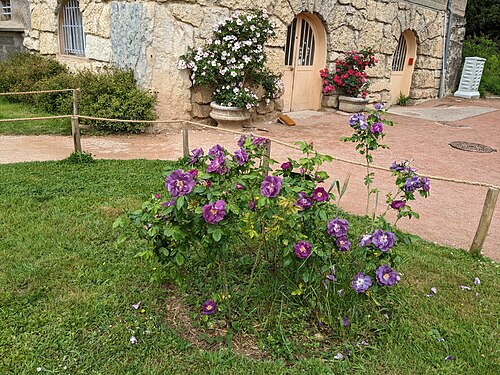
Late spring is a good time, with the "Graines de Jardin" show in the orangery. The visit can be extended to the rose garden, which shows roses bred by Norman growers; access to the greenhouses is best checked with the city before travelling.
49.42° N, 1.08° E
Greenhouses nearby
More greenhouses — France
Do you have a good photo of this greenhouse? Suggest it for this page →
Sources (8)
- rouen.fr/jardindesplantes
- pop.culture.gouv.fr/notice/merimee/PA00100921
- fr.wikipedia.org/wiki/Jardin_des_plantes_de_Rouen
- rouen.fr/sites/default/files/cm/2017-04-03/7-1ann3.pdf
- lapostegroupe.com/fr/hot-article/les-serres-de-rouen-retrouvent-leur-lustre-d-antan
- tendanceouest.com/actualite-295843-rouen-la-renovation-des-serres-du-jardin-des-plantes-de
- jardinsdefrance.org/les-tresors-du-jardins-des-plantes-de-rouen/
- jardinez.com/Parcs-Jardin-des-Plantes_fr_166