Greenhouses of the Parc Emmanuel-Liais
Cherbourg-en-Cotentin, Normandy
Entry updated on October 5, 2026
- Architect
- Unknown
- Style
- Greenhouses of a 19th-century scientist's estate
- Dimensions
- Two greenhouses, 510 m² in total
- Status
- Park open to the public; greenhouses listed as a historic monument (2015)
In the centre of Cherbourg, the Parc Emmanuel-Liais is the former garden of the astronomer, explorer and botanist Emmanuel Liais (1826-1900), who spent nearly twenty-five years in Brazil before becoming mayor of his home town. Laid out from 1878, inaugurated in 1885 and bequeathed to the town on his death, it keeps two greenhouses covering 510 m² in total that hold 4,000 varieties of rare plants, including a rich South American collection. The estate, greenhouses included, has been a listed historic monument since 2015 and a Jardin remarquable since 2020.
Affiliate links — booking through Verrière helps fund our research, at no extra cost to you.
History
1 min
Born in Cherbourg on 15 February 1826 into a family of shipowners and merchants, Emmanuel Liais took an early interest in botany: in 1854 he was among the first members of the Cherbourg Horticultural Society. An astronomer, he left for Brazil to observe the solar eclipse of 7 September 1858 and stayed there for nearly twenty-five years. Close to Emperor Pedro II, he directed the imperial observatory in Rio de Janeiro from January to July 1871 and again from 1874 to 1881, discovered a comet there and, at the emperor's request, led expeditions into the interior, studying its plants and sending specimens to France; the work Climats, géologie, faune et géographie botanique du Brésil came out of these journeys.
From 1878 he had a botanical garden laid out on his Cherbourg property: the park, designed in 1881 and inaugurated in 1885, includes an observatory tower, a pond and two greenhouses. Back in his home town, he served as its mayor from 1884 to 1886 and from 1892 until his death. On 5 March 1900, at his death, he bequeathed the estate to the town. A library was built in the park in 1909 under the terms of his will, and the municipal natural history museum, founded in 1832, moved into his house in 1910.
The whole estate, greenhouses included, was listed as a historic monument on 2 September 2015, and the park received the Jardin remarquable label in 2020. Liais is buried at Hardinvast, beneath a palm tree brought back from one of his journeys.
Architecture and engineering
1 min
The two greenhouses belong to a 19th-century scientist's estate of just over a hectare, born of an astronomer's passion for botany: they stand near his house, now the museum, the observatory tower, the science library of 1909, the keeper's lodge and a pond planted with water lilies, all enclosed by walls.
Together they cover 510 m². The 2015 listing order protects the greenhouses in their entirety, along with the estate's land and boundary walls, the library and its fittings, the observatory tower, the museum and its extension, and the keeper's lodge. The sources consulted, including the Mérimée heritage record, give neither the exact construction date of the greenhouses, nor the name of their builder, nor any description of their structure or materials: what is established is only that they belong to the layout of the estate created by Liais in the late 19th century.
Plant collections
1 min
Under their 510 m², the two greenhouses bring together some 4,000 varieties of rare plants, including a rich collection of South American plants acclimatised by Liais, who had studied the flora of the Brazilian interior on his expeditions. The Comité des parcs et jardins de France notes that some of these varieties are unique in France, or even in the world, and the regional tourist board points to unique tropical plants in them.
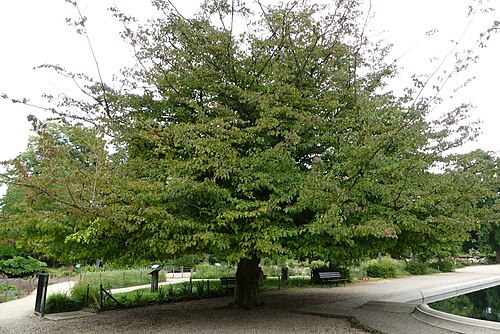
In the park itself, trees and shrubs have reached a considerable size, and the pond holds water lilies and other aquatic plants. Awarded the Jardin remarquable label, this botanical garden carries on the work of a man who was at once astronomer, explorer and botanist.
Visiting
1 min
The park lies in central Cherbourg, in the Bucaille district on Rue de la Bucaille; it is open all year and takes about an hour to explore, either on your own or on a guided tour run by the town. Besides the greenhouses, the walk takes in the observatory tower, the library and the bust of Liais that replaced the 1903 statue destroyed during the Second World War. The museum in the house has been closed for renovation since 2020. A few kilometres away, the rotunda greenhouse of the Château des Ravalet at Tourlaville can extend a tour of the Cotentin's glasshouses.
49.64° N, 1.63° W
Greenhouses nearby
More greenhouses — France
Do you have a good photo of this greenhouse? Suggest it for this page →