Orangery and Greenhouses of the Jardin des plantes de Montpellier
Montpellier, Occitanie
Entry updated on September 30, 2026
- Year
- 1802-1806 (orangery); 1860 (Martins greenhouse)
- Architect
- Claude-Mathieu Delagardette (orangery); Martins greenhouse built under the direction of Charles Martins
- Style
- Functional neoclassical orangery and 19th-century metal glasshouses in France's oldest botanical garden
- Dimensions
- Orangery 49 m long (13 arched glazed bays); about 688 m² of glasshouses
- Status
- Garden open to the public; classified historic monument (1992); orangery restored and reopened in 2018
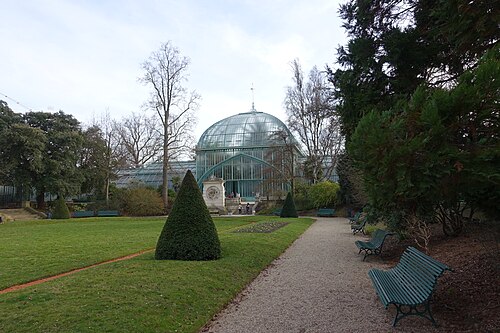
The Jardin des plantes of Montpellier, founded in 1593 by Henri IV, has a group of historic glasshouses. The orangery, designed by the architect Claude-Mathieu Delagardette and inaugurated in 1806, protected citrus and tender plants from frost in a functional architecture decorated with zodiac medallions. The Martins greenhouse, built in 1860 under the direction of Charles Martins, now shelters a collection of cacti and succulents. The whole, classified as a historic monument in 1992, was restored in the 2010s, the orangery reopening in 2018 after several years of closure.
Affiliate links — booking through Verrière helps fund our research, at no extra cost to you.
History
1 min
The garden was founded on 8 December 1593 by royal letter from Henri IV and entrusted to the physician Pierre Richer de Belleval: it is the oldest botanical garden in France. A first heated greenhouse was built there in 1757. In the early 19th century the orangery was designed by the Parisian architect Claude-Mathieu Delagardette at the instigation of the botanists Antoine Gouan and Auguste Broussonet, with the decision of the minister Chaptal; built from 1802 to 1804, it was inaugurated in 1806.
Under Charles Martins, director from 1851, the garden gained an English garden with a lotus pool, and a large greenhouse was raised in the centre of the garden, in 1860 according to most sources, which today bears his name. Under Jules-Émile Planchon, director from 1881, new greenhouses were built; the large Planchon greenhouse, on the left flank of the orangery, was destroyed in 1956 according to a Ministry of Culture document. A winter garden dates from 1887.
The garden was classified as a historic monument on 3 September 1992, after an initial inscription was annulled. The restoration, framed by a preliminary study by the chief architect of historic monuments, dealt first with the Martins greenhouse (works completed in 2012), then with the orangery, reopened in September 2018 for the garden's 425th anniversary thanks to the sponsorship of twenty-four companies. In 2022 the garden received the Jardin remarquable label.
Architecture and engineering
1 min
Delagardette's orangery is a building of great restraint: a Ministry of Culture document calls it functional, refined and discreet in its corner details, with circular medallions showing the signs of the zodiac in place of heraldic cartouches. It is 49 metres long and opens through thirteen arched glazed bays; its area is about 267 m². Meant to protect plants from frost, especially citrus, it also became a meeting place in fine weather. Its metal joinery has been restored.
The Martins greenhouse, of about 300 m², is a glazed building restored to its original architecture; the renovation also made room for cactus houses inside it. Beside it, the Planchon houses have five chapels, the largest devoted to South American plants, and the Harant house shelters tropical shrubs. In all the garden has about 688 m² of glasshouses, and sources differ on dates and on the fate of the Planchon houses.
Plant collections
1 min
The Martins greenhouse holds one of the major French collections of cacti and succulents: thirteen biotopes are presented, with about 500 species from 130 genera and some thirty families, mostly cacti. The garden has been growing about 400 species of succulents since 2011, for plants from the world's deserts.
The other houses shelter ferns, bromeliads and orchids from French Guiana, as well as tropical shrubs; in all about 1,000 species grow under glass, out of nearly 2,700 in the garden overall. Outdoors the garden keeps a 19th-century arboretum and the lotus pool, a symbol of the garden, where the sacred lotus was introduced under the director Raffeneau-Delile. The palms have been reduced to about thirty species after damage from the Argentine palm moth in 2006.
Visiting
1 min
The glasshouses stand in the Jardin des plantes, on rue Auguste-Broussonet, close to the centre of Montpellier. The garden, about 4.5 hectares, is open to individual visitors; access to the Martins greenhouse is said to be limited to certain days, to be checked with the university before visiting. Allow an hour or two.
The visit combines with the lotus pool, the norias, the astronomy pavilion and the Institut de botanique of 1959, by Jean de Richemond, which borders the garden on the north.
43.61° N, 3.87° E
Greenhouses nearby
More greenhouses — France
Do you have a good photo of this greenhouse? Suggest it for this page →
Sources (8)
- culture.gouv.fr/content/download/203698/file/Duo_Jardin_des_plantes_2019_01.pdf
- pop.culture.gouv.fr/notice/merimee/PA00103773
- fr.wikipedia.org/wiki/Jardin_des_plantes_de_Montpellier
- en.wikipedia.org/wiki/Jardin_des_plantes_de_Montpellier
- umontpellier.fr/en/universite/patrimoine/jardin-des-plantes
- musee.info/Le-jardin-des-plantes
- parcsetjardins.fr/jardins/1048-jardin-des-plantes-de-montpellier
- jardinez.com/Parcs-Jardin-des-Plantes-de-Montpellier_fr_481