Orangery of the Moscow Zoo (Оранжерея Московского зоопарка)
Moscow
No freely licensed photo of this greenhouse yet. Do you have one? Suggest it for this page →
Sources checked September 2026
- Year
- 2012
- Architect
- Mosproekt-4 (M. Kryshtal)
- Style
- Contemporary pavilion with a glazed rotunda, two levels plus basement
- Dimensions
- 2,668 m² total (including 1,170 m² footprint)
- Status
- In operation within Moscow Zoo
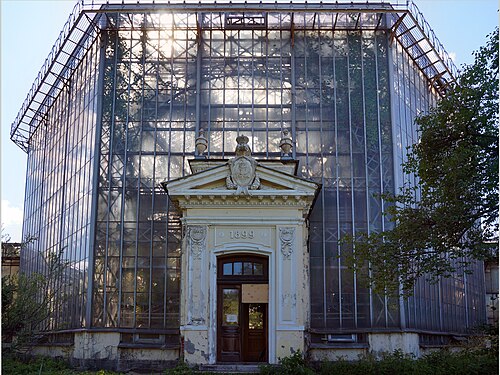
In 2012, Moscow Zoo added a contemporary orangery in the northeastern part of its historic grounds, between Bolshaya Gruzinskaya Street and the zoological passage. The building, constructed on two levels with a basement, is arranged around a central glazed rotunda meant to house tall plants, surrounded by walkways and observation platforms. With a footprint of 1,170 square meters and a total built area of 2,668 square meters, including 819 square meters below ground, it ranks among the largest glass structures recently built for a European zoo. Conceived as a hybrid space between botanical greenhouse and zoo attraction, it lets visitors move around the tropical vegetation on several levels. Less well known than the historic Aptekarski Ogorod at Moscow's botanical garden, this zoo orangery illustrates the ongoing vitality of greenhouse architecture in Russia.
Affiliate links — booking through Verrière helps fund our research, at no extra cost to you.
History
Moscow Zoo was founded on 31 January 1864 by Moscow University biologists including Sergei Usov and Anatoly Bogdanov. It expanded onto neighbouring land in 1926, and since the renovation of the 1990s a footbridge has linked the original 1864 grounds with the newer section. The orangery was built in the early 2010s on the old grounds, in their north-eastern corner between Bolshaya Gruzinskaya Street and Zoologichesky Lane.
The project was designed by the Mosproekt-4 institute, with architect M. Kryshtal credited as author, for the zoo as client; construction was carried out by the Orbita firm of the Mospromstroy group. The builder gives 2012 as the year the building was commissioned, while the project listing on archi.ru dates it to 2011–2013. According to the zoo, the orangery opened to visitors in spring 2014 with a programme called Secrets of the Tropical Forest, combining the glasshouse with amphibian and butterfly displays.
Architecture and engineering
The building has two storeys and a basement. Its composition centres on a glazed rotunda for tall plants, ringed by walkways and viewing platforms from which the vegetation can be seen at different heights. The builder's figures give a site of 1,760 square metres, a footprint of 1,170 square metres and a total floor area of 2,668 square metres, 819 of them below ground.
The tropical forest display itself covers about 138 square metres according to the zoo. Technical systems keep it hot and very humid and generate tropical rain, wind and mist, while the lighting follows a seasonal cycle. All this machinery makes the house surprisingly noisy, a point noted by the Moscow city government in a 2019 guide to the city's winter gardens.
Plant collections
The planting is layered like a rainforest. The upper storey has palms such as Thrinax radiata, Washingtonia robusta, Trachycarpus fortunei and the fishtail palm Caryota mitis; figs and climbers fill the middle level; the ground layer holds bromeliads, a cacao tree, bananas, bamboo and familiar houseplants such as Monstera deliciosa. The bromeliads shelter tiny poison dart frogs.
Next to the glasshouse, a deliberately dim room shows more than thirty species of amphibians, both tailed and tailless: toads, poison dart frogs, tree frogs and salamanders. A display of tropical butterflies and moths, including hawk-moths, completes the circuit.
Visiting
The orangery stands in the old part of the zoo, on the Bolshaya Gruzinskaya Street side. According to the zoo and the city government, it is seen on accompanied visits booked in advance, as part of the Secrets of the Tropical Forest programme, which takes in the glasshouse, the amphibian room and the butterflies. Commented amphibian feedings have been offered on certain days. It makes a welcome warm, humid stop in winter and fits easily into a wider tour of the zoo's pavilions, with the footbridge linking the old and new grounds.
55.76° N, 37.58° E
Greenhouses nearby
More greenhouses — Russia
Do you have a good photo of this greenhouse? Suggest it for this page →
Affiliate links — booking through Verrière helps fund our research, at no extra cost to you.