Glass Greenhouse, Yeongyang Bonsai and Wildflower Theme Park (영양 분재야생화테마파크)
Yeongyang (Ipam-myeon), Gyeongbuk
No freely licensed photo of this greenhouse yet. Do you have one? Suggest it for this page →
Sources checked October 2026
- Style
- Exhibition greenhouse with glass curtain walls and a glass roof, an upper walkway and an indoor stream
- Dimensions
- 2,397 m² announced for the project; 185 bonsai and 210 wildflower species (2022)
- Status
- Open to the public, free entry since October 2021 (temporary measure); closed on Mondays
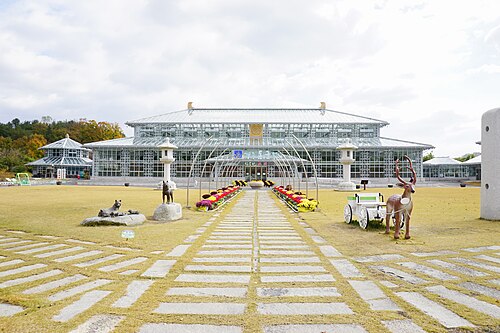
At the Seonbawi tourist site in Ipam-myeon (Yeongyang County), the Bonsai and Wildflower Theme Park is built around a large glass greenhouse, announced at 2,397 m² and started in 2011 to replace a 1,090 m² plastic-film shed. It shows bonsai, some more than 250 years old, over 200 species of wildflowers, viewing stones and an indoor stream; an older hall under plastic film follows it. Entry has been free since October 2021, as a temporary measure; the park closes on Mondays.
Affiliate links — booking through Verrière helps fund our research, at no extra cost to you.
History
The Seonbawi tourist site in Ipam-myeon drew about 70,000 visitors a year in 2011, according to the local press. Yeongyang County had run a bonsai exhibition space there since 2002 (opened on 25 May 2002 according to the daily Maeil in 2019): in 2011 the press describes it as a 1,090 m² plastic-film shed showing about 130 works, judged too cramped and lacking reception and hands-on facilities.
In July 2011 the county announced a 4-billion-won project to make the site "the largest bonsai and wildflower theme park in the country": a "cutting-edge" glass greenhouse of 2,397 m² (726 pyeong), a stream-fed pond and an artificial brook. Delivery was set for June 2012; in March and April 2013 the press still announces it for the first half of the year, with a lecture room, an experience room and a shop added, and a national bonsai and wildflower show planned for the same year. A 2018 blog places the opening of the large greenhouse in October 2014.
Since 19 October 2021 the county has let visitors in free of charge, as a temporary measure. An April 2022 article counts 185 bonsai, 210 species of wildflowers and 51 viewing stones.
Architecture and engineering
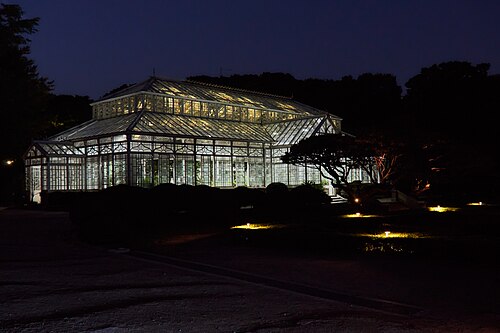
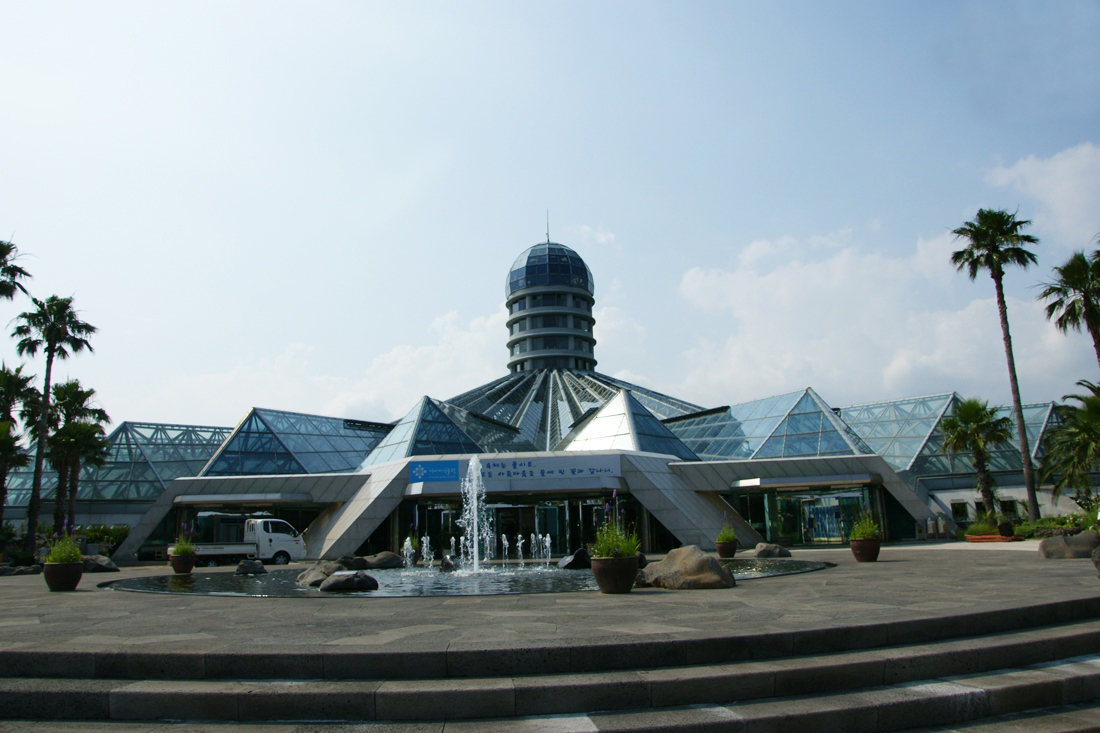
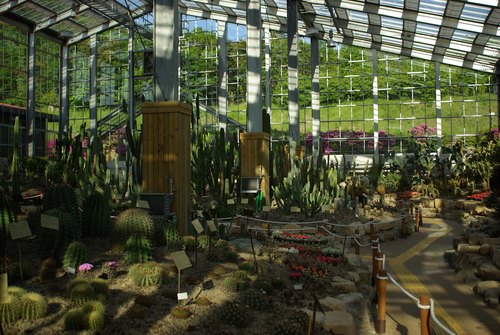
The articles of 2011 to 2013 announce a cutting-edge "large glass greenhouse", and the 2019 and 2022 press speaks of a large glass greenhouse alongside a plastic-film greenhouse. A 2024 visitor describes a building with the look of a glasshouse, whose windows let the sun in, and notes that it is not cold inside in winter; his photographs show a glass curtain-wall facade on a metal frame, bearing the park's sign, and, inside, tall glazed walls and a glazed roof, a wooden floor and bonsai set on stands. On satellite imagery the volume appears as a long multi-bay roof, gridded with small panes, next to a second volume with a plainer translucent roof; the identification rests on this reading and on the announced floor area.
In the large hall, called the first exhibition hall, the plantings are not crowded and a wooden deck leads up to an upper level with tables and a view down over the plantings; water runs through the interior. The first hall continues into the second, which has windows and explains how to water and how to look at a bonsai, and then into a room of viewing stones.
Plant collections
According to the 2022 press, the park gathers 185 bonsai — including a juniper (향나무) over 250 years old, wisterias, honeysuckles and yews —, 210 species of wildflowers (among them 물매화, 솜나물, 해국 and 설앵초) and 51 viewing stones. The counts vary: a 2018 blog gives 85 bonsai and 13 landscape compositions in the first hall, 101 bonsai and 32 wildflower compositions in the second, and a 2014 blog notes elms and yews of 250 years, a mountain cherry of 150 years, a 모과나무 of 65 years and a 수달래 of 80 years.
In spring the large hall shows flowering quinces (명자나무), winter jasmines (영춘화), adonis (복수초), lilies of the valley (은방울꽃) and a lady's slipper orchid (복주머니). In 2021 the county listed the 복주머니 and the 깽깽이풀 among threatened wild species of class II, and the 심산해당 among the bonsai. A 2024 visitor further notes 소사나무, junipers (노간주나무), azaleas (철쭉), crabapples (아그배나무), succulents including the 바위솔 and a small moss-looking plant called 아기우산나물, and describes water running in each hall.
Visiting
The park lies within the Seonbawi site, whose large car park is free. Nearby, a 2026 visitor mentions the Yeongyang chili exhibition hall (고추홍보전시관), a viewpoint, a bridge with a trompe-l'oeil decoration, a restaurant serving mountain dishes and a shop of local products. Across the river stands the Seonbawi rock, tied to the legend of General Nam Yi; the Yeongyang Mountain Village Museum is about 700 m away on foot, according to a 2014 blog.
For the plants, the county recommended in 2021 March and April, when the bonsai bud and the first wildflowers open; in winter the interior remains pleasant. The visit follows a single route, from the first hall to the second and then to the stone room.
36.61° N, 129.08° E
Greenhouses nearby
More greenhouses — South Korea
Do you have a good photo of this greenhouse? Suggest it for this page →
Sources (8)
- yeongnam.com/web/view.php?key=20220405010000516
- kbmaeil.com/article/202204070331923
- imaeil.com/page/view/2019030512485964129
- kyongbuk.co.kr/news/articleView.html?idxno=547165
- hidomin.com/news/articleView.html?idxno=152059
- idaegu.com/news/articleView.html?idxno=234092
- yeongnam.com/web/view.php?key=20130422.010100803190001
- m.blog.naver.com/itoy51/223353455985
Affiliate links — booking through Verrière helps fund our research, at no extra cost to you.