Hantaek Botanical Garden Greenhouses (한택식물원 온실)
Yongin (Cheoin-gu, Baegam-myeon), Gyeonggi
No freely licensed photo of this greenhouse yet. Do you have one? Suggest it for this page →
Sources checked October 2026
- Style
- Themed greenhouses, three of them glass buildings
- Dimensions
- Three glass buildings
- Status
- Open to the public with the garden (private garden, admission charged)
Hantaek Botanical Garden in Yongin, presented as the largest private botanical garden in Korea, has several greenhouses: the Australia house, with eucalyptus and bottle trees; the Central and South America house, filled with cacti; a South Africa house; and a herb and carnivorous plant house. The Encyclopedia of Korean Culture counts three glass greenhouse buildings. The garden was founded in 1979 or 1981 and opened in 1984 or, officially, in 2003.
Affiliate links — booking through Verrière helps fund our research, at no extra cost to you.
History
Korean Wikipedia dates the creation of the garden to 1979, at Oksan-ri (Cheoin district, Yongin), and its opening to 1984; a Gyeonggi provincial magazine (April 2024) also gives 1984. The Encyclopedia of Korean Culture, written in 2015 and revised in 2023, tells it differently: the western zone, reserved for ex situ conservation and research and closed to the public, was developed in 1979, the garden founded in 1981, a foundation set up in 2000, the central complex and garden centre completed in 2002, and the official opening set for 2 May 2003.
A provincial press article of 1 March 2017 already describes the Australia house, made of hexagonal greenhouses linked to one another, and the provincial magazine of 2024 ranks the Australia and Central and South America houses among the most popular attractions. Korean Wikipedia mentions an “Africa greenhouse” devoted to African tropical plants; other sources name a South Africa house, and it cannot be said whether this is the same building. The garden is run by a private foundation (재단법인).
Architecture and engineering
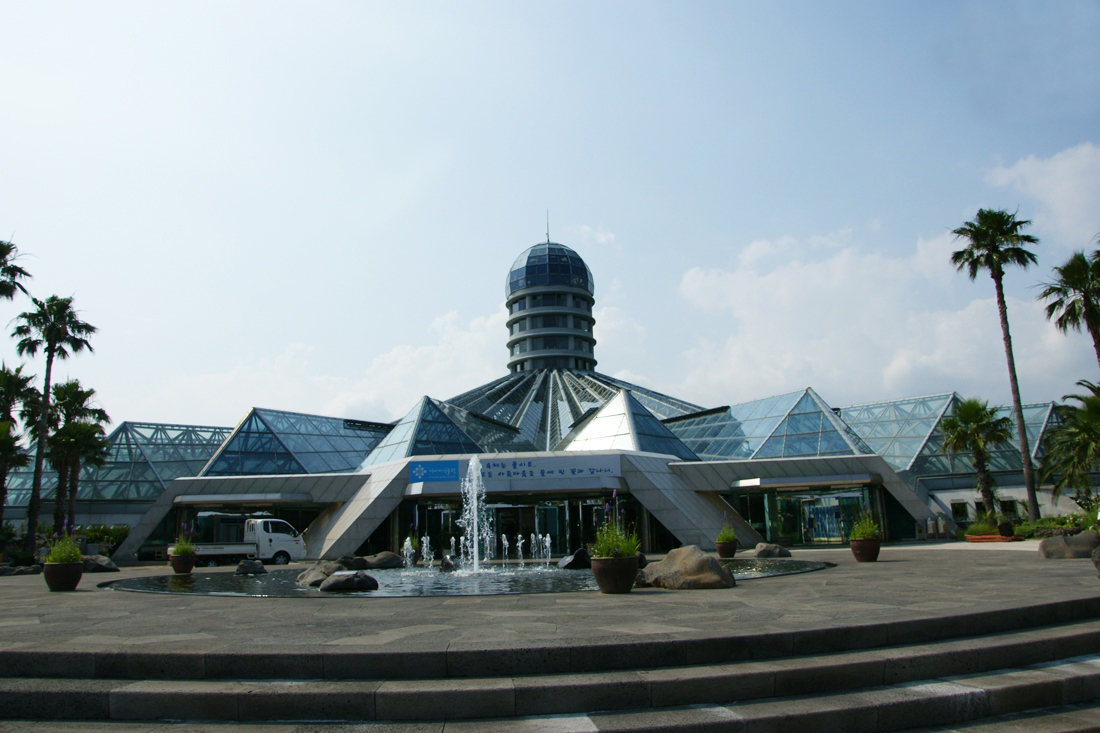
The Encyclopedia of Korean Culture counts three glass greenhouse buildings among the garden's facilities, while naming four sheltered areas: the Australia house, the Central and South America house, the South Africa house and the herb and carnivorous plant garden, described as a greenhouse.
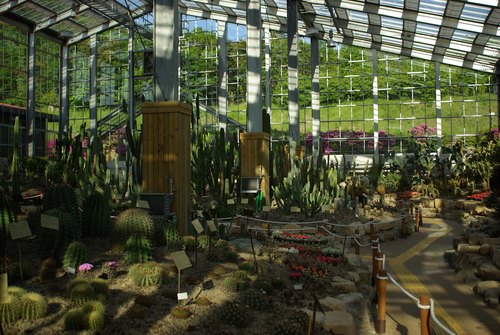
The Australia house consists, according to the 2017 provincial press, of hexagonal greenhouses linked to one another. The Central and South America house is described in 2026 by a visitor's blog as a glass house fitted out with sand, rocks and unusual cacti, reproducing both hot, dry deserts and the misty climate of the Mexican highlands and the Andean foothills.
Plant collections
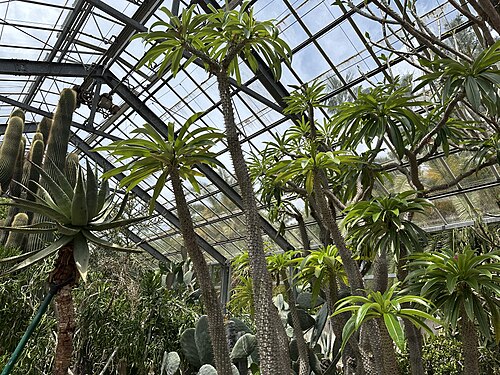
The Australia house presents native plants of Australia and New Zealand, including eucalyptus and “baobabs”. A provincial magazine of April 2024 specifies that this tree, shaped like a water bottle, is called the Australian bottle tree and is a different species from the African baobab.
The Central and South America house reportedly preserves about 400 species of desert and tropical plants, from Mexico to Chile, with large columnar and paddle cacti; bougainvillea and begonias are also mentioned. The herb and carnivorous plant house shows about a hundred carnivorous species, including the Venus flytrap, and herbs that do not survive winter outdoors in central Korea, such as rosemary, lavender and mint. Across the garden, the encyclopedia counts nearly 9,700 species, of which 2,400 are native, and about ten million plants.
Visiting
The garden occupies the western flank of Mount Bibong, at the south-eastern tip of Yongin, on the border with the municipality of Anseong. The encyclopedia gives it 27 ha, Korean Wikipedia 200,000 pyeong (about 66 ha). The greenhouses, several of which are described as indoor spaces, suit cold days; a 2026 blog says the garden stays open all year, with no closing day.
The visit can continue through the themed gardens, among them the four-seasons garden, the collections of peonies, irises and aquatic plants, the rock garden and the conifers. The western zone (Seowon), reserved for research and conservation, is not open to the public.
37.10° N, 127.41° E
Greenhouses nearby
More greenhouses — South Korea
Do you have a good photo of this greenhouse? Suggest it for this page →
Affiliate links — booking through Verrière helps fund our research, at no extra cost to you.