Akiyoshidai International Art Village (秋吉台国際芸術村)
Mine, Yamaguchi Prefecture
Sources checked November 2026
- Year
- 1998
- Architect
- Arata Isozaki
- Type
- Arts centre and artists' residence
- Access
- Buildings open to visit freely after checking in at reception; closed 29 December to 3 January, temporary closures possible (official website, November 2026)
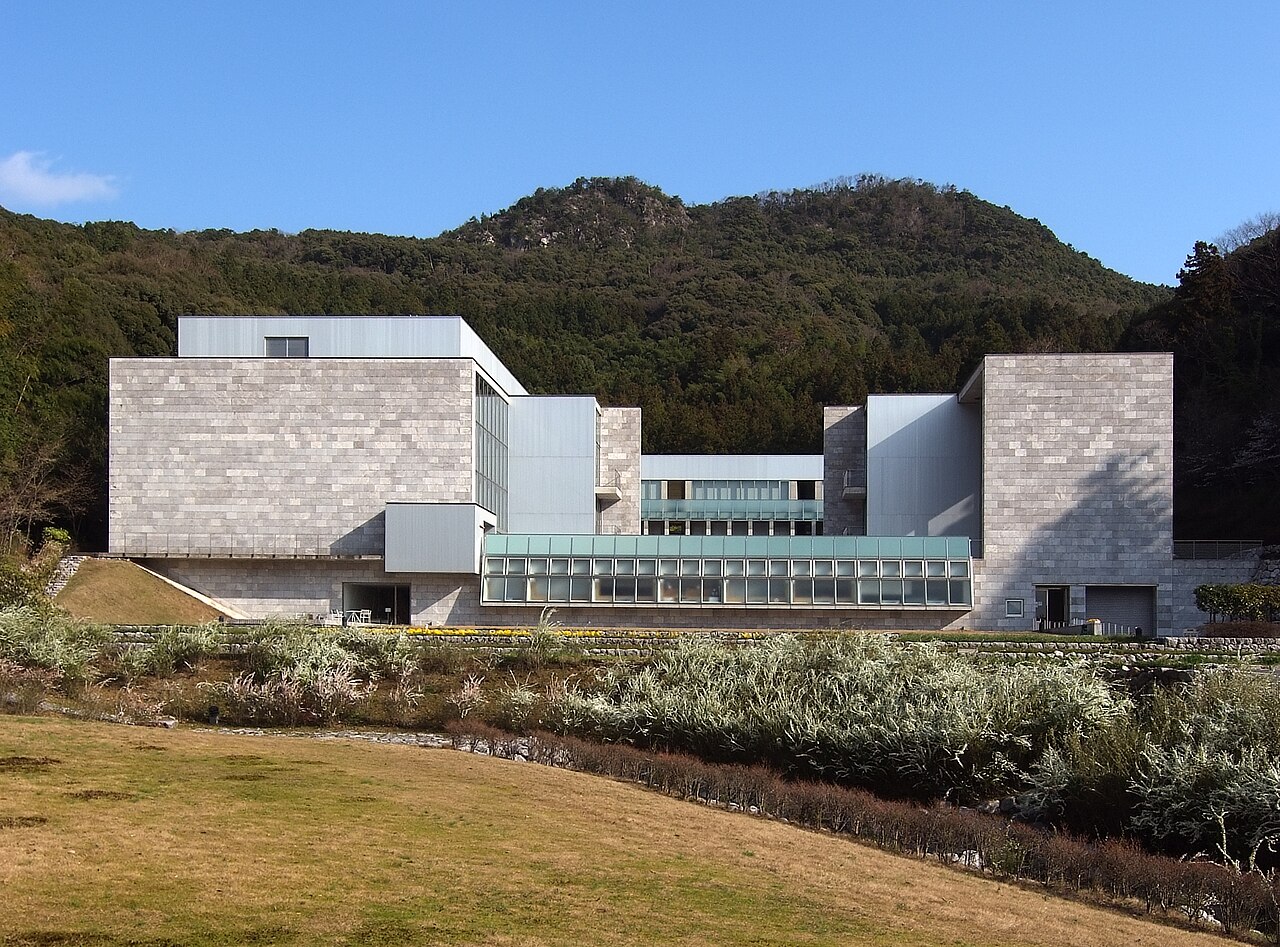
Arata Isozaki designed this art village, opened in 1998 near the Akiyoshidai plateau, as an "archipelago" of small buildings rather than a single structure. A hall drawn up for Luigi Nono's opera "Prometeo", an open-air theatre whose seating is a grassy slope, a column-free restaurant 14 m high and a salon that rebuilds N House from Ōita make up the site.
Affiliate links — booking through Verrière helps fund our research, at no extra cost to you.
History
Akiyoshidai International Art Village opened in August 1998 at the foot of the Akiyoshidai plateau, as a place of creation and residence for artists from Japan and abroad. Arata Isozaki's project runs from 1995 to 1998.
The chosen plot is the south slope of a pocket of land ringed by low hills, away from the centre, so that artists could be set apart from everyday bustle. At the opening, "Prometeo", the opera by Luigi Nono, a contemporary-music composer who had been close to Isozaki, received its first performance in Japan.
Architecture
Isozaki thought of the place as an "archipelago": not one large building but a village, a group of small neighbouring buildings that recalls a traditional Japanese village. It covers 32 hectares. Visitors enter through a gate set between two narrowing hillsides, after which the path widens toward the back.
The main building, of reinforced concrete partly on a steel frame, has one basement level, holding offices and dressing rooms, and three levels above ground. It spreads in a U around a courtyard with a square stage: the hall to the west, three training rooms to the north, the café, the gallery and the studios to the east. Behind the training rooms, a fan-shaped open-air theatre is surrounded by the green of the mountain woodland. Its seating is a grassy slope for about 600 people, and its stage is the second training room, once its doors are opened.
The hall, of 482 m2 and about 300 seats, was drawn up for "Prometeo". It has three levels: a ground-floor parterre of movable chairs, where the stage can be placed anywhere, and on the upper floors platforms that can serve as stages and balconies with fixed seats. Its space is multifocal, each seat hearing a different sound, and its form recalls the inside of Akiyoshido Cave.
The 267 m2 gallery lines up imposing columns and takes light through its windows. The three training rooms, two storeys high, open onto a massive cloister; one is fitted out for dance. Seven studios, soundproofed for instrument practice, complete the building.
The second group, the accommodation, combines an administration building (one basement level, two above ground) and eight two-storey blocks of rooms, set in echelon on terraced ground like rice terraces. The restaurant is a volume 7.2 m wide and 36 m long, 14 m high and without a single column; its outer walls are clad in marble and its inner walls are bare concrete. Its fully glazed north front is oriented in response to the main building.
The salon for guests staying on site rebuilds N House, a private house Isozaki designed in 1964 in Ōita, since demolished: one of the representative works among his early houses, made of cubes of differing scales. Here it is a bare-concrete cube raised on four legs, reached by a spiral stair from ground level or by a bridge from the entrance building. The room is a single space, with a 5.4 m by 2 m opening to the north framing the main building, glass-block openings of the same size to east and west, and four cubic skylights at the centre of the ceiling. The furniture, including the "Monroe" chair, is also designed by Isozaki.
Use today
The village serves as a base for artist residencies and for programmes supporting young artists in music, visual art, dance and theatre. It also offers seminars, workshops, programmes with organisations in Japan and abroad and exchanges with local people, and hosts the Akiyoshidai music competition. Its rooms are open to everyone for creating, rehearsing and presenting. The 36 rooms, for up to 100 people, serve artists as well as tourist stays.
Three works are installed permanently: "Untitled No. 218-1998" by Yonekichi Tanaka, a red work that visitors walk under at the entrance, "Pulse of the Earth" by Takeshi Tanabe and a laser work by Kazuhiko Miwa.
Visiting
The buildings may be visited freely from 9 am to 4.30 pm, except on closing days: visitors first check in at reception, at the office on the basement level of the main building. Depending on current use, a visit may not be possible; for the hall in particular, it is best to ask beforehand whether it is free. The village is closed from 29 December to 3 January and may close from time to time for maintenance. By car it is about 40 minutes from Yamaguchi along National Route 435.
34.22° N, 131.32° E
Greenhouses nearby
Architecture nearby
By the same architect
Sources (20)
- aiav.jp/
- aiav.jp/about/
- aiav.jp/facility/
- aiav.jp/facility/hall/
- aiav.jp/facility/restaurant/
- aiav.jp/facility/salon/
- aiav.jp/facility/gallery/
- aiav.jp/facility/seminarroom/
- aiav.jp/facility/outdoorstage/
- aiav.jp/facility/residencehall/
- aiav.jp/facility/courtyard/
- aiav.jp/guide/onlooking/
- aiav.jp/access/
- aiav.jp/en/about/
- aiav.jp/en/facility/hall/
- aiav.jp/en/facility/restaurant/
- aiav.jp/en/facility/salon/
- isozaki.co.jp/projects/akiyoshidai/
- pref.yamaguchi.lg.jp/press/361053.html
- setouchi.travel/en/see-and-do/spot/akiyoshido-cave/
Affiliate links — booking through Verrière helps fund our research, at no extra cost to you.