Nagi Museum of Contemporary Art (Nagi MOCA, 奈義町現代美術館)
Nagi, Okayama Prefecture
Sources checked November 2026
- Year
- 1994
- Architect
- Arata Isozaki
- Type
- Municipal contemporary art museum (three rooms, each an artwork)
- Access
- Open to the public; under renovation until 8 January 2027, with the 'Sun' and 'Moon' rooms closed until 29 November 2026 and groups not admitted until the end of March 2027 (official website, November 2026)
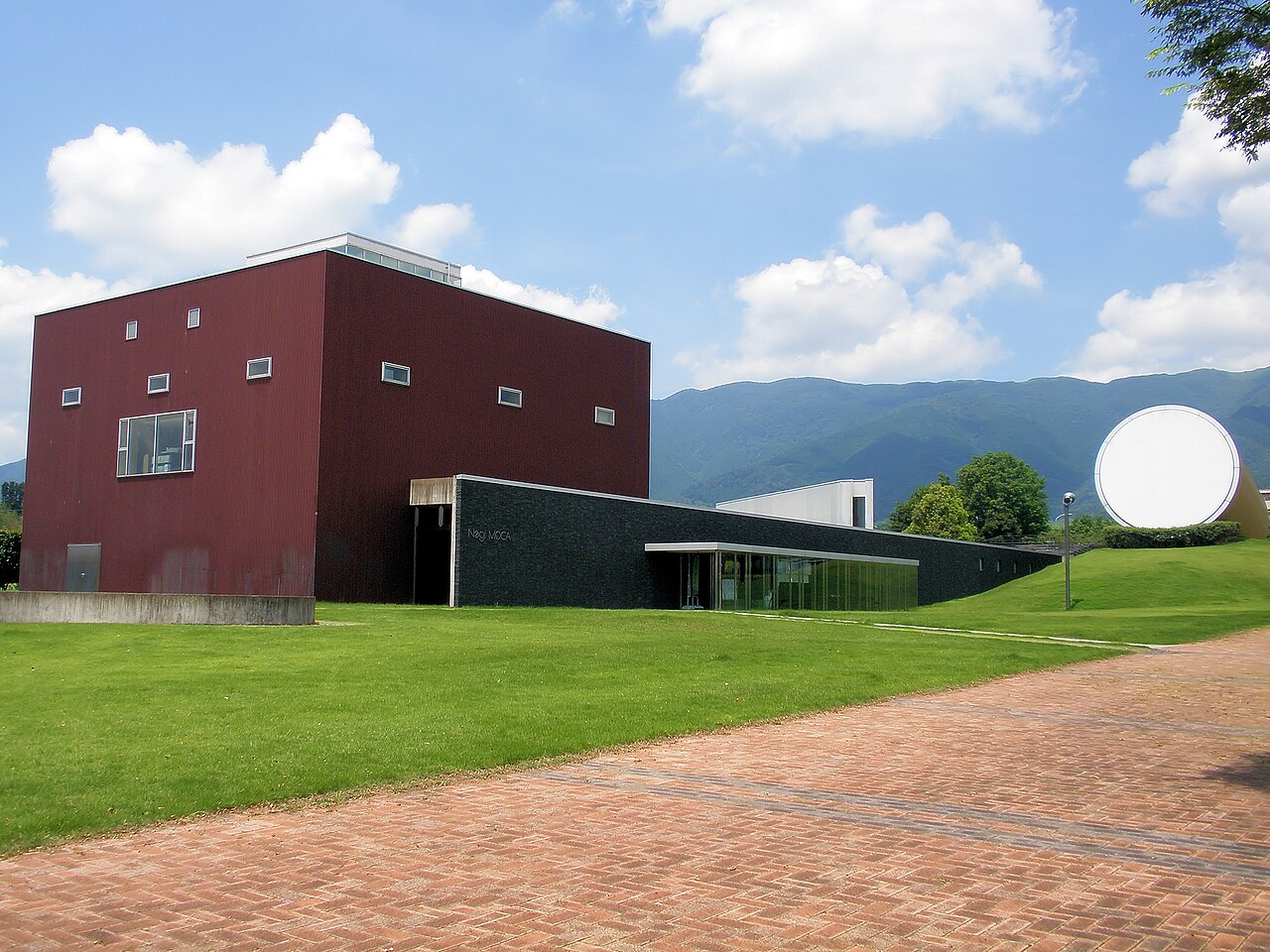
Opened in 1994 in Nagi, in the north-east of Okayama Prefecture, this municipal museum was designed by Arata Isozaki's atelier for works commissioned in advance from artists, with architect and artists discussing each space together. Its three rooms are a cylinder, a crescent and a third whose long axis points to the summit of Mount Nagi, which can also be seen from the café beside the pond. The complex is built of reinforced concrete and a steel frame.
Affiliate links — booking through Verrière helps fund our research, at no extra cost to you.
History
Nagi MOCA is the museum of the town of Nagi, in the north-east of Okayama Prefecture, near the border with Tottori Prefecture. It was built for the town's fortieth anniversary and opened on 25 April 1994. The town is the client and Arata Isozaki's atelier designed it; the project runs from 1991 to 1994.
The principle lies in the order of operations. Artists (Shūsaku Arakawa and Madeline Gins, Kazuo Okazaki, Aiko Miyawaki) were commissioned, before construction, to make gigantic works that an ordinary museum cannot acquire. Each space was discussed between them and the architect, then built accordingly, so that works and building are joined almost permanently. Isozaki likens the situation to a temple, where the statue is made first and the main hall is then built to cover it.
He places Nagi in what he calls the third generation of museums. The first dates from the end of the eighteenth century, when princely collections opened to the public; the second, from 1960 onwards, covers the 'white cubes', built first and only then filled with works; the third lets artists install their works freely in spaces that stimulate their inspiration.
In 2020 the building received the 25-year award of the Japan Institute of Architects (JIA).
Architecture
Rather than a single block, the museum is a set of separate volumes, each coloured in its own way and arranged along several axes: a cuboid, a cylinder and a crescent, like building blocks. The structure is reinforced concrete and steel frame, two levels above ground. The cuboid, which houses the municipal library, runs parallel to the road in front; the three rooms, by contrast, break free of the road plan and follow axes drawn from the nature of the place.
These rooms, Sun, Moon and Earth, can be recognised from outside. The axis of the Sun room, a cylinder, lies exactly north-south; the flat wall of the Moon room, a crescent, points in the direction of the mid-autumn moon at 10 pm; the long axis of the Earth room aims at the summit of Mount Nagi. The mountain sits at the centre of the picture, the Earth in front, the Moon and Sun on either side: from the café facing the pond one sees the three rooms and the mountain, and the view recalls a pair of six-panel Japanese screens of the 'sun, moon, mountains and waters' type. Isozaki says this image came out of the discussions with the artists, not from a starting scheme.
The Sun room, by Arakawa and Gins, faces due south and the light comes at you head on. A vestibule precedes it, where a tilted black cylinder holds a very narrow spiral staircase; its floor is yellow with a maze of black lines, and the ceiling repeats the maze in reverse. Upstairs, the large tilted cylinder has a red and grey floor with a curved bench, a see-saw set at an angle and a horizontal bar; the green and grey ceiling carries the same objects enlarged one and a half times. On either side, two stone gardens much like that of Ryōan-ji in Kyoto answer each other symmetrically about the axis of the cylinder; the slope of the cylinder's curve is too steep to reach them.
In the Moon room, by Okazaki, one enters at one end of the crescent. On a large flat white wall, at about eye level, are fixed three golden bronze forms, the HISASHI ('eaves'), taken from small plaster objects enlarged and then cast. Two long benches of Okayama granite, about 2 tonnes, each cut from a single pink and grey block, follow the curve of the wall; the floor is beaten earth, and by day light arrives from both sides.
The Earth room, by Miyawaki, is long and narrow: it runs from outside light into shade, as if sinking into the ground while staying level. The stainless-steel wire arcs of Utsurohi ('a moment of movement') rise above a square pool, a kind of courtyard that suggests a stage, and above a second sheet of water further back, framed by a beam wall. Black stones cover the floor, and a corridor of stone slabs runs straight along the wall.
Use today
Each work is made to be walked through and felt with the body, in the room itself: form, light, material, viewpoint and time are all part of the work, made on site. In the same complex, the north-side gallery shows drawings and models of the museum, and the municipal library is next door.
Visiting
The museum is open from 9:30 am to 5 pm, last admission 4:30 pm. It is closed on Mondays, unless the Monday is a public holiday, and on the day after a public holiday, unless that day is a Saturday or Sunday. Admission is free from age 75, for people with disabilities and one carer. A group of twenty or more must register in advance through the museum's online form.
The museum is at 441 Toyosawa, in Nagi. Visitors come from JR Tsuyama Station, by bus or taxi.
35.12° N, 134.17° E
Greenhouses nearby
Architecture nearby
By the same architect
Sources (20)
- town.nagi.okayama.jp/moca/about.html
- town.nagi.okayama.jp/moca/
- town.nagi.okayama.jp/moca/shisetsu.html
- town.nagi.okayama.jp/moca/jousetsu/taiyo.html
- town.nagi.okayama.jp/moca/jousetsu/tsuki.html
- town.nagi.okayama.jp/moca/jousetsu/daichi.html
- town.nagi.okayama.jp/moca/news/20261027.html
- town.nagi.okayama.jp/moca/news/20261105.html
- town.nagi.okayama.jp/moca/access.html
- bunka.go.jp/kindai/kenzoubutsu/research/okayama/028/index.html
- jia.or.jp/twentyfive_years/2136/
- jia.or.jp/twentyfive_years_cat/2020/
- isozaki.co.jp/projects/nagi_museum/
- ja.wikipedia.org/wiki/奈義町現代美術館
- en.wikipedia.org/wiki/Nagi_Museum_of_Contemporary_Art
- ja.wikipedia.org/wiki/荒川修作
- ja.wikipedia.org/wiki/宮脇愛子
- ja.wikipedia.org/wiki/那岐山
- ja.wikipedia.org/wiki/龍安寺
- openstreetmap.org/way/606654709
Affiliate links — booking through Verrière helps fund our research, at no extra cost to you.