21st Century Museum of Contemporary Art, Kanazawa (金沢21世紀美術館)
Hirosaka, Kanazawa, Ishikawa Prefecture
Sources checked November 2026
- Year
- 2004
- Architect
- Ryue Nishizawa
- Type
- Contemporary art museum (glass circle)
- Access
- Open to the public; closure for major works planned from 6 May 2027 to March 2028 (official site, November 2026)
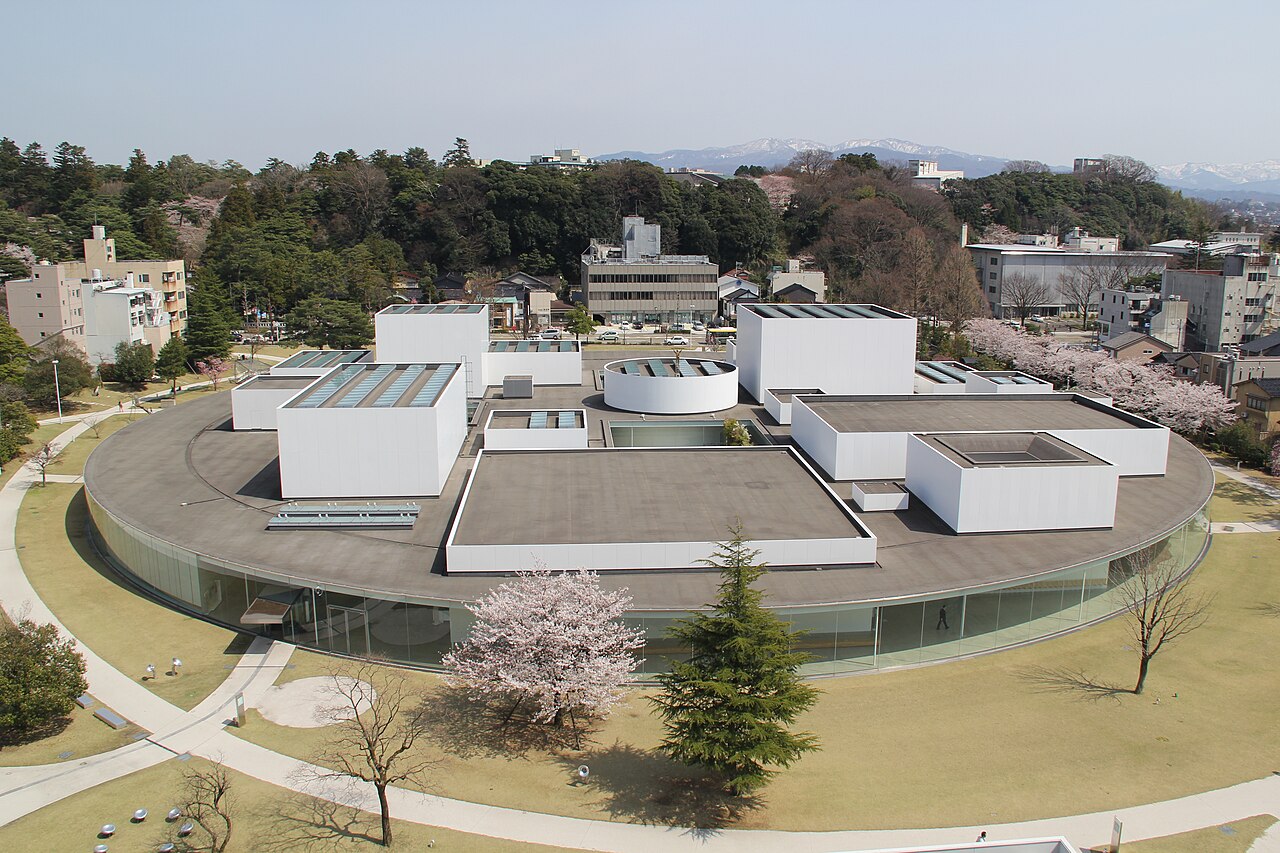
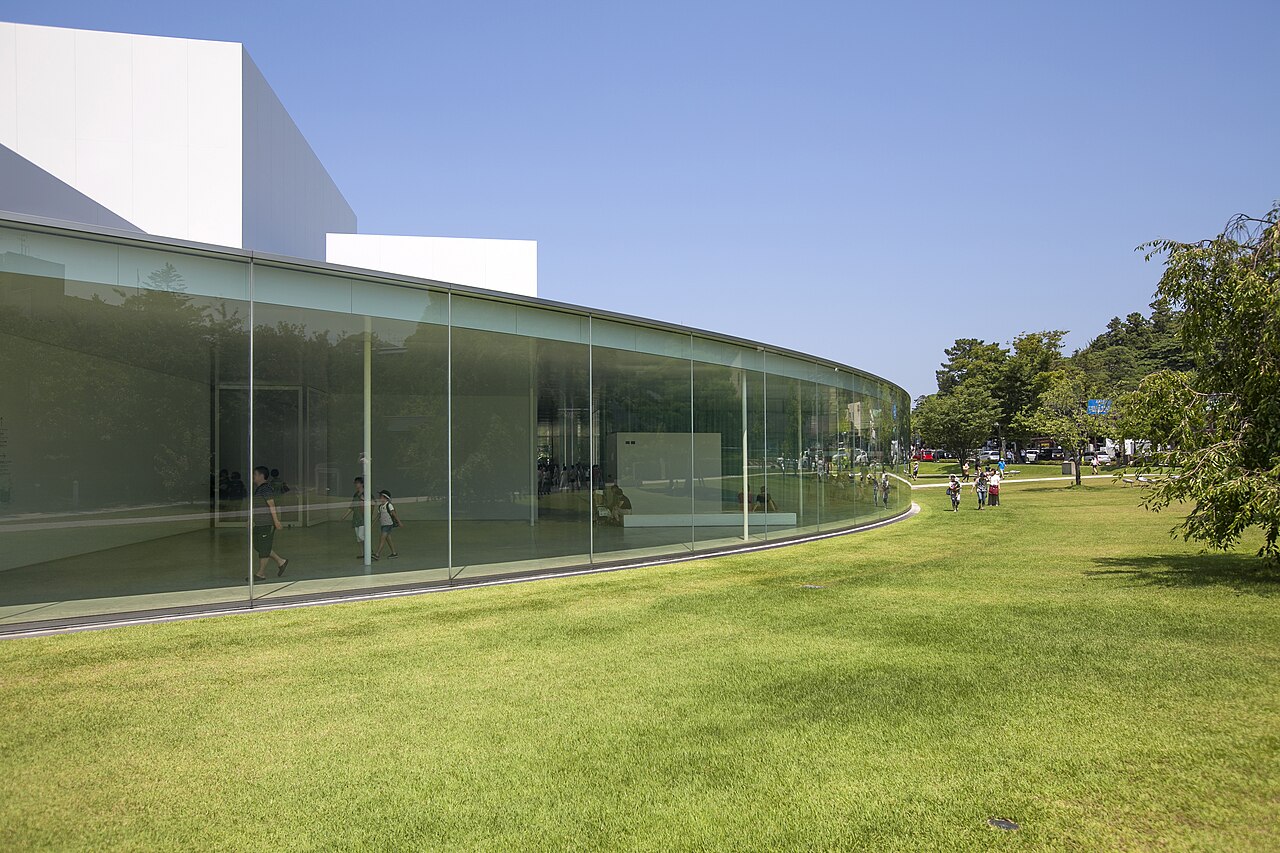
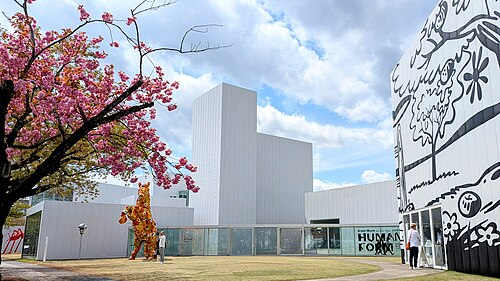
SANAA (Kazuyo Sejima and Ryue Nishizawa) designed this contemporary art museum, which opened in 2004 in the centre of Kanazawa. Its plan is a glass circle with no front and no back, approached from all sides, with skylights and inner courtyards for brightness and openness. Exhibition rooms, a café, an art library and other spaces sit almost entirely on one horizontal plane, along a ring-shaped gallery.
Affiliate links — booking through Verrière helps fund our research, at no extra cost to you.
History
In May 1995 Ishikawa Prefecture and the city of Kanazawa jointly set up a committee to study the planning of the city centre. A preparatory office for building the museum opened in April 1996, and the basic concept for the museum was settled in June 1997. In March 1999 the joint venture formed by Kazuyo Sejima's office and the SANAA office was chosen as designer; basic design began that May, and detailed design, begun in June 2000, was completed in October 2001 for both the building and its grounds.
Work began with a ceremony in April 2002. The building was finished in June 2004 and the outdoor works in August, and the museum opened on 9 October 2004. In September of that year it received the Golden Lion of the Ninth International Architecture Exhibition of the Venice Biennale.
In November 2016, to mark the museum's tenth anniversary, SANAA added a spherical pavilion, "Maru". In January 2024 the Noto Peninsula earthquake damaged the building, among other things bringing down the glass ceiling of an exhibition room.
Architecture
The city of Kanazawa had asked for a "low threshold" museum open to everyone. The museum sets out to be "a museum open to the city, like a park": anyone can drop in when they wish and meet people or have all kinds of experiences there. The site is bordered by streets on three sides; so that people can arrive from any direction, the plan is a circle with no front and no back, making the building a part of the town. Visitors come in by the entrances all around it, with no set route.
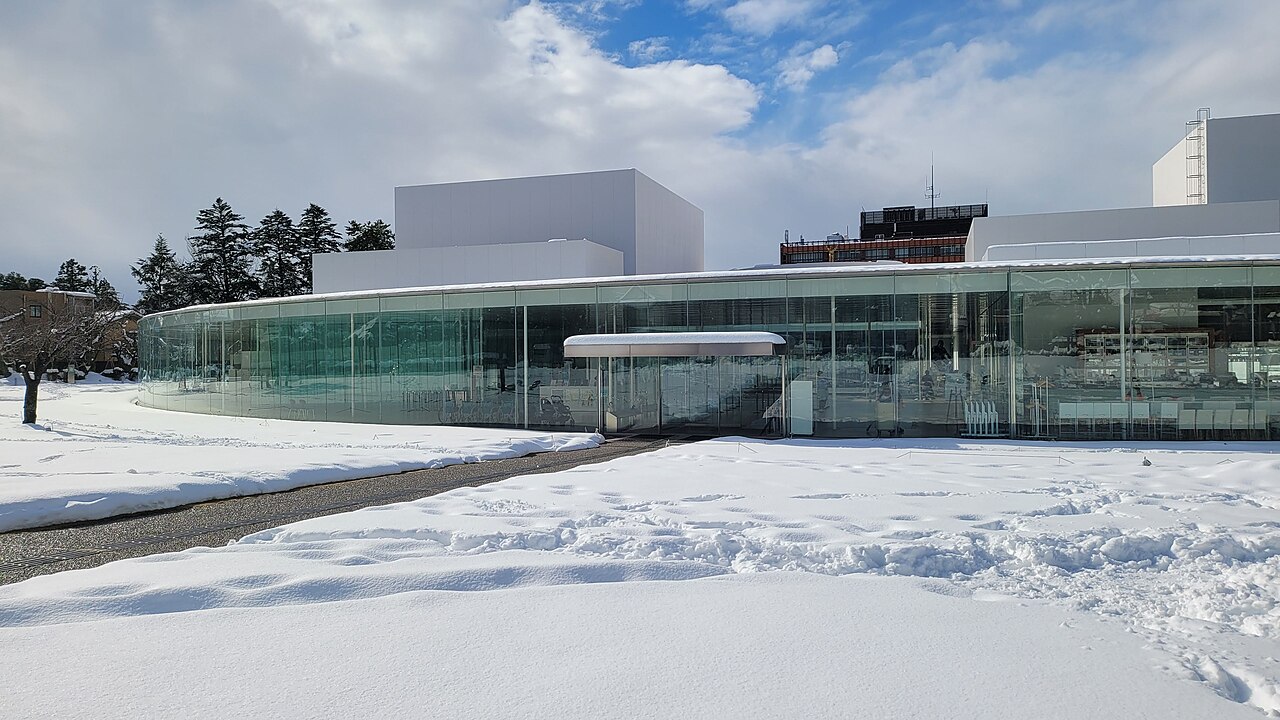
The glass circle is 113 m across. Its structure is reinforced concrete and steel; the eaves along the perimeter are 4.651 m high and the highest point reaches 14.9 m.
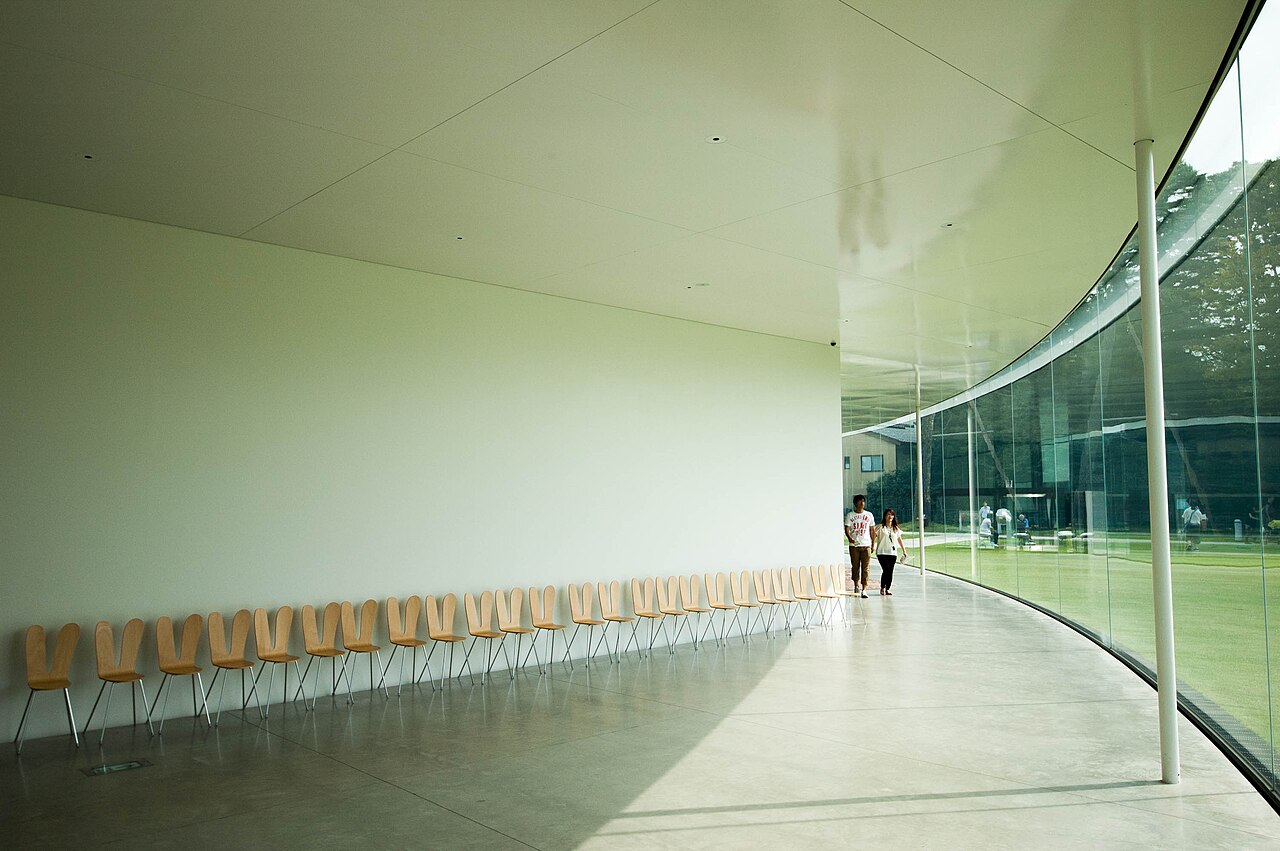
Exhibition rooms, a café-restaurant, an art library and other spaces, each with its own character, are laid out almost horizontally, which gives the spread of a town; walking round the ring-shaped gallery, one meets them one after another. The exhibition rooms differ in size, height and shape.
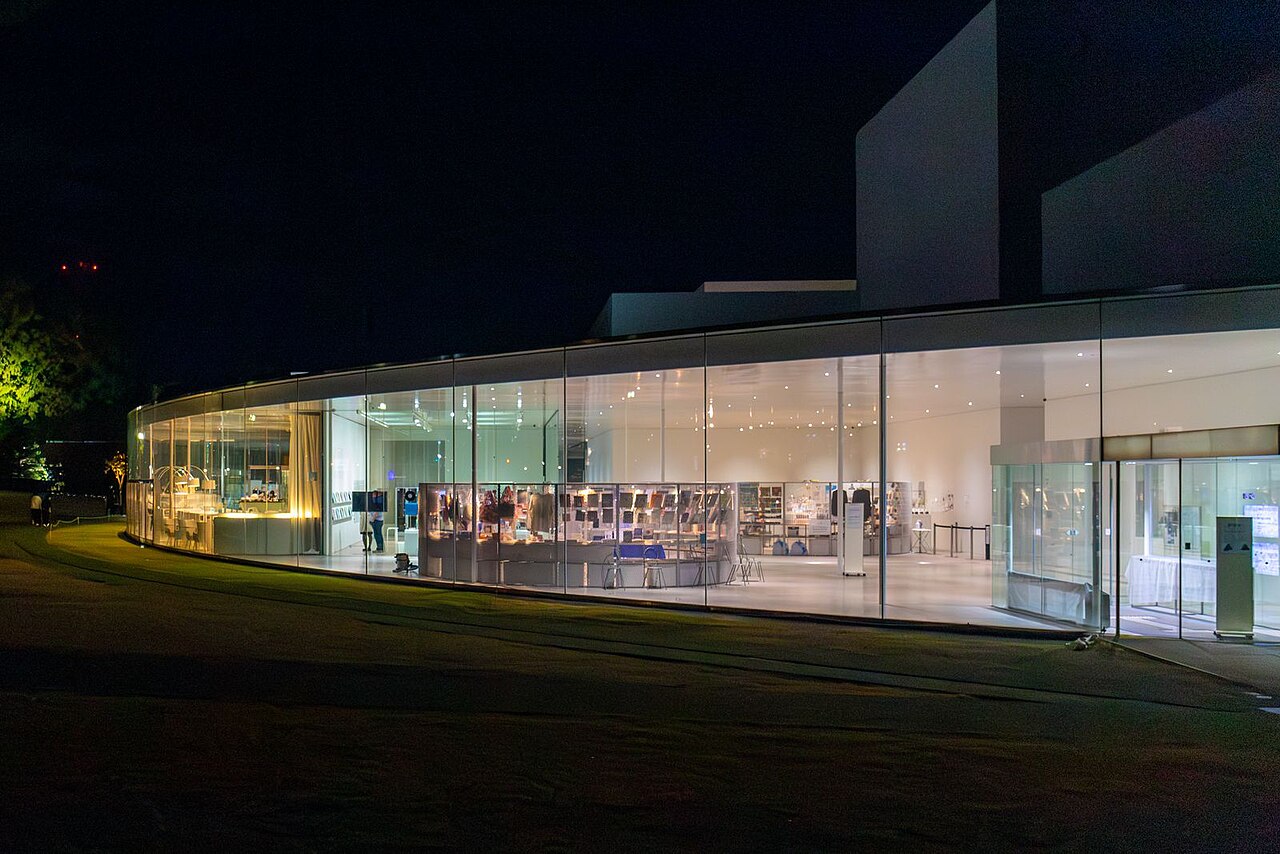
Many of the walls, outside and in, are of glass: the aim was transparency, brightness and openness, and for people in different spaces, indoors or out, to sense one another's presence. Skylights and inner courtyards serve that brightness and openness as well.
Use today
The museum is devoted to contemporary art. The building is divided into an exhibition zone and an exchange zone. It also holds a café-restaurant, a shop, an art library, a play and creation space for children, a gallery where local people show their work, and a multipurpose hall.
Permanent works stand inside the building and around it. In one of the light courts, Leandro Erlich's "The Swimming Pool" (2004) is a pool edged with limestone decking: the water is only about 10 cm deep, lying on transparent glass, and visitors can also enter the pale blue space beneath the glass. In James Turrell's "Blue Planet Sky" (2004), a square of sky is cut from the centre of a room's square ceiling, so that one feels the light change from hour to hour and season to season. Patrick Blanc's "Green Bridge" (2004) spans a glass corridor: a living wall 14 cm thick, planted on both faces with about a hundred plant species. Olafur Eliasson's "Colour activity house" (2010) is a spiral pavilion 10 m across, made of cyan, magenta and yellow glass walls. In an exhibition room, Anish Kapoor's "L'Origine du monde" (2004) shows a large black oval, 7 m along its long axis, on a sloping concrete wall.
Visiting
Entering the building, that is the exchange zone, is free; the exhibition zone requires a ticket.
The exhibition zone is open from 10 a.m. to 6 p.m., until 8 p.m. on Fridays and Saturdays; the exchange zone from 9 a.m. to 10 p.m. The hours of the individual facilities vary. The exhibition zone is closed on Mondays (when Monday is a public holiday, on the weekday that follows) and over the year-end and New Year period; the exchange zone only over the year-end and New Year period. The whole building is accessible without obstacles.
From Kanazawa JR Station, the bus ride to the museum's stop takes about ten minutes.
Photos
36.56° N, 136.66° E
Greenhouses nearby
Architecture nearby
By the same architect
Sources (18)
- kanazawa21.jp/data_list.php?g=36&d=1
- kanazawa21.jp/data_list.php?g=11&d=1
- kanazawa21.jp/data_list.php?g=7&d=1
- kanazawa21.jp/data_list.php?g=9
- kanazawa21.jp/data_list.php?g=10
- kanazawa21.jp/data_list.php?g=50
- kanazawa21.jp/data_list.php?g=50&lng=e
- kanazawa21.jp/data_list.php?g=61&d=503
- kanazawa21.jp/data_list.php?g=30&d=1
- kanazawa21.jp/data_list.php?g=30&d=4
- kanazawa21.jp/data_list.php?g=30&d=5
- kanazawa21.jp/data_list.php?g=30&d=7
- kanazawa21.jp/data_list.php?g=30&d=10
- kanazawa21.jp/data_list.php?g=30&lng=e
- kanazawa21.jp/data_list.php?g=11&d=2
- pritzkerprize.com/laureates/2010
- praemiumimperiale.org/en/laureate-en/laureates-en/sanaa-en
- kanazawa21.jp/data_list.php?g=7&d=5
Affiliate links — booking through Verrière helps fund our research, at no extra cost to you.