He Art Museum
Shunde, Foshan
Sources checked October 2026
- Year
- 2020
- Architect
- Tadao Ando
- Type
- Private non-profit art museum
- Access
- Museum open to the public (official site, October 2026)
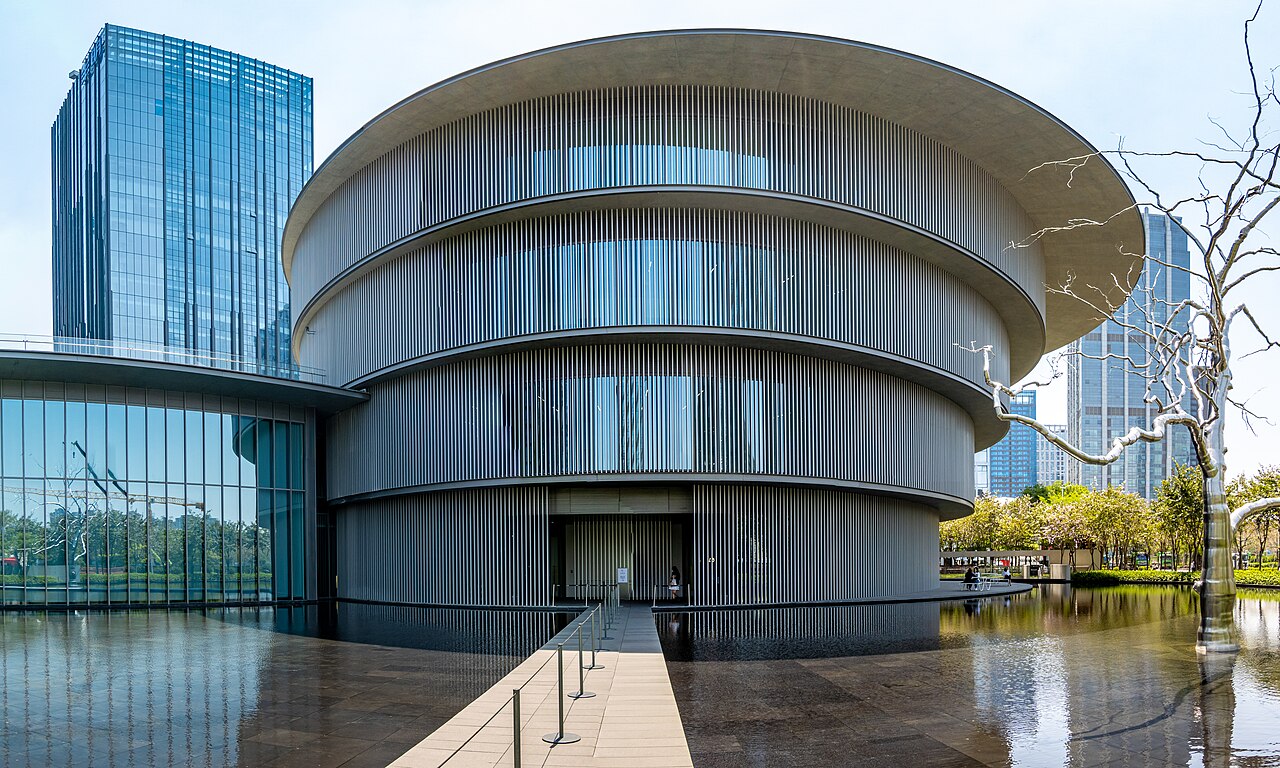
In Shunde (顺德), in the city of Foshan (佛山), Tadao Ando designed, on a family's initiative, a private non-profit art museum. The main building stacks four circles of different sizes, widening from bottom to top, and is organised around an atrium crossed by a double-helix staircase in exposed concrete. Pools of water surround the museum, which opened to the public in October 2020.
Affiliate links — booking through Verrière helps fund our research, at no extra cost to you.
History
The He Art Museum (和美术馆, HEM) was born on the initiative of a family. Its founder, He Jianfeng (何剑锋), wanted to bring art and culture to the people of his hometown, Shunde (顺德), in the city of Foshan (佛山), to those of the Pearl River Delta and to visitors from abroad.
Preparation began about five years before the opening. Members of the family who funded the project visited many museums and, drawn to Tadao Ando's simple, incisive style, asked him to design it. Ando rarely travelled to Shunde, but his office sent team members there every month to check the installation and the building work.
The family's collection was at first mostly modern Chinese painting and calligraphy. As the project took shape, the founding team wanted to add contemporary art, and the galleries were changed accordingly: a room reserved for painting and calligraphy became a multi-purpose gallery, with generous ceiling heights, a hard-wearing floor and enough load capacity for large installations.
Planned for March 2020, the opening was postponed by the pandemic. The museum opened to the public on 1 October 2020, by reservation and as a trial period, with the exhibition From the Mundane World (世间风物).
Architecture
The museum has about 16,000 square metres of total floor area, of which about 8,000 square metres are exhibition space. It stands in the new business district of Shunde, near the headquarters of the founder's company and next to the city park.
Everything starts from the circle. The four-level main building stacks four circles of different sizes that spread from the centre outwards like ripples on water; offset with a certain eccentricity, they widen from bottom to top. The form draws on the phrase "heaven is round, earth is square": the main mass combines arcs and square volumes, and the central circle gradually shifts its centre of gravity, proportion and height, its layers overlapping and extending from inside to outside, from the building to the city. The museum's name, He (和), means both harmony and mixing, an idea of fused spaces. Ando studied the architecture of Lingnan (岭南) before designing the museum; the form also takes its subtropical climate into account, for strong play of light and shadow.
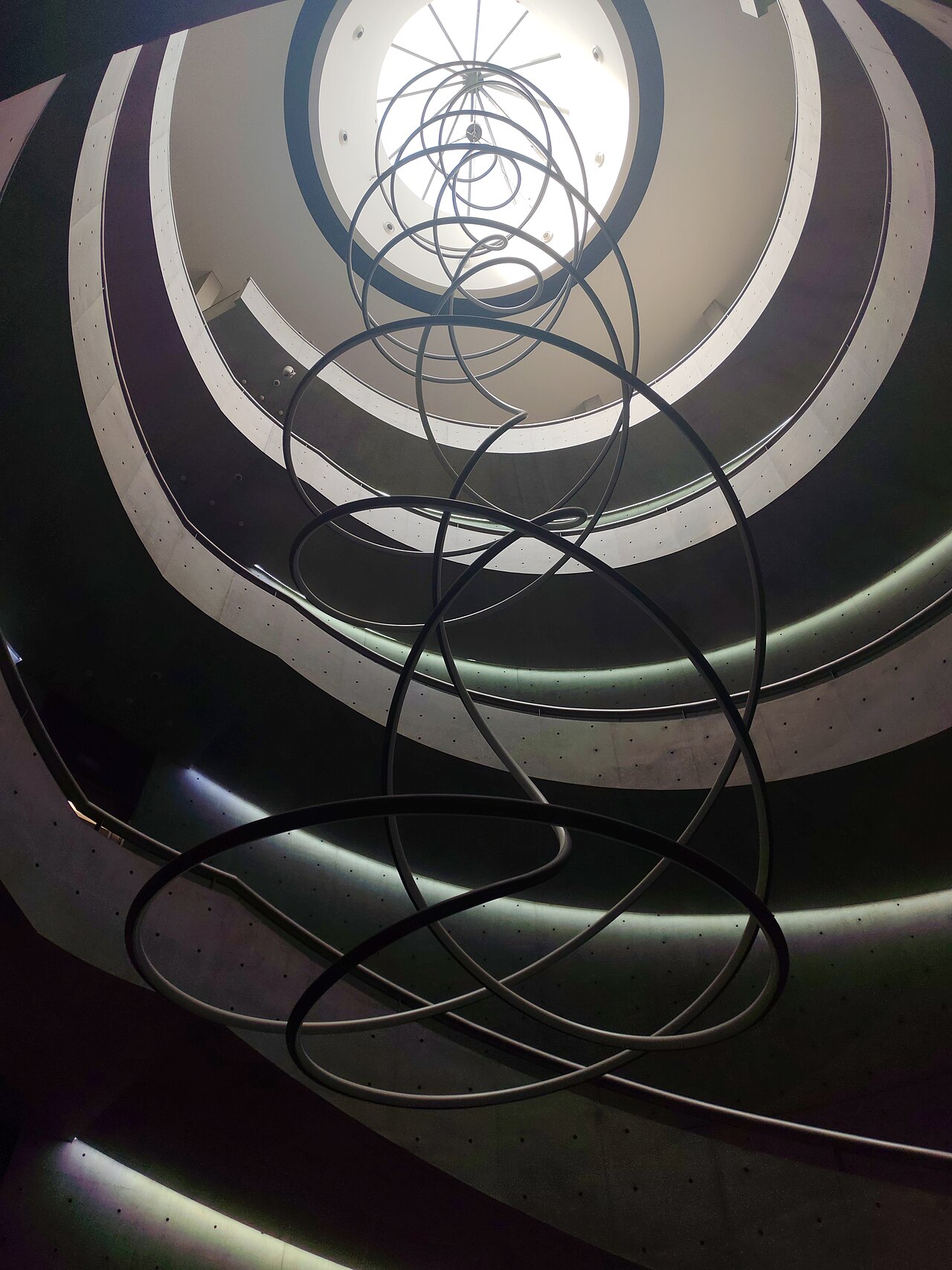
At the heart of the building, an atrium is crossed by a double-helix staircase in exposed concrete, linking the levels. Within the circular form are exhibition spaces for modern Chinese art and public education spaces; plain, tall cubic galleries meet the needs of contemporary art. The contrast between circle and square gives the whole its character. A central skywell lets natural light into every exhibition level.
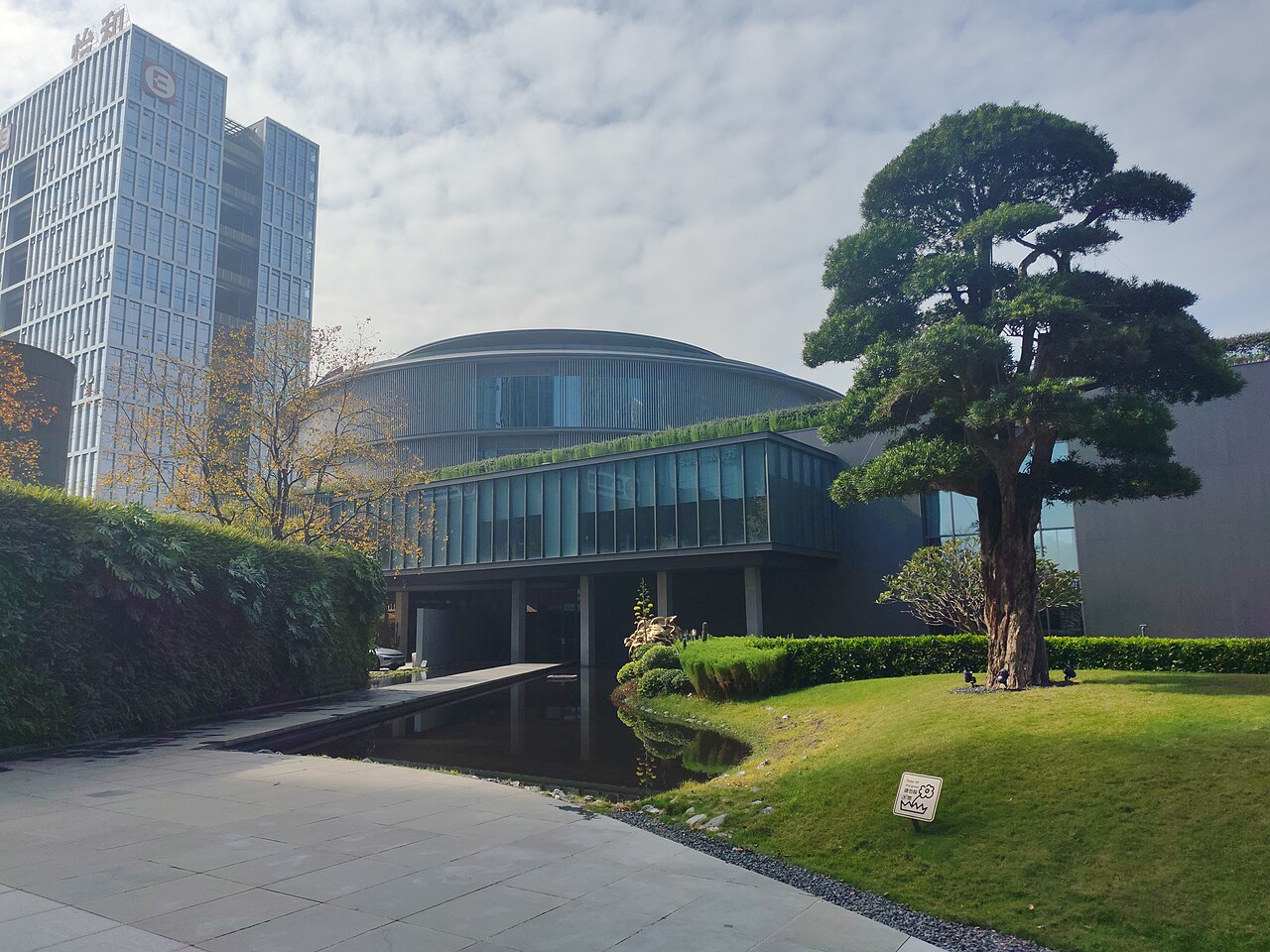
The landscape is mostly water. The museum is surrounded by pools that ease the heat of the subtropical summer and reflect the building, as if it stood on a plinth. The Crescent Garden (夹岸花园) answers the view of nature found in Lingnan gardens, and a water path leads to the main entrance. Open spaces give people from the neighbouring business district a place to rest.
Use today
The museum takes an interest in modern cultural and artistic currents as well as contemporary art, in an international perspective, and offers exhibitions and cultural activities to the public.
The collection has more than 700 works, Chinese and Western, modern and contemporary. Among those the museum highlights: Crag with Yellow Boomerang and Red Eggplant (1974) by Alexander Calder, Homme et Femme Nus (1968) by Pablo Picasso, Buffalo by Gao Jianfu (高剑父), Glisten (2018) by Anish Kapoor, Apsara (1941) by Chang Dai Chien (张大千) and Ballast (2019) by Roxy Paine.
Ballast is a stainless-steel sculpture in the garden, to the right of the water path leading to the entrance: it reproduces a tree trunk and its branches.
Visiting
Address: 广东省佛山市顺德区北滘新城美和路6号, in Shunde's new business district.
Photos
22.94° N, 113.21° E
Greenhouses nearby
Architecture nearby
Sources (14)
- hem.org/zh/about/overview
- hem.org/zh/about/architecture
- hem.org/zh/about/hemcollection
- hem.org/about/hemcollection
- hem.org/zh/about/contactus
- hem.org/zh/exhibition/current
- gooood.cn/en/he-art-museum-china-by-taodao-ando-architects.htm
- jiemian.com/article/5000392.html
- archdaily.com/947876/tadao-ando-completes-the-he-art-museum-in-china
- m-news.artron.net/20200928/n1085255.html
- en.wikipedia.org/wiki/He_Art_Museum
- wikidata.org/wiki/Special:EntityData/Q85877621.json
- api.openstreetmap.org/api/0.6/map.json?bbox=113.2135,22.9345,113.2160,22.9368
- hem.org/zh/visit
Affiliate links — booking through Verrière helps fund our research, at no extra cost to you.