Langen Foundation
Neuss (Raketenstation Hombroich)
Sources checked October 2026
- Year
- 2004
- Architect
- Tadao Ando
- Type
- Foundation museum (Asian and modern art)
- Access
- Open to the public Tuesday to Sunday, 10 a.m.-6 p.m. (official website, October 2026)
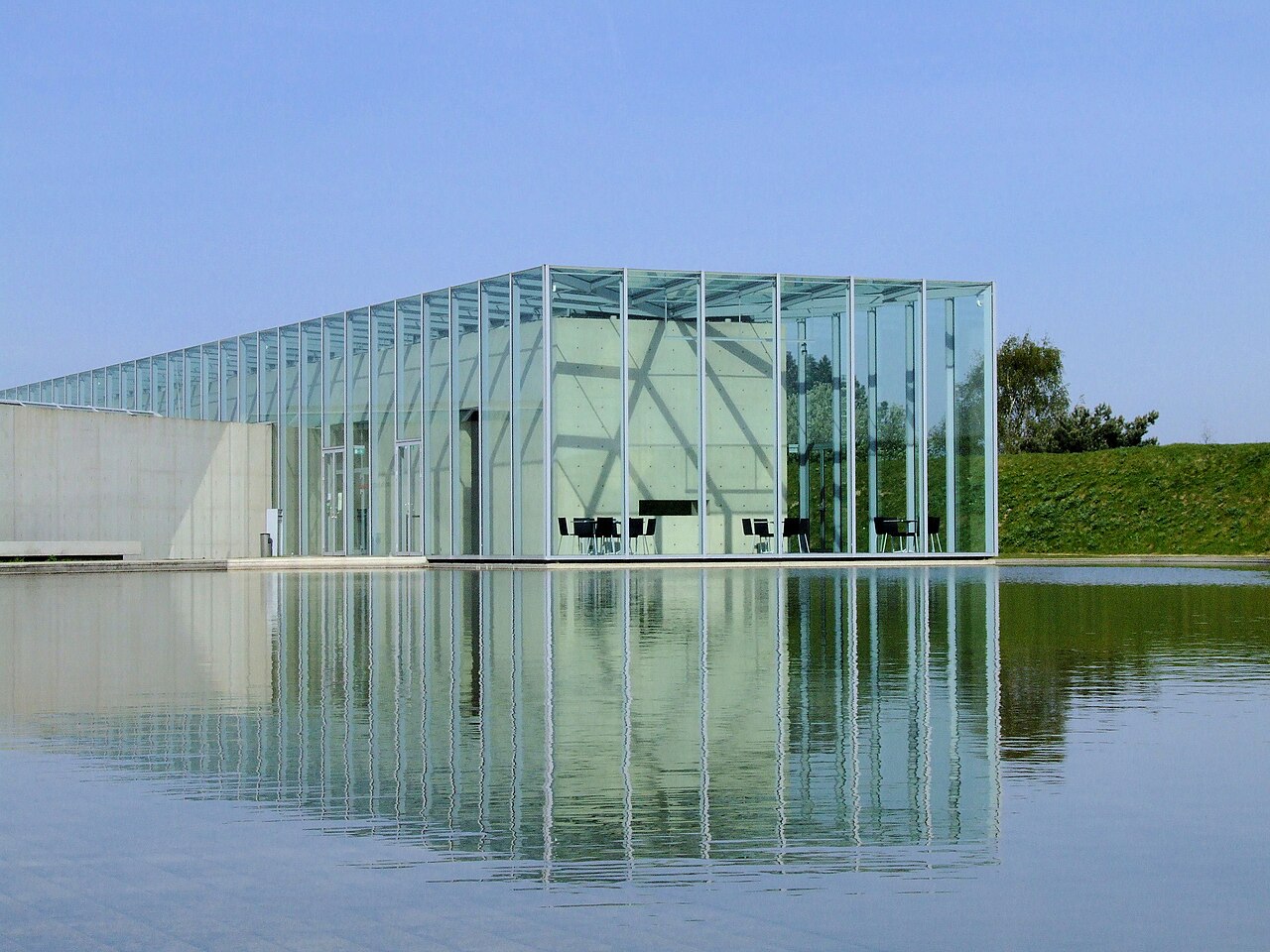
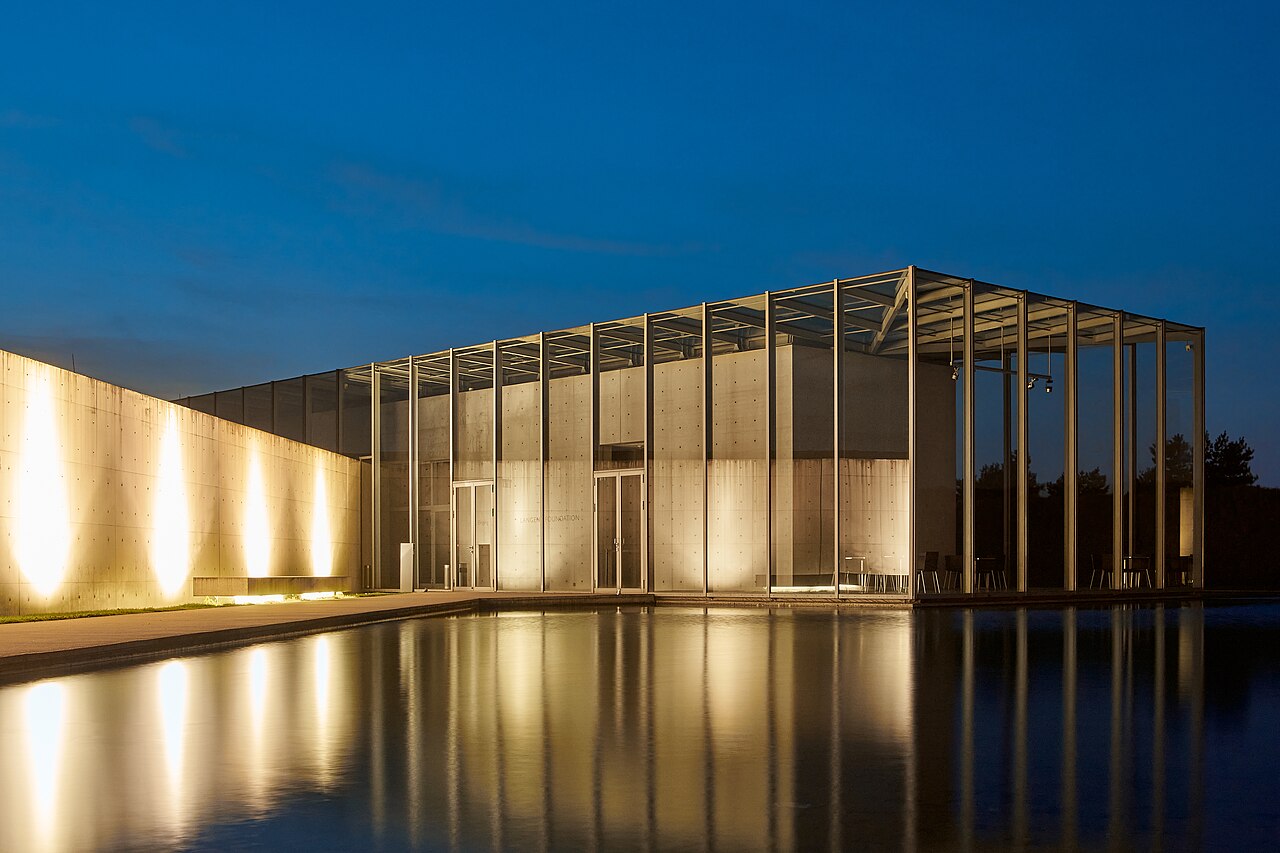
Tadao Ando built the Langen Foundation for the collection of Viktor and Marianne Langen, sheltered by the earth ramparts of a former NATO missile base in Neuss. Concrete, glass and steel; a large reflecting pool before the entrance; an open stairwell rising from the depths back into the Lower Rhine landscape. The galleries show the Japanese and modern art of the Langen collection.
Affiliate links — booking through Verrière helps fund our research, at no extra cost to you.
History
Viktor Langen (1910-1990), a Düsseldorf businessman and president of the chamber of commerce and industry, and his wife Marianne, née Heimann (1911-2004), began collecting soon after the Second World War. They visited museums and private collections in the United States, kept up with current trends in Paris, bought classic modernists in Basel; their curiosity ran to the art of other worlds as well. Over the years the couple built up one of the most important collections of Japanese art in Europe. Viktor, who held several patents in automobile production, travelled regularly to Japan to see customers, and it was there that the collection took shape.
The Langens lived with their art. Their houses in Meerbusch and Ascona were full of paintings and sculptures that were swapped around from time to time, and in 1979 they set up a private museum in Ascona for their Japanese picture scrolls (it closed in 2004).
The idea of a building of their own took shape at Hombroich, in close exchange with Karl-Heinrich Müller. The site had been a NATO missile base, put into service in 1967: Nike Hercules missiles were kept ready here, dismantled in 1988 under the INF Treaty, and the site closed in 1990. Müller bought the land in 1994 and developed a visionary project for it, to bring art and nature together in a unique synthesis. He invited Tadao Ando, who visited the Raketenstation in its original state and, enthused by Müller's plans, developed an architectural model that was to become part of that project. When Marianne Langen first saw Ando's plans in 2001, she quickly decided to have the building erected as the last and largest work of art in her collection; true to her maxim, she refused any outside funding. For her it was "the greatest work of art I have ever bought". She established the foundation in 2002 and visited the construction site every week. She died in February 2004 without seeing the finished building. It opened in September 2004 with "Bilder der Stille" ("Images of Silence"), on the tradition of Japan and Western modernism, which ran until June 2005.
A short walk from the Museum Insel Hombroich, the Langen Foundation is nonetheless independent of it in both organisation and programme.
Architecture
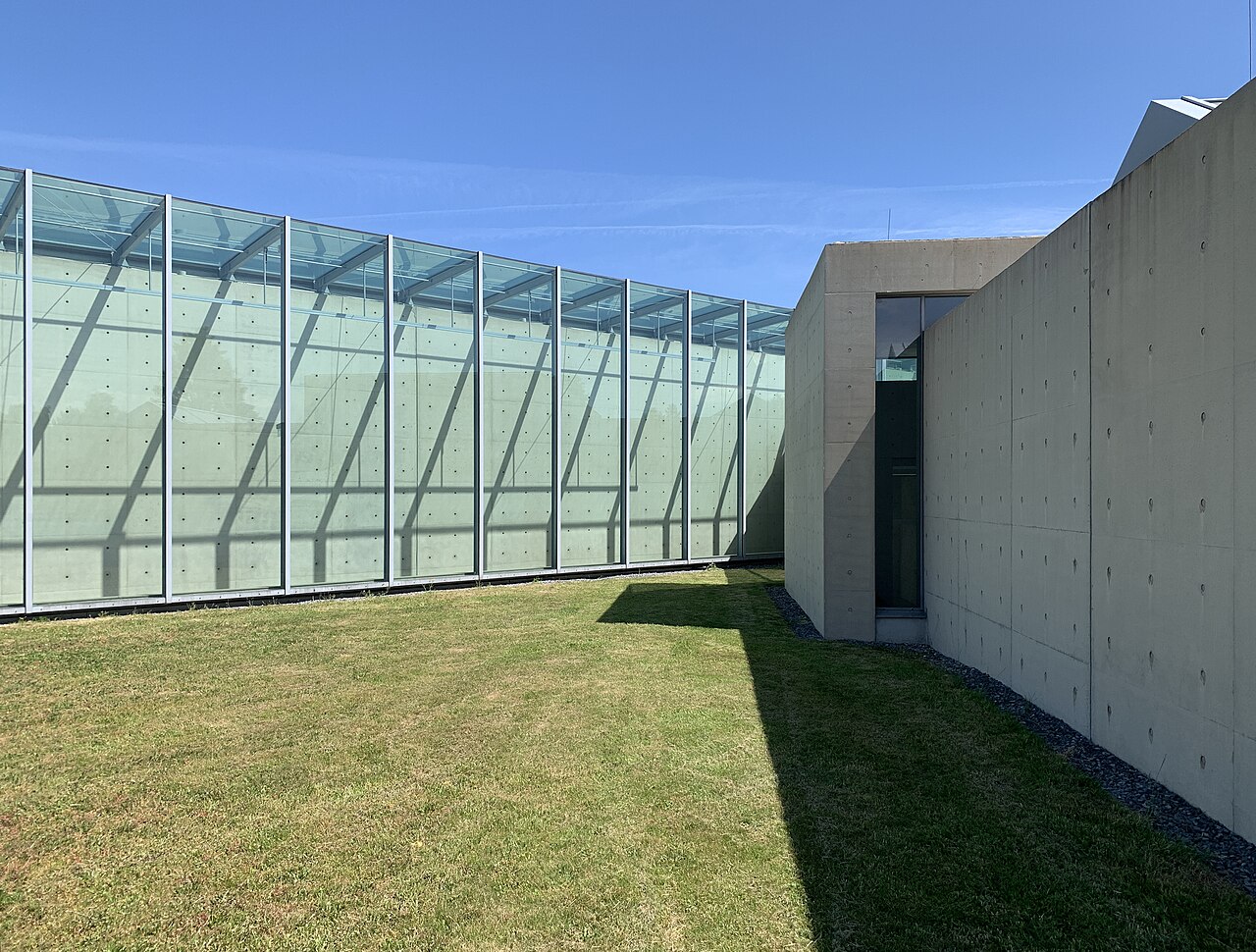
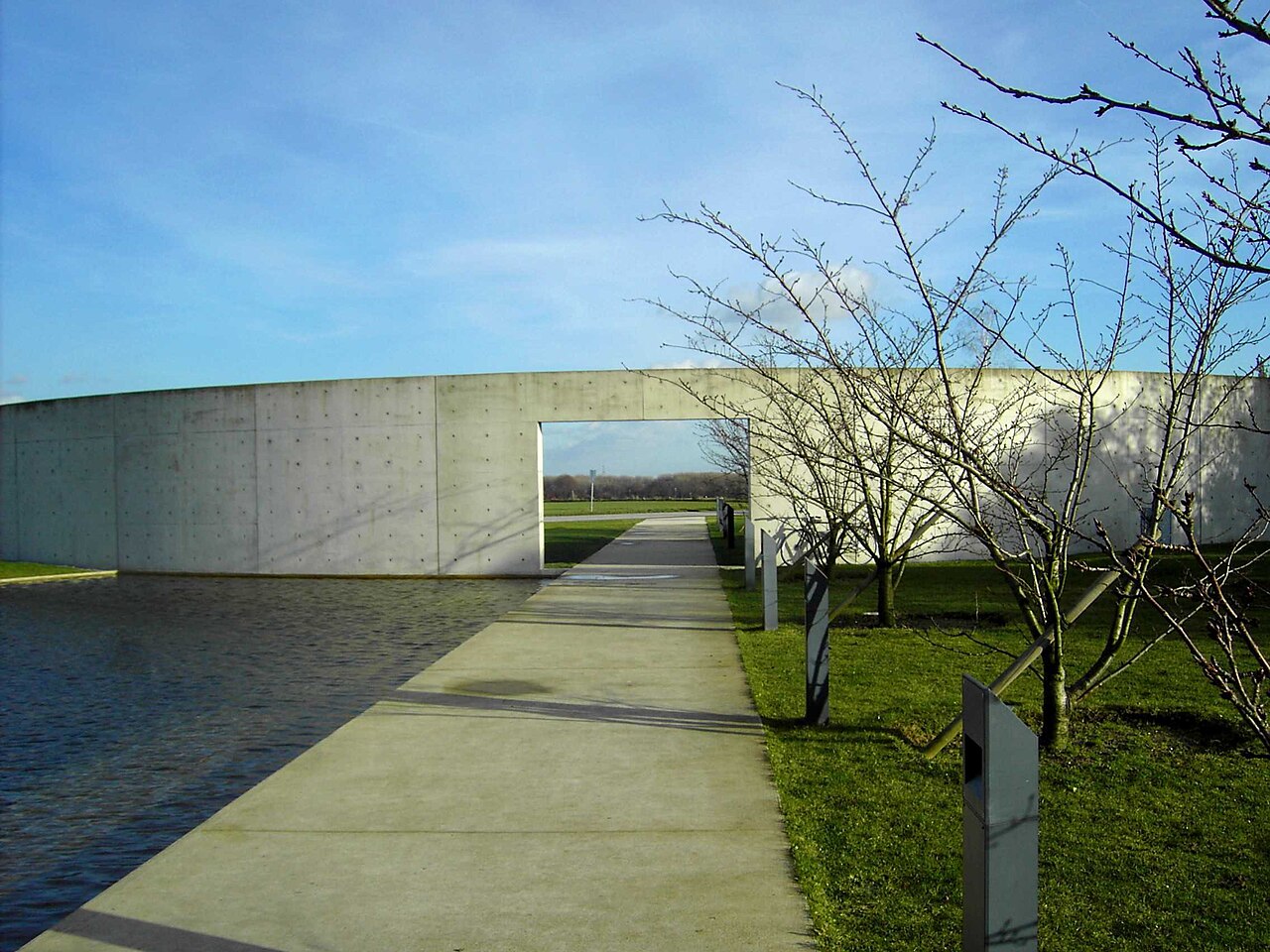
Tadao Ando says that we borrow from nature the place where we build. In Neuss he fits the building to the topography of the earth ramparts that surround the former base, opened on one side only, at the entrance. There rises a semi-circular concrete wall, four metres high, cut by a portal that frames both the building and the large reflecting pool in front of it. Concrete, glass and steel: from a distance the complex is barely visible behind grassy embankments, and in places it digs deep into the ground.
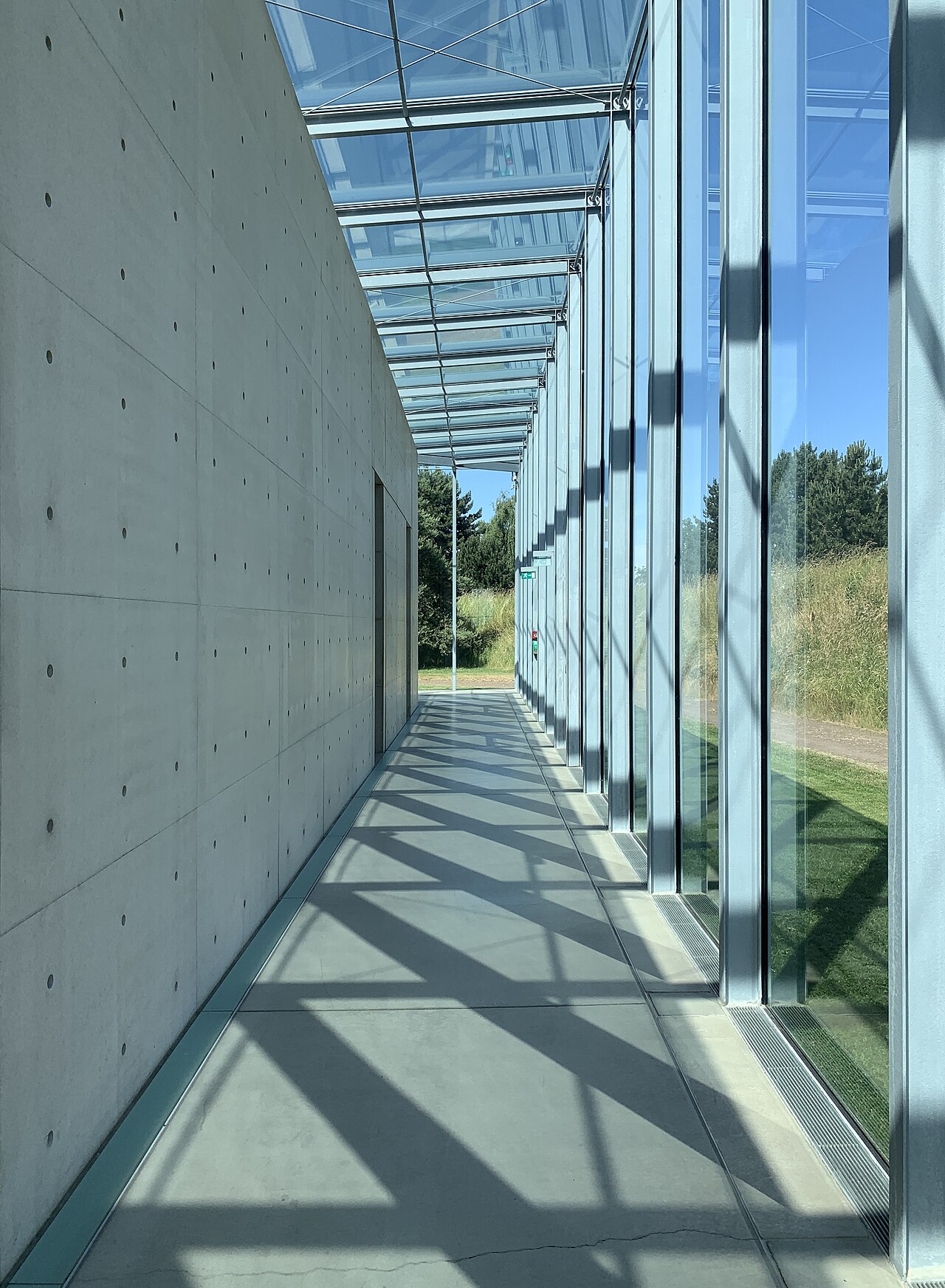
Two interconnected volumes of different character make up the building. The first is a long concrete slab veiled in glass; the main wing, two parallel cubes sunk nearly six metres into the ground, abuts it at an angle of forty-five degrees. Between them runs a large open stairwell, a kind of stairway to heaven, rising from the depths back up into nature.
Three exhibition spaces total 1,300 square metres. In the ground-level slab lies the "Japan Room", a gallery, unusually long and narrow, that Ando conceived as a space of "tranquillity" for the Japanese part of the collection. The two subterranean rooms, with a surprising ceiling height of eight metres, house the modern part. As in many of the architect's works, the smooth concrete carries the marks of the formwork panels, sized to tatami mats, and of the anchor holes; here the pattern is visible throughout, even from the inside in places.
Use today
Since 2004 the foundation has shown the collection of Viktor and Marianne Langen in rotating presentations alongside exhibitions of contemporary art; the rooms are used differently from one exhibition to the next. The collection comprises over 600 works of East Asian art, joined by pieces from Africa, Oceania and South America: the Langens travelled to many of these regions themselves to see the objects in their original context.
The Japanese holdings, about 500 works from the 12th to the 20th century, run from ceramics of the prehistoric Jōmon period and Buddhist statues of the Nara and Heian periods to court painting of the Kanō school, works by Maruyama Ōkyo (1733-1795) and 19th-century genre painting. There are also more than 100 Buddhist sculptures from India, Cambodia and Thailand and over 130 pre-Columbian objects.
On the modern side: Cézanne, Beckmann, Warhol, Rothko, Dubuffet, Bacon, Polke, the Zero artists of the couple's Düsseldorf circle (Mack, Piene, Uecker), Lucio Fontana and Yves Klein. The Langens also assembled the most extensive group of works by Dubuffet in Europe. In 2014 several modern works went to auction at Christie's in New York, among them pieces by Picasso, Léger, Braque and Kandinsky. Since 2010 the foundation has also staged exhibitions with private German collections, including ALTANA Art and the Viehof Collection.
Visiting
Open Tuesday to Sunday between 10 a.m. and 6 p.m. (admission closes at 5.30 p.m.), and on some public holidays, among them Easter Monday, Whit Monday, 1 May, the Day of German Unity and All Saints' Day. Admission is charged, with a reduced rate. The Hombroich Ticket, a combined ticket, covers all institutions in Hombroich. An individual guided tour, charged on top of admission, can be booked for a group of up to 20.
Address: Raketenstation Hombroich 1, 41472 Neuss. From Düsseldorf Hbf, tram 709 runs to Neuss Landestheater, where bus 877 continues to the stop Neuss Bergerhof, serving the Raketenstation and Kirkeby-Feld, between which the Langen Foundation lies: allow 50 to 60 minutes. Alternatively, take the RB 39 to Neuss Holzheim Bhf and walk about 30 minutes (15 by bike). You can also come by car or bicycle.
A few steps away begins the sprawling Raketenstation site: you pass old bunkers and meet art that merges into nature, on to Álvaro Siza's small, light-filled pavilion, Café Biemel and Thomas Schütte's Skulpturenhalle, a structure of brick and light. All institutions in Hombroich are 5 to 20 minutes' walk from one another; the Museum Insel Hombroich is about a 20-minute walk from the Raketenstation.
Photos
51.15° N, 6.64° E
Greenhouses nearby
Sources (14)
- langenfoundation.de/about/architektur
- langenfoundation.de/about/geschichte
- langenfoundation.de/besuch/ihr-besuch
- langenfoundation.de/programm/sammlung
- langenfoundation.de/besuch/ein-tag-in-hombroich
- langenfoundation.de/en/about/architecture
- inselhombroich.de/mit-bus-und-bahn/
- inselhombroich.de/de/besuch/anreise/
- de.wikipedia.org/wiki/Langen_Foundation
- de.wikipedia.org/wiki/Raketenstation_Hombroich
- en.wikipedia.org/wiki/Langen_Foundation
- en.wikipedia.org/wiki/Museum_Insel_Hombroich
- wikidata.org/wiki/Q830675
- langenfoundation.de/en/besuch/plan-your-visit
Affiliate links — booking through Verrière helps fund our research, at no extra cost to you.