Regenwaldhaus (Rainforest House)
Krefeld Zoo, Krefeld, North Rhine-Westphalia
No freely licensed photo of this greenhouse yet. Do you have one? Suggest it for this page →
Sources checked September 2026
- Year
- 1998
- Style
- Tropical house with timber frame and Plexiglas roof
- Dimensions
- About 1,100 m²
- Status
- Open to the public
Krefeld Zoo's third tropical house, the Regenwaldhaus opened in 1998, its 4.5 million Deutschmark cost met by a bequest from the entrepreneur Walter Gehlen, the zoo's friends' association and other donors. Across about 1,100 m², under a timber and Plexiglas roof strengthened with steel in 2019, it recreates a South American rainforest kept at 25–28°C. Some 400 plant species surround around forty animal species, among them sakis, sloths and tamanduas, most of which roam without barriers. A fire on a wooden bridge in October 2023 led to a temporary closure.
Affiliate links — booking through Verrière helps fund our research, at no extra cost to you.
History
Krefeld Zoo opened on 22 May 1938 in the Bockum district, on the grounds of the Grotenburg park. Tropical houses gradually became its hallmark: the Affentropenhaus, a 2,000-square-metre ape and monkey house opened in 1975 and described as the first of its kind in the world, was followed in 1989 by a tropical bird hall.
The Regenwaldhaus, the zoo's third tropical house, opened in 1998. Its construction, costing 4.5 million Deutschmarks, was funded by a bequest from the Krefeld entrepreneur Walter Gehlen, together with the zoo's friends' association (Zoofreunde Krefeld e.V.) and other donors.
In 2019 its timber roof structure was strengthened with steel: the firm Steel Box installed an auxiliary steel frame and new bearings, working from scaffolding up to 17 metres high in 35°C heat and 80% humidity. A few months later, on New Year's Eve 2019–2020, fire destroyed the Affentropenhaus and killed more than fifty animals. On 24 October 2023, shortly after 1 pm, it was a wooden bridge inside the Regenwaldhaus that caught fire during repair work; zoo staff tackled the flames with extinguishers before the fire brigade put out the embers, and an anteater and seven water turtles were moved to safety. Police investigated the then unknown cause, and the house was temporarily closed.
Architecture and engineering
The Regenwaldhaus covers about 1,100 square metres. Unlike a classic metal-framed glasshouse, its roof pairs a timber structure with Plexiglas cladding. During the 2019 works this timber frame was doubled by an auxiliary steel framework resting on new bearings, and the installation called for scaffolding up to 17 metres high, which gives a sense of the volume inside.
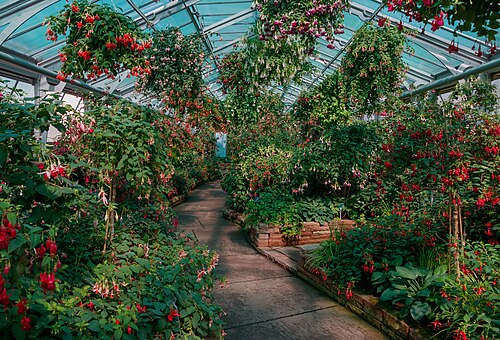
The temperature is kept between 25 and 28°C to reproduce the warm, humid atmosphere of a rainforest. The layout is built around the absence of obtrusive barriers: most animals move freely throughout the house and can be watched without fences, while species that cannot mingle with visitors, such as caimans and anacondas, have separate quarters. A jungle path winds through dense vegetation, passes through a stone tunnel and skirts an island occupied by leaf-cutter ants, and a wooden bridge completes the circuit.
Plant collections
The house recreates a South American rainforest with around 400 plant species and some forty animal species. White-faced sakis and two-toed sloths move through the canopy alongside tamanduas, nectar-feeding bats and a variety of birds. Crested basilisks, turtles and fish live on the ground and in the water, while a colony of leaf-cutter ants occupies its own island.
Species that cannot roam freely are shown separately: spectacled caimans, green anacondas, poison dart frogs and tarantulas. This mix of free-ranging animals and terrariums makes it possible to present several layers of the forest, from canopy to riverbank, within a modest volume. The house thus carries on the zoo's tropical tradition, which had made inhabited glasshouses its speciality since the 1970s.
Visiting
The Regenwaldhaus is part of a 14-hectare zoo that held about 820 animals of some 120 species at the end of 2024. Its humid warmth makes it a welcome stop in cold weather, and the more discreet animals, such as the sloths, take some patience to spot; the daily saki feed in the early afternoon and the caiman feed on Friday afternoons punctuate a visit.
It pairs well with the Schmetterlingsdschungel, a butterfly house opened in 2010 that holds up to 200 butterflies, and with the MenschenaffenWald, opened on 3 October 2025 as the first building of the planned AffenPark conservation centre; it is home to Bally and Limbo, the two chimpanzees that survived the 2020 fire.
51.34° N, 6.60° E
Greenhouses nearby
Architecture nearby
More greenhouses — Germany
Do you have a good photo of this greenhouse? Suggest it for this page →
Sources (6)
Affiliate links — booking through Verrière helps fund our research, at no extra cost to you.