Tropenhaus and display glasshouses of the Solingen Botanical Garden (Botanischer Garten Solingen)
Solingen, North Rhine-Westphalia

Entry updated on October 5, 2026
- Year
- 1965
- Architect
- Unknown
- Style
- 1960s steel-framed tropical house with a mono-pitch roof
- Dimensions
- Tropenhaus about 140 m² (137 or 143 m² depending on the source); about 826 m² of display glasshouses
- Status
- Open to the public (Tropenhaus reopened in 2023 after restoration)
Solingen's municipal botanical garden, inaugurated in 1963 in the Wald district, gained a Tropenhaus in 1965: a steel-framed house with a mono-pitch roof 7 to 8 m high, which brought the display glasshouses to 826 m². Saved from closure by an association founded in 1998, it was listed as a monument together with the whole garden in 2010. Restored from 2017 onwards, the Tropenhaus reopened in 2023. It leads into an orchid hall and into houses for succulents and bromeliads.
Affiliate links — booking through Verrière helps fund our research, at no extra cost to you.
History
1 min
The Solingen botanical garden grew out of a proposal by the municipal inspector Heinrich Walbert, discussed by the city's building committee as early as 1947: the old tree nursery near the Vogelsang cemetery, in the Wald district, was to be turned into a garden. The municipal nursery was built from 1950; four glasshouses were finished in 1951, and by 1952 the complex had eight glasshouses, a work building and a coal-fired boiler house.
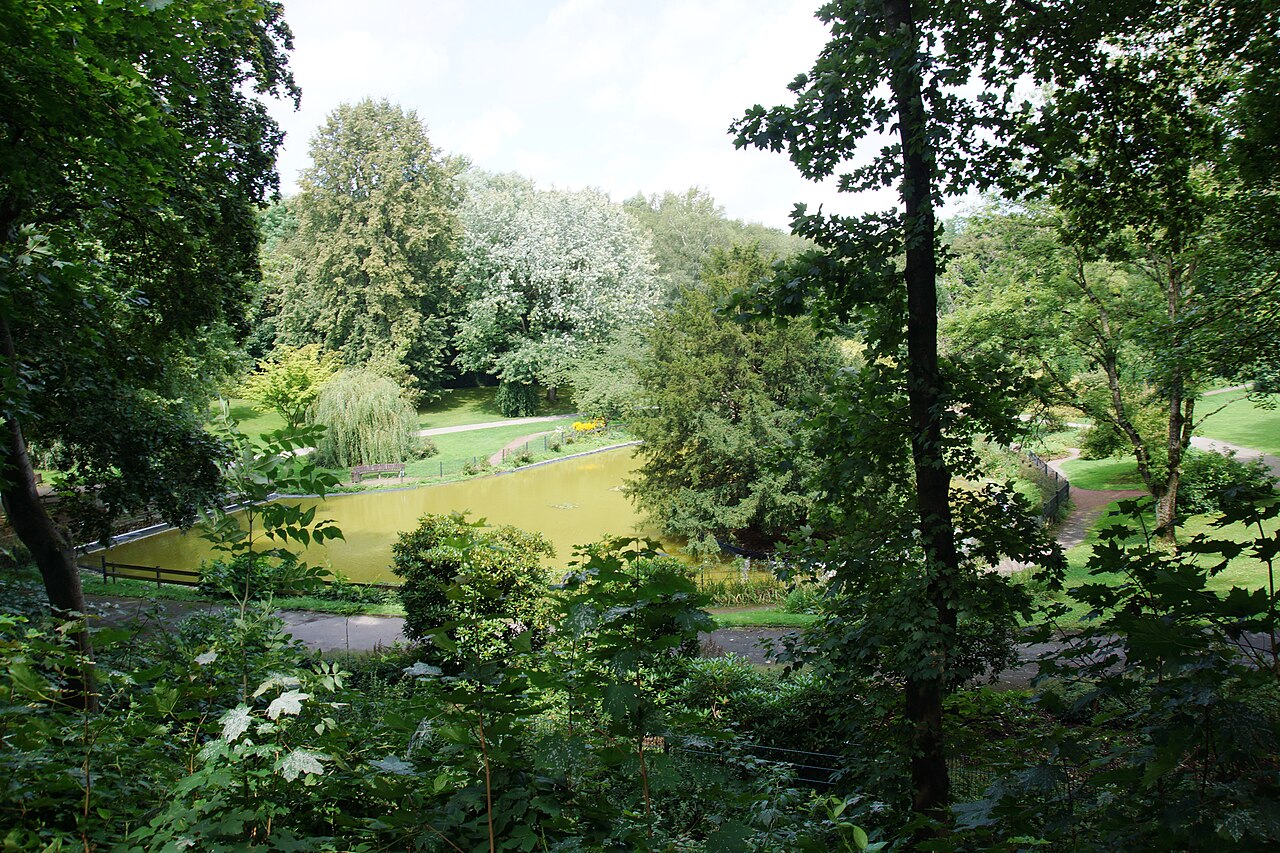
Mayor Otto Voos opened the garden on 7 September 1963 on 40,600 m², with the landscape architect Siegfried Brendel laying out its themed gardens. The Tropenhaus followed in 1965, bringing the display glasshouses to 826 m². Public interest was such that by 1968 the houses opened three times a week. In 1970 two glasshouse roofs had to be rebuilt because their timber supports had rotted, and the interior of the Tropenhaus was completely redesigned in the winter of 1994-95.
When closure and sale loomed, the Stiftung Botanischer Garten Solingen e.V., founded on 15 October 1998, came to the garden's aid and in 2005 took over three display houses that were due to close. In June 2010 the Tropenhaus and the entire garden were placed under monument protection. Restoration of the Tropenhaus began in March 2017 with asbestos removal and trial panes of UV-permeable double glazing; with support from the NRW-Stiftung, the old plastic sheets were replaced by double-glazed panes, and the house reopened in 2023, the year the garden turned sixty.
Architecture and engineering
1 min
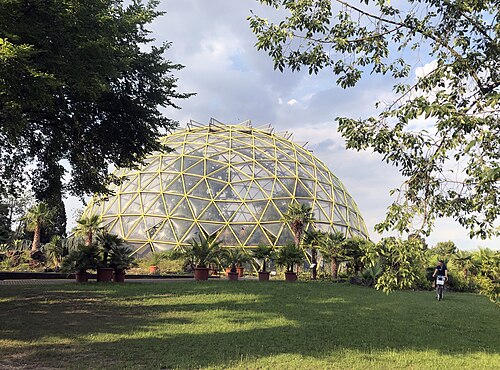
The Tropenhaus was built in 1965 by a steel construction firm that the garden does not name. Its frame rests on oversized steel girders under a mono-pitch roof, oriented to the south-west to give the plants the best possible tropical conditions. The garden's own page gives 12.80 m in length, 10.70 m in width, a volume of 688 m³ and a height of 7.10 m on the garden side; its history page, Wikipedia and the NRW-Stiftung speak of 8 m, and the floor area is stated as either 137 m² or 143 m². The adjoining aquarium adds 37.10 m², making about 175 m² in all.
The Tropenhaus heads a group of linked houses: an orchid hall connects it with the succulent and bromeliad houses, a stock-plant house and a 55 m² kiosk pavilion completed in 2008 to fill a gap between two glasshouses. Since the 1960s the complex has been heated by the district heating network fed by the municipal waste incineration plant. In 2009 the stock-plant house received a twin-wall polycarbonate roof, and in 2011 the thermal screens of the bromeliad house were renewed to save energy.
Plant collections
1 min
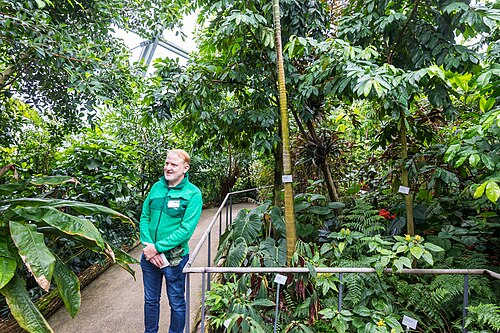
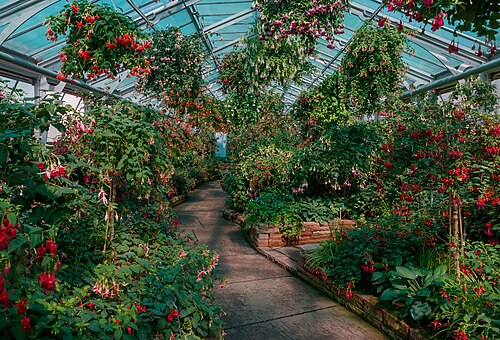
The Tropenhaus brings together palms, sugarcane, a cinnamon tree, an elephant's foot, strelitzias and other tropical ornamental and useful plants around a stream lined with a small terraced rice field, marsh plants and aquatic plants. The annotated tour published by the garden names, among others, Monstera obliqua, Ficus lyrata, the tree fern Dicksonia antarctica and the orchid Cattleya bowringiana. In the vestibule a former aquarium was turned in 2006, by a member of the association, into a Vietnamese biotope planted with South-East Asian orchids.
The orchid hall concentrates on species from Central and South America, shown in rotating displays as they come into flower. The succulent house holds about 250 plants, among them Melocactus and a queen of the night that flowers only once a year, after sunset. With some 220 species, the bromeliad house claims one of the largest collections in North Rhine-Westphalia; it also shelters bananas, vanilla, carnivorous plants and Phragmipedium. The orangery keeps lemons, sweet oranges, mandarins, bitter oranges and citrons.
Visiting
1 min
Since the neighbouring old cemetery was added in 2001, the garden has covered a little over 6 hectares. The glasshouses open less often than the garden, and the stock-plant house and the orangery can only be seen on certain days, so the calendar is worth checking before a visit. From Easter to the end of October the kiosk pavilion serves coffee and home-made cakes. Sunday concerts, a tradition begun in 1966, returned in 2011 on the festival square laid out that year. Outside, the listed pergola restored in 2024-25, the iris garden renovated in 2017 and the alpine garden round off the walk, and a virtual tour of more than 700 panoramas shows the glasshouses from afar.
51.18° N, 7.07° E
Greenhouses nearby
More greenhouses — Germany
Do you have a good photo of this greenhouse? Suggest it for this page →
Sources (5)
- botanischer-garten-solingen.de/der-garten/schauhaeuser/
- botanischer-garten-solingen.de/der-garten/schauhaeuser/tropenhaus/
- botanischer-garten-solingen.de/index.php/der-garten/geschichte
- nrw-stiftung.de/entdecken/foerderprojekte/botanischer-garten-solingen.html
- de.wikipedia.org/wiki/Botanischer_Garten_Solingen