Nagaragawa Convention Center (長良川国際会議場)
Gifu, Gifu Prefecture
Sources checked October 2026
- Year
- 1995
- Architect
- Tadao Ando
- Type
- Convention centre and performing-arts hall
- Access
- Common areas open to visit on prior request when not in use; halls open during events (official website, October 2026)
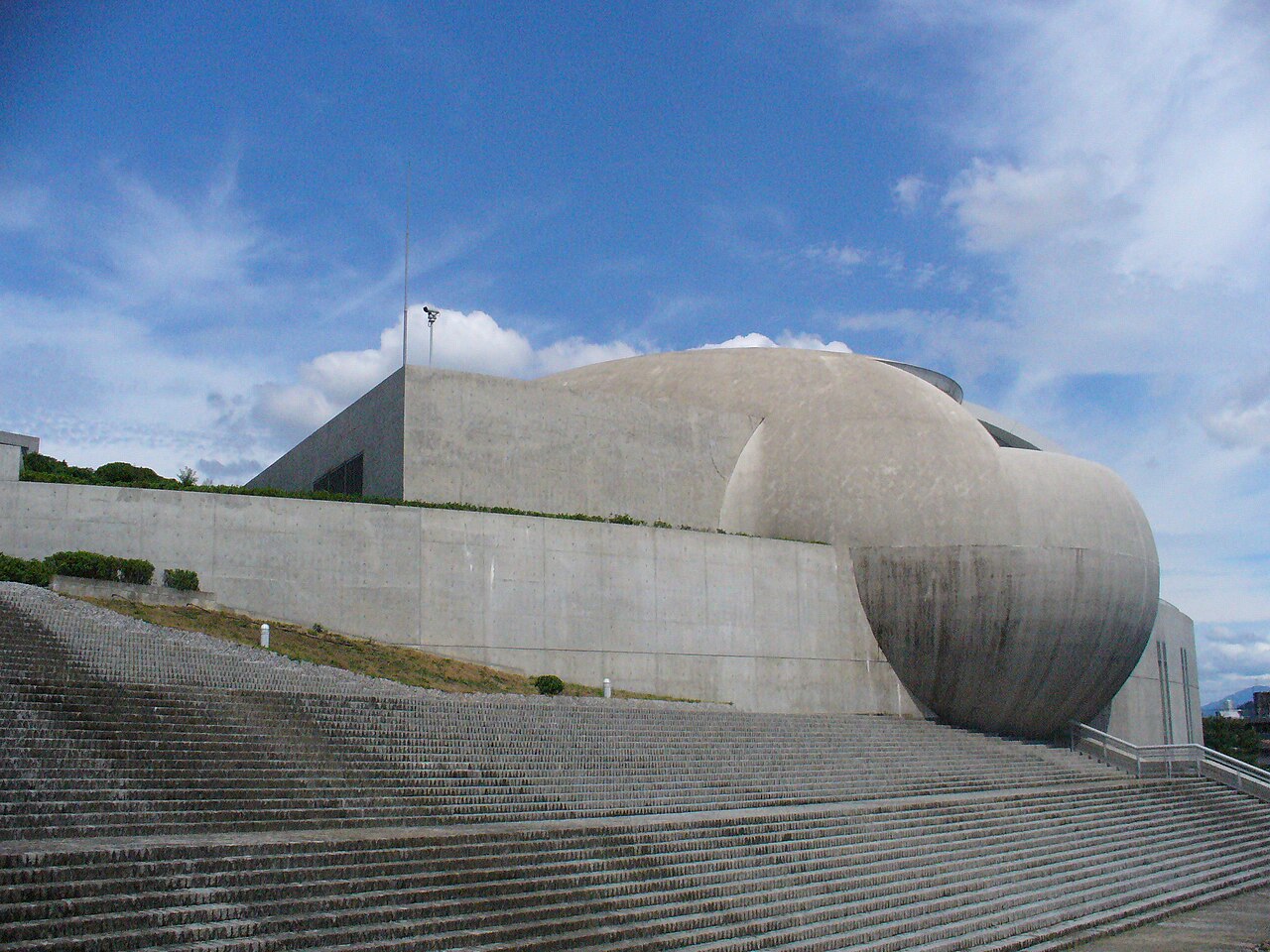
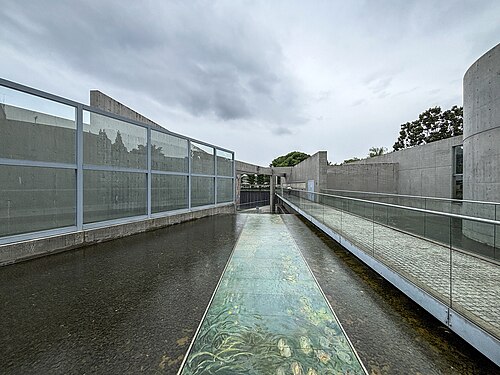
Built by Tadao Ando between 1993 and 1995, this convention centre in Gifu is organised around a square atrium open over four levels and lit by four skylights, from which a spiral staircase leads to the rooftop garden. The starting idea was to bring Mount Kinka and the Nagara River into the architecture. On the top floor, the international conference room, in an egg-shaped volume, looks out over Gifu Castle and Mount Kinka. People come for concerts and conferences; the common areas can be visited on request.
History
The Nagaragawa Convention Center (長良川国際会議場, Nagaragawa Kokusai Kaigijō), a facility of the city of Gifu (岐阜市), stands north of the urban area, on the banks of the Nagara River. Construction ran from October 1993 to 30 June 1995 and cost 13.5 billion yen; it was inaugurated on 1 September 1995.
The place claims a local heritage. Gifu grew greatly about 450 years ago thanks to Oda Nobunaga's (織田信長) "rakuichi-rakuza" (楽市楽座, free markets and open guilds) policy, and the convention centre sets out to be a "rakuichi-rakuza of the Heisei era": a place where the people of Gifu and its visitors exchange freely and with energy.
Closed for one year and four months for works, it reopened in April 2026, the year of its thirtieth anniversary.
Architecture
Tadao Ando's (安藤忠雄) design starts from one idea: to take Mount Kinka (金華山) and the Nagara River (長良川) as parts of the architecture, in harmony with nature, and to create something that exists only in Gifu. The building is steel-framed reinforced concrete, with one basement level and five storeys, 27.5 m high with 19,264.5 m2 of floor space.
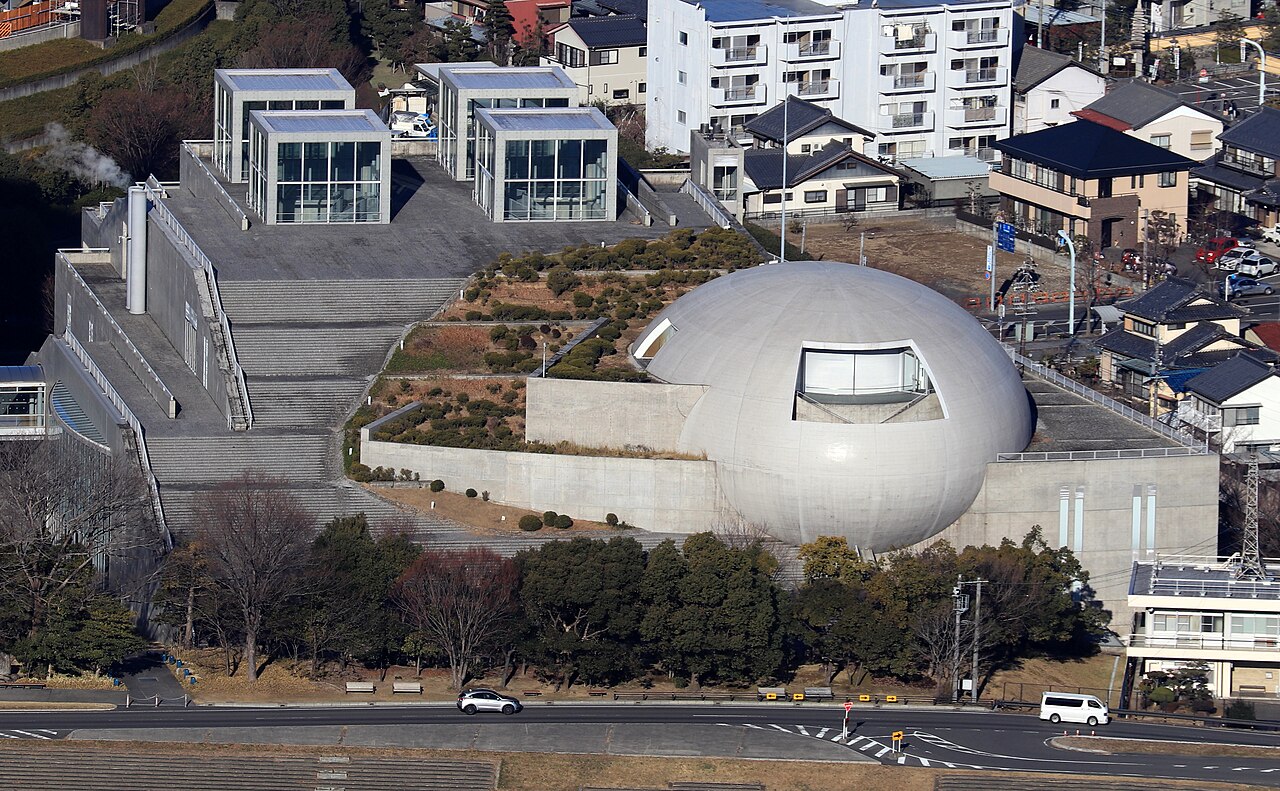
The entrance recalls a rōmon (楼門), a monumental gate with an upper storey. Beyond it opens an atrium that serves as a citizens' gallery (市民ギャラリー): a square space, open over four levels, where light falls from four skylights cut into the roof. A spiral staircase and galleries lead up to the rooftop garden. It takes in the Nagara River and Mount Kinka, and also serves as a place to enjoy the view after a conference.
On the top floor, the international conference room (国際会議室, 300 m2, 80 seats in classroom layout) sits in an egg-shaped volume that gives the building its distinctive silhouette. It looks out on Mount Kinka, Gifu Castle and the Nagara River; four booths allow simultaneous interpretation in four languages.
The main hall (メインホール, さらさ~ら) uses a movable-floor system that changes the stage and part of the seating. It can hold up to 1,897 people, and the upper-level seats can be closed off depending on attendance. Its stage curtain, titled "Nagare" (流れ, "the current"), is credited to Tadao Ando.
Use today
It is a municipal convention and performance facility. The main hall is used for conferences, concerts, plays and fashion shows; the large conference room holds up to 450 people in theatre layout and can be divided, and the building also has smaller rooms. The city has entrusted its management to a consortium, Trinity Gifu (トリニティぎふ), led by the Gifu City Public Hall Management Foundation.
Visiting
This is not a museum: most people come in by attending a concert or an event. The common areas can be visited when they are not in use, on prior request with the venue's visit form; the interior of the rental spaces (main hall, rooms) and the backstage areas cannot be visited. Depending on the date, the accessible areas may be limited, or no visit may be possible. To visit or take photographs, you must first report to the office on the ground floor.
The venue is open in principle from 8:30 to 17:30, hours which may change depending on use, and closed from 29 December to 3 January. There is no restaurant in the building; eat at the neighbouring hotel or nearby. From JR Gifu Station, a Gifu Bus service takes about 20 minutes to the "長良川国際会議場前" stop, one minute on foot.
Photos
35.44° N, 136.77° E
Greenhouses nearby
Architecture nearby
Sources (17)
- g-ncc.jp/about/
- g-ncc.jp/en/about_en/
- g-ncc.jp/facilities/
- g-ncc.jp/facilities/main-hall/
- g-ncc.jp/facilities/international/
- g-ncc.jp/facilities/large/
- g-ncc.jp/faq/
- g-ncc.jp/news/%e9%a4%a8%e5%86%85%e3%81%ae%e8%a6%8b%e5%ad%a6%e3%81%ab%e3%81%a4%e3%81%84%e3%
- g-ncc.jp/administrator/
- g-ncc.jp/organizer/photo/
- g-ncc.jp/access/transport-2/
- g-ncc.jp/%e9%95%b7%e8%89%af%e5%b7%9d%e5%9b%bd%e9%9a%9b%e4%bc%9a%e8%ad%b0%e5%a0%b4-%e5%86%8
- city.gifu.lg.jp/_res/projects/default_project/_page_/001/011/044/sekokisoku-kaigijyo_s.pdf
- ja.wikipedia.org/wiki/長良川国際会議場
- en.wikipedia.org/wiki/Nagaragawa_Convention_Center
- openstreetmap.org/way/583992861
- wikidata.org/wiki/Q1086088