Ornamental Greenhouse, Sano Botanical Park (佐野植物公園 観賞温室)
Ōita, Ōita Prefecture
Entry updated on October 5, 2026
- Architect
- Unknown
- Style
- Brick-built ornamental greenhouse
- Status
- Open to the public
Sano Botanical Park was opened by Ōita City in April 1991 on 8.6 hectares, with a brick-built ornamental greenhouse at its heart in which tropical and subtropical plants can be seen in every season. The greenhouse is heated by surplus heat from refuse incineration at the adjoining Sano Cleaning Center, which also supplies a public foot bath. Its plants include shrubby begonias, bougainvillea, hibiscus, plumeria, Calliandra, Pachystachys, Phalaenopsis orchids and bananas.
Affiliate links — booking through Verrière helps fund our research, at no extra cost to you.
History
1 min
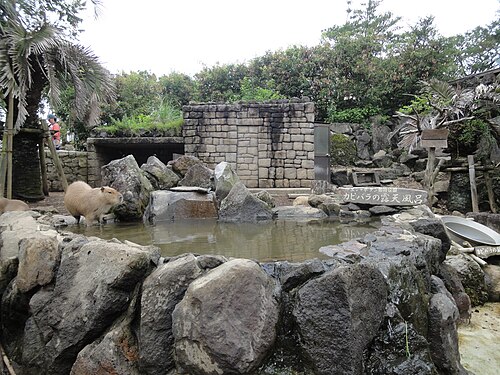
Sano Botanical Park opened in April 1991 in the Sano district of Ōita City, whose parks and green spaces department manages it. It covers 8.6 hectares. Its location is explained by an unusual neighbour: the Sano Cleaning Center, a refuse incineration plant whose surplus heat was harnessed to warm the ornamental greenhouse and a foot bath known as the "warm pond" (pokapoka-ike).
The park later took in pieces of local heritage. In 1996 car no. 506, a 500-series tram built in 1958 for Ōita Kōtsū's Betsudai line, which closed in 1972, was moved here from Wakakusa Park in central Ōita when that park was redeveloped; visitors can step inside, and the car was repainted in March 2014. The park also preserves the Ikemi House, the residence of a village headman (shōya) of the Usuki domain in the Edo period.
The sources consulted neither name the designer of the greenhouse nor record any renovation. The city runs the park as a space open every day and fully accessible to wheelchair users, with the greenhouse and foot bath observing one weekly closing day.
Architecture and engineering
1 min
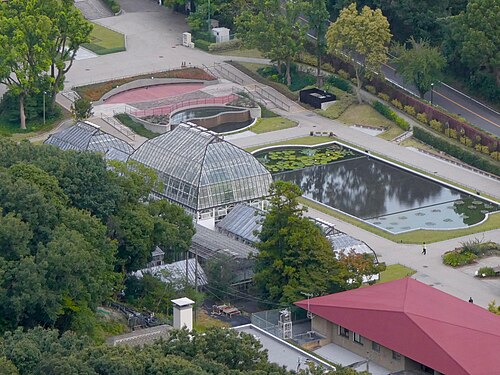
Japanese Wikipedia describes the ornamental greenhouse as a brick-built structure. On the illustrated map in the municipal brochure it stands at one end of the park, next to the large multipurpose lawn, and is drawn as a building on a circular plan. Its dimensions, height and roofing are not published.
What sets it apart is its heating. Ōita City states that the greenhouse is warmed by surplus heat from refuse incineration at the adjoining Sano Cleaning Center, and the same source supplies the park's foot bath. The two facilities are closely linked: during periodic inspections of the centre's equipment, use of the foot bath is suspended, as it was scheduled to be from 9 to 16 October 2026, with the city reserving the right to extend the stoppage depending on the results of the checks.
The park is designed to be barrier-free, and the city points out that wheelchair users can enter the greenhouse; wheelchairs can be borrowed at the management building.
Plant collections
1 min
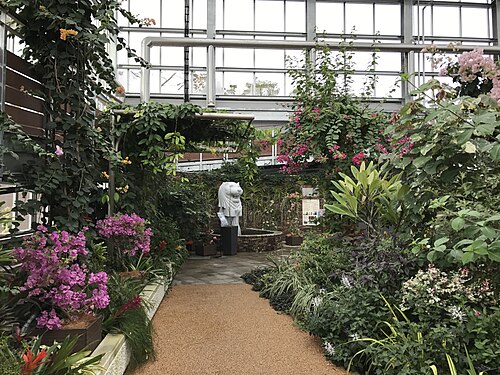
The greenhouse shows tropical and subtropical plants in every season, with the display changing through the year. Japanese Wikipedia lists shrubby begonias, Pachystachys, bougainvillea, hibiscus, plumeria, Calliandra and unazuki-himefuyō. Ōita City's page names Phalaenopsis orchids, Calliandra, bananas and Pachystachys.
The same page also flags what is in flower, with a short note on each. At the end of September 2026 it highlighted daturas with large hanging blooms, the "white candle", whose white flowers stand out against green leaves, a Dichorisandra related to the dayflowers, fūrin-bussōge, whose flower is shaped like a wind chime, plumeria, a Dianthera covered in pink tubular flowers, Strelitzia that resemble a large bird, bijinshō with its red-orange bracts and the star fruit tree with its small flowers.
These regularly updated lists point to a collection built mainly around flowering plants from warm climates, shown in rotation as each comes into bloom.
Visiting
1 min
The park is about five minutes by car from the Miyakawachi interchange on the Higashi-Kyūshū Expressway, and around fifteen minutes by taxi from Tsurusaki and Sakanoichi stations on the Nippō line. Pets are not allowed in the greenhouse.
A visit extends easily into the rest of the park, with lawns, the warm foot bath, a play forest, a 60-metre giant slide, a grass-sledding slope, a lookout with a telescope and walking paths. Tram no. 506, which visitors can board, and the Ikemi House, an Edo-period rural residence, add a touch of local heritage, and the city also pictures the park under cherry blossom.
33.19° N, 131.73° E
Greenhouses nearby
More greenhouses — Japan
Do you have a good photo of this greenhouse? Suggest it for this page →