Napoleon III Greenhouse, Jardin des plantes d'Amiens
Amiens, Hauts-de-France

Entry updated on October 5, 2026
- Year
- 1895
- Architect
- Carpentier
- Style
- Napoleon III-style glasshouse with a central palm house, rebuilt to the original design in 2007
- Dimensions
- 371 m² according to the garden (135 m² according to the city)
- Status
- Greenhouse open to the public twice a year (including the 1 May plant fair); garden open to the public
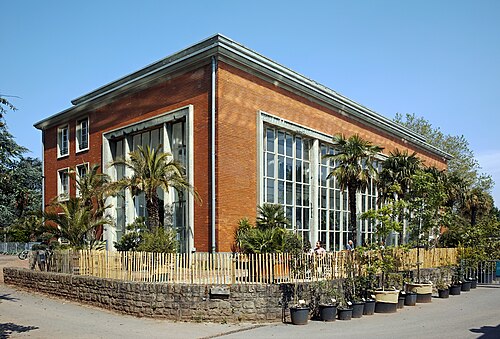
Granted to the city by Louis XV in 1751, the Jardin des plantes of Amiens is one of the oldest botanical gardens in France. Its Napoleon III-style greenhouse, raised at the end of the 19th century to designs by the architect Carpentier, joins two galleries around a central palm house. Founded on piles because of the marshy ground and roofed with overlapping panes like scales, it was rebuilt almost identically in 2007. Long used to grow plants for the city, it opens to the public only twice a year.
Affiliate links — booking through Verrière helps fund our research, at no extra cost to you.
History
1 min
The Jardin des plantes of Amiens stands on former marshland recorded as early as the 13th century and known from 1604 as the "Jardin du Roy". In May 1751 Louis XV granted it on condition that it become a botanical garden, and in 1754 Dom Robbe, prior of the Feuillants, gave the first public botany lectures there. Shelters for plants followed in stages: an orangery at the very start of the 19th century (1801 according to the city and the regional Villes et Pays d'art et d'histoire network, 1802 in other sources), then in 1836 a small lean-to greenhouse against the boulevard, reserved for the botanists.
From the second half of the 19th century the garden refocused on growing plants to decorate the city, and in 1895 the botany lectures moved to the medical faculty. It was at the end of the century that the so-called "Napoleon III" greenhouse was built, designed by the architect Carpentier and given a central pavilion. The date most often quoted is 1895; the city's presentation page gives "1795", which is hard to square with the style.
The 20th century added more growing space: Dutch-type greenhouses in 1970, and aluminium houses replacing the old wooden ones in 1998. The Napoleon III greenhouse was rebuilt almost identically in 2007. Meanwhile the garden had revived its teaching role in 2001, begun a botanical restoration from 2005 and received the "Jardin remarquable" label in 2013. The municipal flower production left the site in 2020 for land behind the Saint-Pierre cemetery.
Architecture and engineering
1 min
The greenhouse consists of two galleries converging on a central palm house crowned by a dome, which the garden's own presentation gives as 3 metres high. The marshy ground forced the builders to set the structure on piles. The glass roof is made of panes laid side by side and overlapping like fish scales.
Two catwalks were built along the roofs of the galleries, used to unroll straw mats to protect the plants. The 2007 reconstruction followed the original almost exactly. Sources disagree on the floor area: 371 m² according to the garden, 135 m² according to the city. It is the only greenhouse in the garden licensed to receive the public.
It stands among shelters of other periods: the orangery of the early 19th century, a Dutch-type greenhouse built in 1970 and aluminium production houses put up in 1998.
Plant collections
1 min
Since it was built, the greenhouse has served mainly for horticultural production. The city describes it as given over to decorative foliage plants and flowering pot plants used to dress public buildings. The central palm house holds the largest specimens, notably cacti and palms. The garden has announced its wish to turn it into a botanical greenhouse open more regularly.
Around it, the garden of about 9,800 m² arranges its collections under the theme "plants, their uses and people"; the number of species varies between sources, from about a thousand to 1,800 taxa. Highlights include woad (Isatis tinctoria), the dye plant tied to the medieval textile trade of Amiens, crops that trace the farming history of Picardy, an alpine rockery and notable trees. In summer, standard bougainvilleas are set out along the 1970 Dutch greenhouse.
Visiting
1 min
The Jardin des plantes lies at 60 boulevard du Jardin-des-Plantes, in the Saint-Maurice district between the citadel and the city centre. The garden is public, but the Napoleon III greenhouse opens only twice a year. It has been opened during the 1 May plant fair, a free event that held its tenth edition in 2022, so it is worth planning a visit around that date or checking with the city beforehand. The walk can continue through the ethnobotanical collections and the rockery, then on to the nearby citadel.
49.90° N, 2.30° E
Greenhouses nearby
More greenhouses — France
Do you have a good photo of this greenhouse? Suggest it for this page →
Sources (6)
- amiens.fr/Vivre-a-Amiens/Environnement/Jardin-des-plantes/Presentation
- tmatic.travel/en/view/story/la-serre-de-style-napoleon-iii_eEzutWo/fr
- vpah-hauts-de-france.fr/ressources/le-jardin-des-plantes-amiens/
- amiens.fr/Vivre-a-Amiens/Culture-Patrimoine/Les-Archives-municipales-et-communautaires/Tre
- fr.wikipedia.org/wiki/Jardin_des_plantes_d%27Amiens
- action-agricole-picarde.com/le-jardin-des-plantes-damiens-en-effervescence-ce-1er-mai