Educational Greenhouses of the Tourcoing Botanical Garden
Tourcoing, Hauts-de-France

Entry updated on October 5, 2026
- Year
- 2009
- Style
- Contemporary greenhouses set against brick walls, HQE-certified
- Dimensions
- 1,200 m² (8 houses)
- Status
- Guided visits only, on set dates and by reservation
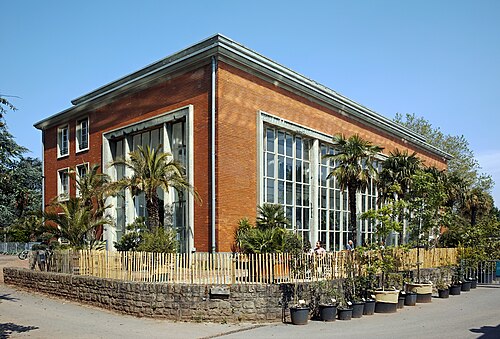
Tourcoing's botanical garden occupies the former estate of wool spinner Émile Leplat, who left it to the town in a will drawn up in 1906; it became public property in 1917. When the garden was renovated in 2009 it gained a 1,200 m² complex of educational greenhouses certified under France's HQE environmental standard: four cool houses and four warm houses built against red-brick walls. More than 2,000 plant varieties grow there, from pelargoniums and cacti to ferns, orchids and tropical species. The greenhouses can only be seen on guided tours booked in advance.
Affiliate links — booking through Verrière helps fund our research, at no extra cost to you.
History
1 min
Tourcoing's botanical garden began as a bequest. Its founder, Émile Leplat, was a local wool spinner. According to the town, a journey to Ireland introduced him to that country's public parks; his wife was herself of Irish origin and, as tourist literature tells it, a keen botanist.
In a will drawn up in 1906, Leplat offered his property at 32 rue du Moulin-Fagot to the municipality on condition that it become a public garden after his death. He died in 1917; the town council accepted the bequest that same year, only a few months later, and the purchase of the land was finally settled in 1919. The former private garden thus became the municipal botanical garden, and the donor's house, still standing within the grounds, now holds a small horticultural museum.
The site underwent a major renovation in 2009, during which the present greenhouses were built into the garden. Their name, educational greenhouses, sums up their purpose: they show plant diversity to accompanied groups rather than to casual strollers, which is why access is limited to guided tours. The sources consulted do not name their designer.
Architecture and engineering
1 min
The educational greenhouses form a 1,200 m² complex certified under HQE (Haute Qualité Environnementale), a French building-certification scheme that covers energy use and materials among other criteria. The complex is split in two according to temperature: a heated part and a cool part, each made up of four houses, giving eight compartments in all.
The houses are built against red-brick walls that close one of their sides. The climates recreated inside range across several broad habitats: humid tropical forest, arid land and a Mediterranean setting. One of the warm houses also serves as a propagation area, so the complex combines display rooms with a space where plants are raised.
Plant collections
1 min
The greenhouses hold more than 2,000 plant varieties, grown in conditions close to those of their natural habitats. The cool houses bring together pelargoniums, cacti, fuchsias and carnivorous plants, while the warm houses are given over to succulents, ferns and tropical species.
Tourist descriptions identify three main displays: a tropical forest section where the orchids are concentrated, an arid house where cacti share space with carnivorous plants, and a Mediterranean area devoted to pelargoniums and citrus.
Outdoors, the garden continues the tour with a formal French garden with a central fountain and a pergola of white and blue wisteria, an English landscape garden, a North America garden made up of two botanical islands representing the continent's north-east and north-west, and teaching beds on scented plants, perennials and ornamental grasses.
Visiting
1 min
The botanical garden is entered at 32 rue du Moulin-Fagot in central Tourcoing and is open all year round. The greenhouses, by contrast, can only be seen with a guide, on dates set by the town and by reservation, so it is essential to check the visit calendar before making the trip.
A tour of the greenhouses combines well with the small horticultural museum in the former Leplat house, followed by a walk through the French and English gardens, the North American garden and the themed beds that surround the buildings.
50.72° N, 3.17° E
Greenhouses nearby
More greenhouses — France
Do you have a good photo of this greenhouse? Suggest it for this page →