Mazel Greenhouses, La Bambouseraie en Cévennes (Prafrance)
Générargues (near Anduze), Occitanie
Entry updated on October 5, 2026
- Year
- 1860
- Architect
- Unknown
- Style
- Victorian or Napoleon III-style glasshouses
- Status
- Open to the public with the park (visiting season)
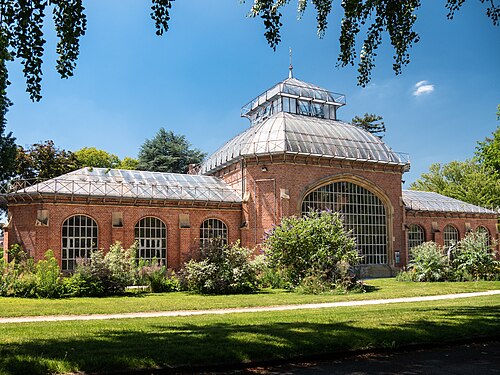
On the Prafrance estate near Anduze, the botanist Eugène Mazel had glasshouses built in 1860 for the most delicate plants in his acclimatisation collections, four years after his first bamboo plantings. Described by the magazine Jardins de France as Victorian or Napoleon III in style, they now hold tropical plants and temporary exhibitions; a 2016 visitor account mentions a hot house kept humid by a waterfall. They are reached by steps which, the park explains, the estate's 2008 listing as a historic monument does not allow it to alter.
Affiliate links — booking through Verrière helps fund our research, at no extra cost to you.
History
1 min
The greenhouses were born with the Prafrance estate at the foot of the Cévennes. Eugène Mazel (1828-1890), an orphan raised by a maternal uncle, a wealthy Marseille shipowner whose fortune he inherited, began laying out the property in 1855; the historic-monument record dates the start of his bamboo collection to that year, while the park itself gives 1856, the year of the first plantings. He acclimatised plants from Japan, North America and the Himalaya, bamboos from India and China, and cedars of Lebanon and the Atlas. In 1860 he had greenhouses built for his most tender species, and in 1865 he created and enlarged the estate's irrigation network.
Mazel was declared bankrupt in 1889 according to the park and the magazine Jardins de France, or in 1890 according to Wikipedia, and his assets were seized by the Crédit Foncier de France. Gaston Nègre bought the estate at a candle auction in 1902 and secured full ownership in 1906. According to Jardins de France, the frost of 1956 destroyed most of the collections, and the Gardon flood of 1958 caused severe damage. After Maurice Nègre, who died in 1960, and his wife Janine, their daughter Muriel took charge in 1977; Valentine Crouzet, Gaston Nègre's great-granddaughter, has led the estate since 2020.
The park received the Jardin remarquable label in 2005, and the historic estate was listed as a historic monument on 24 July 2008. None of the sources consulted dates any restoration of the greenhouses.
Architecture and engineering
1 min
The available sources say little about the building itself. The greenhouses date from 1860, and the magazine Jardins de France assigns them to the Victorian or Napoleon III idiom. A visitor account published in 2016 states that Mazel had them built in cast iron and describes a central hot house with a tropical atmosphere, its humidity supplied by a waterfall at the far end, alongside cooler houses.
Steps lead up to the greenhouses, and the park explains that the historic-monument listing leaves it no freedom to alter them to improve access. The 2008 protection covers the whole historic estate: Mazel's garden, the production areas and the entire water system, with its mill, canals and pumps, that carries water through the park. The English Wikipedia puts the length of the canals at some 5 km.
Neither the dimensions of the greenhouses, nor the name of a builder or architect, nor the type of glazing appears in the sources consulted.
Plant collections
1 min
Built to shelter the most tender species Mazel introduced, the greenhouses now hold tropical plants and temporary exhibitions, according to the park's visitor booklet; Jardins de France mentions the collections of rare plants they contain. A 2016 visitor account described a hot house with a tropical climate, cooler houses given over to cacti and carnivorous plants, and another devoted to the dye plants used before synthetic colourants; the arrangement may have changed since.
Just behind the greenhouses, the garden of Eugène's ponds shows plants that grow only in water, such as water lilies; it was restored in 2014 together with its pergola. Around them the park gathers more than 1,300 plant varieties, including a bamboo collection that Jardins de France puts at more than 200 species and the English Wikipedia at some 300 species and cultivars.
Visiting
1 min
The greenhouses stand on the visitor route of La Bambouseraie at Générargues, 2 km north of Anduze and 11 km south-west of Alès. The visitor booklet places them after the sequoia avenue, the Laotian village, the avenue of Chinese palms, the Dragon Valley and the bamboo forest, just before the garden of Eugène's ponds and the bamboo maze that ends the walk.
The 14-hectare park opens seasonally, and a visit takes about two hours; the greenhouses can be reached only by steps. In autumn the great ginkgo of the Dragon Valley turns a golden yellow. The park's blog highlights nearby partner sites, among them the Cévennes steam railway and the Trabuc cave.
44.07° N, 3.98° E
Greenhouses nearby
More greenhouses — France
Do you have a good photo of this greenhouse? Suggest it for this page →
Sources (8)
- bambouseraie.fr/notre-histoire
- bambouseraie.fr/accessibilite-pour-tous
- bambouseraie.fr/document/share/16/00196c23-8e1d-4810-9b09-988652507ef3
- pop.culture.gouv.fr/notice/merimee/PA30000074
- jardinsdefrance.org/la-bambouseraie-en-cevennes-cent-soixante-dix-ans-dacclimatation-de-pa
- jardinsdefrance.org/la-bambouseraie-plus-de-150-ans-dun-joyaux-exotique/
- fr.wikipedia.org/wiki/Bambouseraie_en_C%C3%A9vennes
- springhillstories.com/2016/07/04/visit-la-bambouseraie-en-cevennes/