Sera de expoziție (Exhibition Greenhouse), Dimitrie Brândză Botanical Garden
Bucharest
Entry updated on October 5, 2026
- Year
- 1973-1976
- Architect
- Unknown
- Style
- Glass exhibition greenhouse complex with an 18 m central pavilion
- Dimensions
- 2,500 m² in eight compartments
- Status
- Open to the public
Built between 1973 and 1976 in the University of Bucharest's botanical garden, this exhibition greenhouse complex took over from the Sera Veche of 1891, which closed to the public in 1976. Its 2,500 m² are divided into eight compartments arranged on biogeographical, taxonomic, aesthetic and practical lines: palms beneath an 18-metre central pavilion, bromeliads, cacti, succulents, tropical aquatic plants, citrus, tropical ferns and orchids. The garden lists some 680 taxa from tropical, subtropical and equatorial regions here.
Affiliate links — booking through Verrière helps fund our research, at no extra cost to you.
History
1 min
Bucharest's botanical garden was founded in 1860 on the initiative of Carol Davila, near the Faculty of Medicine, under a decree signed on 5 November that year by Prince Alexandru Ioan Cuza; the botanist Ulrich Hoffmann was its first director. In 1884 it moved to the Cotroceni district, laid out by the botanist Dimitrie Brândză and the Belgian landscape architect Louis Fuchs, and it opened to the public in 1891, once its first glasshouse, the Sera Veche, modelled on those of Liège, was complete.
For almost a century this 760 m² glasshouse was the garden's only display of warm-climate plants. The bombing of 4 April 1944 broke every one of its panes and wrecked the irrigation supply. Between 1973 and 1976 the University of Bucharest, which runs the garden, built a new and far larger set of exhibition greenhouses. Their opening in 1976 coincided with the closure of the Sera Veche to the public; the old house became a growing and teaching greenhouse for students, and one of its pavilions was rehabilitated in 2011.
Since then the Sera de expoziție has been the garden's main covered showcase. According to English Wikipedia the garden now covers 18.2 hectares and holds more than 10,000 species.
Architecture and engineering
1 min
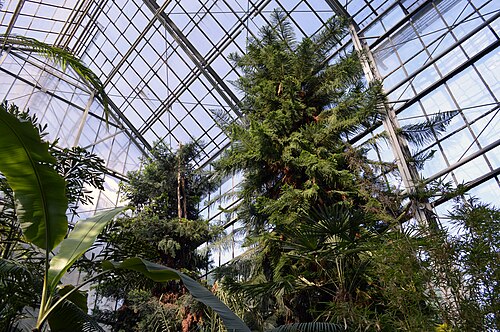
The complex covers 2,500 m² and consists of eight separate glazed compartments, each set up for a particular kind of vegetation. The tallest is the central pavilion, rising to 18 metres, which shelters the large plants: palms of the family Arecaceae, some of them more than ten metres tall, as well as bananas and figs.
The other compartments are grouped around it, and the garden explains that the plants are distributed on biogeographical, taxonomic, aesthetic and practical criteria. Organising the space by habitat allows sharply different conditions to sit under one roof, from the humid air of the fern and tropical water-plant rooms to the dry atmosphere needed by cacti and succulents.
In size the complex is more than three times as large as the neighbouring Sera Veche (760 m²), which it replaced as the exhibition house. None of the sources consulted names its architect or builder.
Plant collections
1 min
The garden's website counts about 680 taxa from tropical, subtropical and equatorial zones; Romanian Wikipedia instead gives some 3,000 species from Africa, India, Indonesia and South America, a discrepancy the sources do not explain.
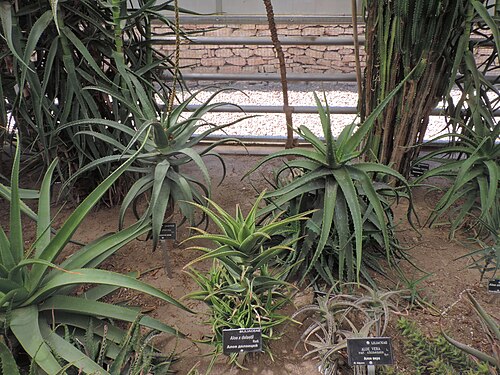
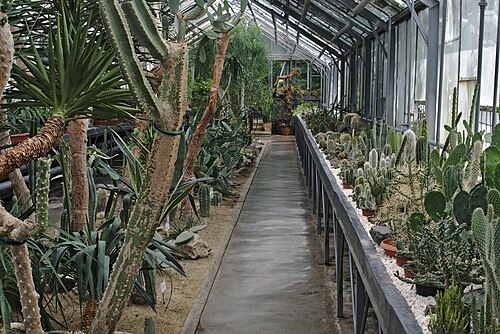
The central palm house holds palms, bananas and figs. It is followed by epiphytic bromeliads from Central and South America (Aechmea, Billbergia, Neoregelia), cacti from the Americas and Mexico, succulents (Aloe, Haworthia, Lithops, Sempervivum) and tropical aquatic plants, including Nymphaea water lilies and Pandanus. The subtropical room shows a citrus collection of lemons, oranges, grapefruits, tangerines and kumquats. Tropical ferns such as Asplenium and Nephrolepis grow alongside cycads, Cycas revoluta among them, and the final compartment is given over to orchids, including Cattleya, Phalaenopsis and vanilla.
Visiting
1 min
The greenhouses stand inside the Dimitrie Brândză Botanical Garden in the Cotroceni district, which is open all year. Walking through the eight compartments takes about an hour; the visit can be extended to the restored pavilion of the Sera Veche, about a hundred metres away, and to the garden's twelve outdoor sectors, among them the rose garden, the Italian garden, the historical garden, the medicinal garden and the conifer hill. In winter the greenhouses carry most of the botanical interest of the site, while spring and summer suit a visit that combines indoors and out.
44.44° N, 26.06° E
Greenhouses nearby
Do you have a good photo of this greenhouse? Suggest it for this page →