Greenhouses of the “Vasile Fati” Botanical Garden, Jibou (Palmar and Acvariu)
Jibou, Sălaj County
Entry updated on October 5, 2026
- Year
- 1968–1982
- Architect
- Unknown
- Style
- Two glass domes (Palmar and Acvariu) and collection greenhouses
- Dimensions
- Greenhouse complex of 4,000 m² (first greenhouse: 110 m²)
- Status
- Open to the public all year
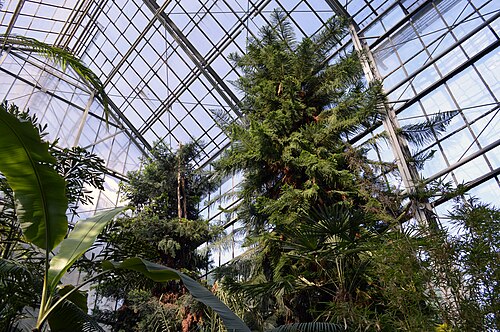
Founded in 1968 by the biology teacher Vasile Fati in the old park of the Wesselényi castle, Jibou Botanical Garden built a first 110 m² greenhouse in 1968-1970 and then, between 1978 and 1982 according to its own history, two glass domes that have become the town's landmark. The large one, the Palmar, holds palms and banana plants; the small one, the Acvariu, keeps the giant water lily Victoria amazonica, cacao and sugar cane around a warm-water pool. The greenhouse complex covers 4,000 m² and leads on to an exhibition of 23 aquariums.
Affiliate links — booking through Verrière helps fund our research, at no extra cost to you.
History
1 min
The garden occupies the former Wesselényi estate, whose Baroque castle was built between 1779 and 1796 according to the Zalău tourist office; the town history quoted by Adevărul has work beginning in 1778. The same office presents the botanical garden as the successor of the old English-style garden and the winter greenhouse laid out beside the castle; Vasile Fati dated the pleasure park to 1781.
From 1959 Vasile Fati (1932-2007), a biology teacher at the secondary school then housed in the castle, showed with his pupils and colleagues that the run-down park was suited to a botanical garden; a study was carried out with botanists such as Al. Borza and Emil Topa. The Ministry of Education approved the project in 1968 and Fati became director that October; 7 hectares were allocated that year and 6 more in 1975. First attached to the school, the garden became independent in 1970, was known as the Young Naturalists' Station from 1974 to 1990, and now belongs to the Jibou Biological Research Centre.
A first 110 m² greenhouse went up in 1968-1970, its foundations poured with the pupils' help. According to the garden's own history, the two domes, the Palmar and the Acvariu, date from 1978-1982; Adevărul places them at the end of the 1960s, and PressOne says work on the collection greenhouses began in 1970 and that they have been modernised several times. After the 1989 revolution came a modern aquarium, an Amazonian gallery and a new Japanese garden. Fati led the garden for almost forty years, and it now bears his name.
Architecture and engineering
1 min
From the entrance avenue two glass domes mark the botanical greenhouses; Adevărul describes them as visible from far away above the town. The large dome is the Palmar and the small one the Acvariu, a name that here refers not to fish tanks but to a tropical house arranged around a warm-water pool. The garden's history calls these 1978-1982 structures 'architectural jewels' and a 'spatial construction' of exceptional design.
The complex grew in stages. After the first 110 m² greenhouse, six more were built for the tropical, subtropical and Mediterranean collections, together with two laboratories integrated into the complex and a boiler house; workers from Jibou's railway depot lent a hand. The 1978-1982 campaign also added six production greenhouses for cut and potted flowers. In 1972 Fati recalled that pupils had learned masonry and metalwork by helping with the construction.
The website lataifas.ro puts the greenhouse complex at 4,000 m² and describes it as four compartments. None of the sources consulted names an architect or gives the height or structural system of the domes.
Plant collections
1 min
The greenhouses display tropical, subtropical and Mediterranean plants grouped by region of origin. The Palmar holds a large collection of palms, banana plants among them. The Acvariu houses species from humid equatorial climates: the giant water lily Victoria amazonica in its central warm-water pool, cacao, papaya and sugar cane. A central zone gathers plants of the genera Cycas, Ceratozamia and Zamia, presented as survivors of the flora of the Mesozoic era, near a waterfall that keeps goldfish.
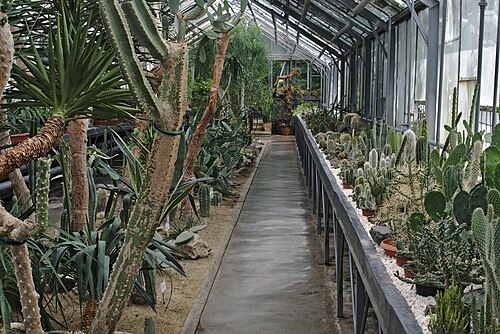
Other houses are given over to orchids, Australian plants and ferns, and the collection of cacti and succulents exceeds 750 species from the deserts of Africa and the Americas. In the early years the greenhouses already held agaves, eucalyptus, bay laurels, olives, orange and lemon trees, carnivorous plants and Mexican cacti. Beyond the greenhouses, an exhibition of 23 freshwater and saltwater aquariums presents more than 40 species of fish.
Visiting
1 min
The two domes can be seen from the avenue leading in from the entrance, and the greenhouse visit continues into the aquarium exhibition and the Amazonian gallery. The greenhouses stay open in winter, so the visit works in any season.
The garden, 24 or 25 hectares depending on the source, has more than twenty sectors: a Japanese garden with ponds, stones, bamboo and water lilies, a rose garden, a dendrological sector, enclosures for deer and wild boar, and aviaries. The tourist office of Zalău, 26 km away, reckons that a full visit can take a whole day. The garden hosts the international visual arts symposium 'Arta în Grădină'. The neighbouring Wesselényi castle has been left derelict, according to Adevărul; the Roman site of Porolissum lies about 20 km away.
47.26° N, 23.25° E
Greenhouses nearby
More greenhouses — Romania
Do you have a good photo of this greenhouse? Suggest it for this page →
Sources (8)
- ccbjb.ro/
- modernism.ro/2014/09/10/gradina-botanica-jibou/
- pressone.ro/jubileu-la-jibou
- adevarul.ro/stiri-locale/zalau/cupolele-uriase-dintr-un-oras-transilvan-ascund-o-2560157.h
- turismzalau.ro/experiente/gradina-botanica-vasile-fati/
- lataifas.ro/destinatii-turistice-unice/51070/gradina-botanica-vasile-fati-paradisul-verde-
- ro.wikipedia.org/wiki/Grădina_Botanică_„Vasile_Fati”_din_Jibou
- primariajibou.ro/site/gradina-botanica/