Victorian glasshouses and grotto, Portmore walled garden
Eddleston, near Peebles (Scottish Borders), Scotland
No freely licensed photo of this greenhouse yet. Do you have one? Suggest it for this page →
Sources checked October 2026
- Year
- 1898 (glasshouse range); grotto after 1911
- Architect
- MacKenzie and Moncur (glasshouse range)
- Style
- Late Victorian glasshouse range along the north wall of a walled garden, with a glazed-roof grotto
- Dimensions
- Walled garden of about 1.5 acres (0.6 ha)
- Status
- Private garden, open on a few days in summer
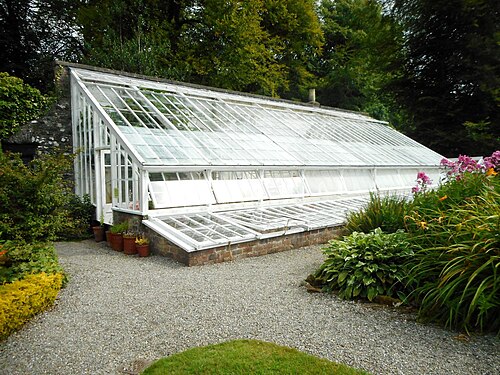
North of Portmore House, near Eddleston, the walled garden is lined along its north wall by a MacKenzie and Moncur glasshouse range, erected in 1898 according to Historic Environment Scotland. It shelters fruit trees, roses, pelargoniums and fuchsias, and leads into an Italianate grotto, dating from after 1911, with tufa or clinker walls and a glazed lean-to roof. Restored by its present owners over some thirty years, the garden opens to the public only on a few days in summer.
Affiliate links — booking through Verrière helps fund our research, at no extra cost to you.
History
The garden at Portmore goes back to Colin Mackenzie, an Edinburgh lawyer and friend of Sir Walter Scott, who began laying out the parkland, woods and a first walled garden in 1807; his notebooks and letters from 1807 to 1809 document the work. In May 1809 he wrote that he had already spent £1,900 on his garden, £820 of it on hothouses. Portmore House, the work of David Bryce, was begun in 1850; Cruft et al. (2006) date the present walled garden to about 1850, perhaps as a replacement for Mackenzie's. The first Ordnance Survey maps, in 1856, already show a range of glasshouses along the north wall.
Historic Environment Scotland's inventory describes the present range as a MacKenzie and Moncur range erected in 1898, and dates the grotto opening off it to after 1911, calling it Edwardian. The sources therefore differ on the label to give the glasshouses: the garden's own website, Scotland's Gardens Scheme and Historic Houses call them Victorian, while Discover Scottish Gardens calls them Edwardian.
The Mackenzie family left the estate in the 1890s, and it was sold in 1979. In the 1980s the garden suffered marked neglect, and the house had a second fire in 1986. Mr and Mrs David Reid, the present owners, have been recreating the Victorian garden, glasshouses included, for some thirty years; the inventory describes it as recently restored to a high standard.
Architecture and engineering
The glasshouse range stands at the foot of the north wall of a rectangular walled garden lying north of the house. Gravel paths enter from the south, and a central grass path, framed by two herbaceous borders, leads straight to the glasshouses, which form the focal point of the whole. The garden, of about 1.5 acres, is divided into eight square compartments separated by hedges.
The Scottish inventory speaks of a restored late 19th-century range by MacKenzie and Moncur, and notes that it offers excellent conditions for fruit trees and flowering plants.
The grotto is entered from the glasshouses. Its walls are decorated with tufa or clinker and its roof is a glazed lean-to. Published descriptions evoke a cool place where water runs down the rock and ferns predominate; the garden's website and Scotland's Gardens Scheme both call it Italianate.
Plant collections
The glasshouses shelter both fruit trees and flowering plants. The inventory cites roses, geraniums and fuchsias; Scotland's Gardens Scheme adds pelargoniums and a wide variety of tender plants. A blog post published in 2024 mentions pelargoniums in unusual colours and a room given over to fuchsias, with 110 recognised varieties.
The grotto is planted with ferns and exotic plants, according to Discover Scottish Gardens. Around the glasshouses the walled garden lays out double herbaceous borders, a potager, a rose garden, a pleached lime walk and ornamental fruit cages; the woodland walks are lined with rhododendrons, azaleas and shrub roses.
Visiting
The glasshouses come into view at the end of the central path of the walled garden, north of Portmore House, a private home that is not open to visitors. The garden opens on only a few days: Scotland's Gardens Scheme listed 18 July 2026, now past, and directories give Wednesdays in July and August as well as group visits by appointment; dates are best confirmed before travelling.
The walled garden is at its peak from mid-July to August. It continues into a water garden, a woodland walk and a formal garden below the house, and one visitor's blog post speaks of several hours spent on site. Access is from the A703, one mile north of Eddleston.
55.73° N, 3.19° W
Greenhouses nearby
More greenhouses — United Kingdom
Do you have a good photo of this greenhouse? Suggest it for this page →
Sources (8)
- portmoregardens.co.uk/
- portal.historicenvironment.scot/designation/GDL00318
- parksandgardens.org/places/portmore
- scotlandsgardens.org/portmore/
- discoverscottishgardens.org/garden/portmore-gardens/
- historichouses.org/house/portmore-house/
- travelinggardener.com/portmore-gardens-a-scottish-delight/
- de.wikipedia.org/wiki/Portmore_House
Affiliate links — booking through Verrière helps fund our research, at no extra cost to you.