Rutherford Conservatory (Rhododendron Species Botanical Garden)
Federal Way, Washington

Sources checked October 2026
- Year
- 2010
- Style
- Contemporary glazed conservatory, frost-free in winter and cooled in summer
- Dimensions
- 5,000 sq ft (≈465 m²)
- Status
- Open to the public (closed on Mondays)
Opened in September 2010 in the Rhododendron Species Botanical Garden at Federal Way, between Seattle and Tacoma, the Rutherford Conservatory is a 5,000-square-foot conservatory designed to grow and display tropical rhododendrons, known as vireyas, together with companion plants: orchids, tree ferns and members of the African violet family. It is named for Francis C. Rutherford, a long-time member and vireya enthusiast. Kept frost-free in winter and cooled in summer, it recreates plant communities of tropical mountains around waterfalls, a stream and large boulders. The garden shows flowers there every day of the year.
Affiliate links — booking through Verrière helps fund our research, at no extra cost to you.
History
The garden that houses the conservatory is the work of the Rhododendron Species Foundation, founded in 1964 by members of the American Rhododendron Society. Its collection settled in 1974 at Federal Way, on land that the Weyerhaeuser Company's headquarters provided at no cost, and the garden opened to the public in 1980 on a limited basis. The idea of a house for vireyas is an old one: in spring 2000 the curator announced a "Vireya House", a large enclosed building with temperature control near the entrance and the gift shop, whose interior was to draw on the Peat House at the Royal Botanic Garden Edinburgh. An architectural design was already in hand, construction was hoped for in the autumn of 2000, and half of the 73,000 dollars then planned had been raised.
The Federal Way Mirror wrote in 2010 that the idea went back more than twenty years, with a great deal of planning, fundraising and plant collecting. The public opening was announced for 25 September 2010. The conservatory is named for Francis C. Rutherford, who had helped for over twenty-eight years to print and mail the Vireya Vine newsletter and whose bequest to the vireya endowment fund, the largest gift the foundation had ever received, helps to pay for its operation. The garden presents the building as one of its greatest achievements.
Architecture and engineering
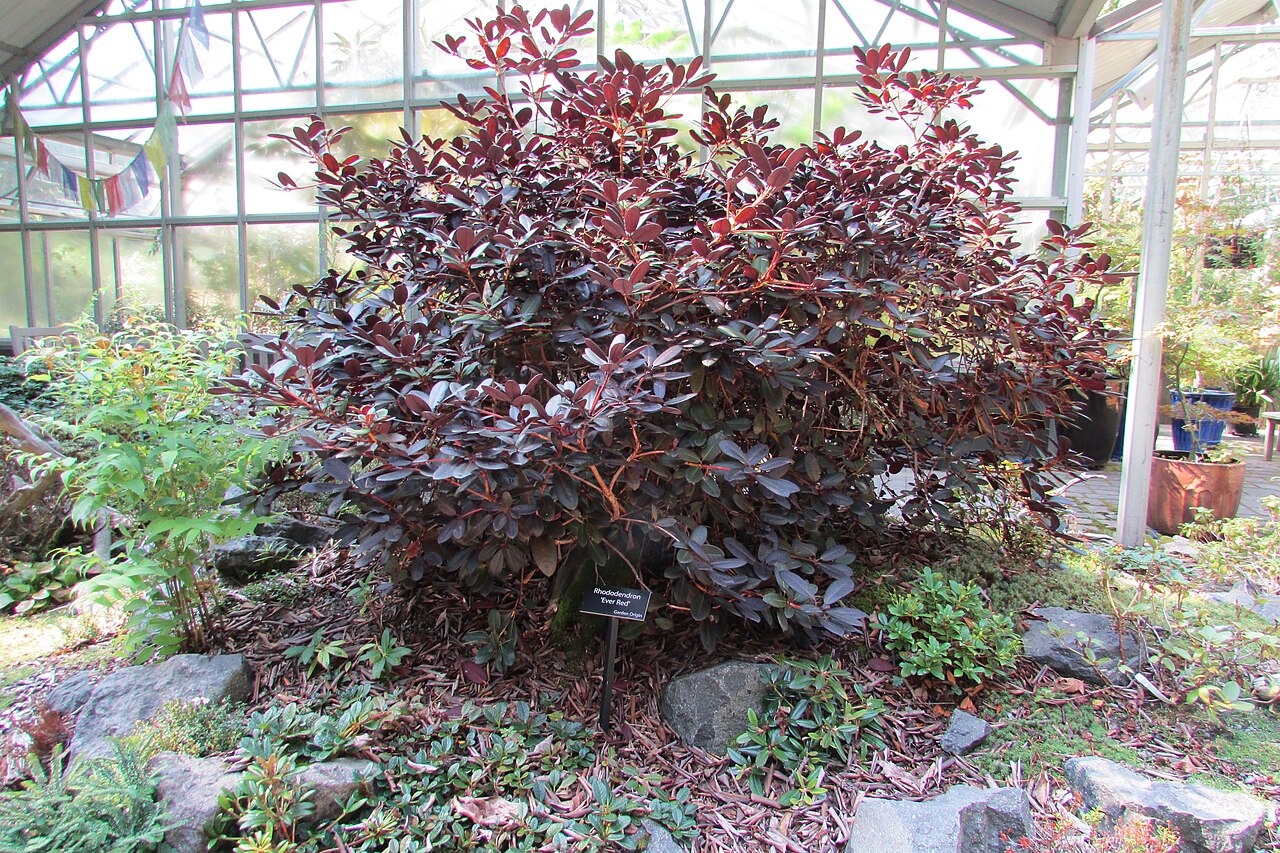
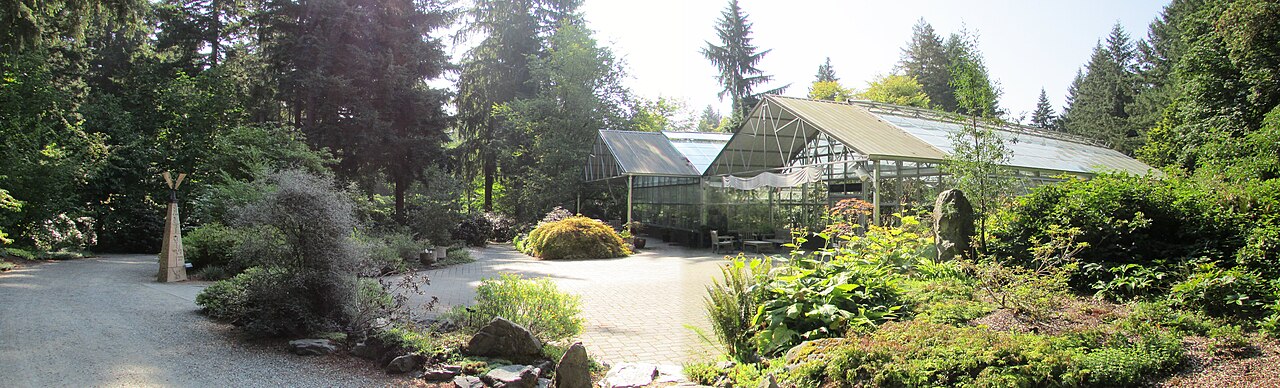
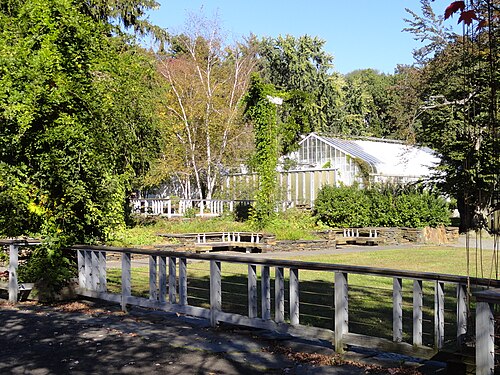
The 5,000-square-foot conservatory was designed specifically, the garden says, to grow and display vireyas and the plants that accompany them in the mountains of Borneo, New Guinea and Southeast Asia. Because these species live at altitude, the building is not a hot, steamy house: it stays above freezing in winter and is cooled in summer to imitate the plants' natural conditions. Photographs published by the garden show a light-coloured metal frame with glazed walls and a gabled roof of large transparent panels, with a gabled canopy over the entrance.
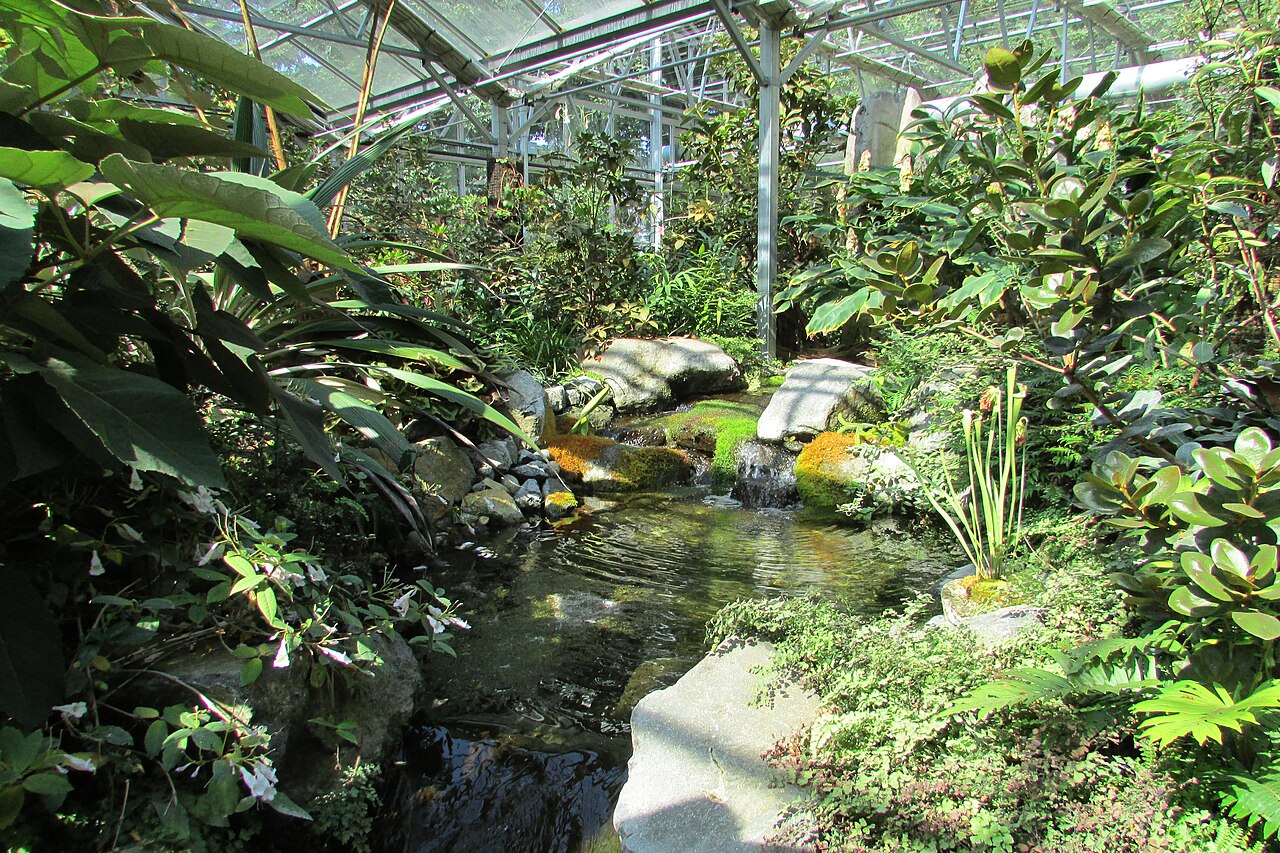
Inside, a path crosses plantings among large boulders, follows a stream with waterfalls and crosses a bridge. An artificial tree trunk made of moss and bark wraps around one of the supporting beams in the middle of the building to host epiphytic plants. In 2010 the local press also mentioned a rock sculpture, a fountain and a paved terrace.
Plant collections
Vireyas make up about a third of the roughly thousand known rhododendron species, around 300 according to the garden; the conservatory shows several hundred species in all with their companions, planted to form communities close to those of their native habitats. The route introduces Rhododendron taxifolium from Luzon, considered critically threatened and possibly extinct in the wild; R. himantodes from Borneo, with narrow scale-coated leaves; R. stenophyllum, with red buds and orange flowers; R. protistum, which could reach some hundred feet; and R. rushforthii from northern Vietnam, with metallic-blue foliage.
Companion plants include orchids, tree ferns such as Dicksonia antarctica, members of the African violet family, a Schefflera macrophylla with huge leaves and Agapetes, a group of which the garden claims the finest North American collection.
Visiting
The conservatory stands near the visitor center and the gift shop, and is entered from their side. The level accessible path runs through it and along the adjoining terrace, where benches invite a rest or a picnic. A visit suits cold or rainy days in the region: the warmth is gentle and flowers appear all year, whereas outdoor rhododendron bloom peaks from mid-March to mid-May.
The garden provides a numbered self-guided tour of the collection. The neighbouring Pacific Bonsai Museum, reached through the same entrance, combines well with a walk to the gazebo, the alpine rock garden, the blue poppy meadow and the Victorian stumpery.
47.29° N, 122.30° W
Greenhouses nearby
More greenhouses — United States
Do you have a good photo of this greenhouse? Suggest it for this page →
Sources (8)
- rhodygarden.org/rutherford-conservatory/
- rhodygarden.org/self-tour-rutherford-conservatory/
- rhodygarden.org/conservatory-opening/
- rhodygarden.org/visit/
- federalwaymirror.com/2010/09/20/world-class-rhododendron-gardens-new-conservatory-goes-tro
- scholar.lib.vt.edu/ejournals/JARS/v54n3/v54n3-hootman.html
- rhododendron.org/vireya/archive/VV/VV89-0210.pdf
- en.wikipedia.org/wiki/Rhododendron_Species_Foundation_and_Botanical_Garden
Affiliate links — booking through Verrière helps fund our research, at no extra cost to you.