Durfee Conservatory (University of Massachusetts Amherst)
Amherst, Massachusetts

Sources checked October 2026
- Year
- 1867; present building: 1954
- Architect
- T. A. Lord (1867); Lord & Burnham (present building, 1954)
- Style
- Five aligned glasshouses on an aluminium-alloy frame (1954), successor to a Victorian complex
- Dimensions
- 4,820 sq ft of floor (≈450 m²) and 7,000 sq ft of glass (≈650 m²) in 1954
- Status
- Open to visitors on weekdays
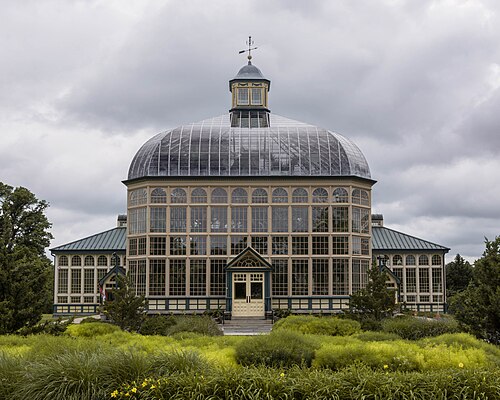
Described by the university as the first great glasshouse for hundreds of miles, the Durfee Plant House was built in 1867 for the Massachusetts Agricultural College, now the University of Massachusetts Amherst, thanks to a 10,000-dollar gift from trustee Nathan Durfee. Designed by T. A. Lord of Syracuse, it had five glass houses with curved roofs. A fire badly damaged it in January 1883; it was rebuilt through 1892, then replaced in 1954 by the present Lord & Burnham building a few feet from the old one. Five houses now hold a rainforest, bonsai and camellias, epiphytes, collections and succulents.
Affiliate links — booking through Verrière helps fund our research, at no extra cost to you.
History
The Durfee Plant House was built in 1867 for the Massachusetts Agricultural College, before the first students had even arrived. Designed by T. A. Lord of Syracuse, it brought together five glass houses with curved roofs trimmed with wrought-iron filigree: the Dry Stove (cacti and succulents), the Moist Stove (tropical species), the Palm House, the Camellia House and the Victoria House (aquatic and air plants). Trustee Nathan Durfee gave 10,000 dollars, covering the heating and water systems. According to the history book the university cites, the complex exceeded 10,000 square feet and was the first great glasshouse for hundreds of miles; the January 1868 report counts about 400 species and varieties, among them camellias presented by Marshall P. Wilder.
On 23 January 1883, at about 8 pm, a fire that began in the work room ruined the building at eight degrees Fahrenheit below zero; thanks to the snow, students saved two wings and the propagating pits. Rebuilding ran to 1892, and a glass tower was added in 1893 for the flowering of a century plant, an agave of nearly 2,000 pounds. An oak felled by the 1938 hurricane destroyed one house, and in 1954 falling glass and rotting wooden frames condemned the old complex. The present Lord & Burnham building cost 69,684 dollars. In 2006 the conservatory passed to UMass Extension, upgrade works began in 2007; it now belongs to the College of Natural Sciences.
Architecture and engineering
The 1954 building was erected by Lord & Burnham, already the builder of the campus greenhouses, a few feet from the old one on a poured concrete foundation. Its aluminium-alloy frame, bolted and braced, was then billed as one of the first all-metal conservatories, and each house received automatic ventilation and steam heat controls. The curved lines of 1867 gave way to a straight even-span roof: only a curved glass pane along the eaves and the double doors of the central house recall the past. The five houses are aligned and separated by glass partitions; in 1954 they totalled about 4,820 square feet of floor and 7,000 square feet of glass. Benches are made of metal pipe and transite, walkways of concrete, and the only wood is the redwood of the connecting doors.
The central house, with a 30-foot ceiling, was meant to replace the great octagon of earlier days and to take palms and tropical trees. According to the student press (2019), the tropical room is kept at 75 to 80°F all year and at about 71 percent humidity, with a mist spraying above its pond.
Plant collections
Each house has its own theme. The Bonsai-Camellia House keeps seven historic camellia trees from the 1867 conservatory, flowering in winter in red, pink and white, beside a sweet olive and bonsai of western yellow pine, trident maple, Chinese elm and ginkgo. The Epiphyte/Vine House gathers orchids (cattleyas, oncidiums, dendrobiums, paphiopedilums), bromeliads, tillandsias, anthuriums and vines. The Tropical House, the largest, shows banana, Mexican breadfruit, rubber tree, starfruit, cacao, shell ginger and bird of paradise around a 4,000-gallon pond crossed by a wooden bridge, where nine koi lived in 2019. The Collections House holds passionflowers, orchid cacti, rex begonias and coleus, with the sensitive plant (Mimosa pudica), one of the most popular plants in the place. The Succulents House is devoted to cacti and other water-storing plants.
Visiting
The conservatory stands on the university campus at 210 Stockbridge Road, opposite the University Health Center and near the Franklin Dining Commons. It receives visitors on weekdays only. Students and passers-by stop to read or study, above all in the tropical room with its benches; in winter its warmth draws people between classes, and the historic camellias flower. The outdoor gardens, designed by a landscape architecture professor at the university, suit fine weather. The neighbouring Morrill Science Center greenhouses, open to visitors on weekdays, round off the visit for anyone interested in botany.
42.39° N, 72.52° W
Greenhouses nearby
More greenhouses — United States
Do you have a good photo of this greenhouse? Suggest it for this page →
Sources (8)
- umass.edu/natural-sciences/research/greenhouses/durfee-conservatory
- umass.edu/natural-sciences/research/greenhouses/durfee-conservatory/history
- umass.edu/natural-sciences/research/greenhouses/durfee-conservatory/history/construction-d
- umass.edu/natural-sciences/research/greenhouses/durfee-conservatory/history/renovation-dur
- umass.edu/natural-sciences/research/greenhouses/durfee-conservatory/collections
- umass.edu/arboretum/greenhouses-conservatories
- scua.library.umass.edu/youmass/doku.php?id=d:durfee_conservatory
- amherstwire.com/26221/student-life-2/durfee-conservatory-umass-amherst-oasis/
Affiliate links — booking through Verrière helps fund our research, at no extra cost to you.