Tropical Dome and Tropical Fruit Greenhouse, Hamamatsu Fruit Park (はままつフルーツパーク時之栖 トロピカルドーム・熱帯果樹温室)
Hamamatsu, Shizuoka Prefecture

Sources checked October 2026
- Year
- 1996
- Style
- Pentagonal greenhouse classed as glass architecture, inspired by a giant kite, continued by tropical fruit houses
- Status
- Open to the public
In the west area of Hamamatsu Fruit Park, opened on 1 October 1996, the Tropical Dome is a pentagonal greenhouse whose shape recalls the giant kites of the Hamamatsu festival. Japanese Wikipedia places the article in the category "glass architecture", and a continuous building of tropical fruit houses extends the dome. The same source counts 80 species and 330 trees there (2012 data), where banana, papaya and pineapple can be seen; the park offers guided tours led by a specialist.
Affiliate links — booking through Verrière helps fund our research, at no extra cost to you.
History
Hamamatsu Fruit Park (浜松市フルーツパーク) opened on 1 October 1996 in Miyakoda, in Hamana ward. The City of Hamamatsu's history (volume 5) presents it as one of the country's largest fruit theme parks; its opening came with improved access roads and the creation of Fruit Park station on the Tenryū-Hamanako Railway. Among the facilities named for the opening are the Tropical Dome, the tropical fruit greenhouse and a cultivation greenhouse, alongside a dining zone and a small train, the Chu-Chu Train.
The park was first run by the municipal Hamamatsu Flower-Fruit Park Corporation, created in 1969 for the Flower Park and also in charge of the Fruit Park since 1993. Closed from 29 December 2012 to 31 March 2013 for redevelopment, it has been operated since 1 April 2013 by Tokinosumika Co., the city's designated manager; the current term runs from April 2023 to March 2028. In 2026 the park marks its 30th anniversary, and the Shizuoka Shimbun reported on 20 July 2026 that it had passed 8 million visitors.
Architecture and engineering
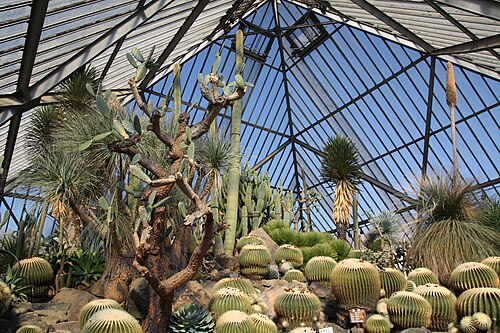
According to Japanese Wikipedia, the Tropical Dome is a greenhouse with a pentagonal plan whose shape recalls the giant kites of the Hamamatsu Festival (Hamamatsu Matsuri); the tropical fruit greenhouse continues it as one connected building. The article is in the category "glass architecture". A 2007 photograph on Wikimedia Commons, which Wikipedia captions as the tropical fruit greenhouse, shows a pyramidal roof of glass panels with metal ridges, a lower glazed skirt and, at ground level, glazed doors.
According to a photo caption on the family-outings portal Iko-yo, the dome is connected to greenhouses devoted to banana, papaya and jaboticaba, and the park's own site speaks of a "group of tropical greenhouses".
Plant collections
Japanese Wikipedia (December 2012 data) counts 80 species of tropical fruit trees and 330 trees in the dome and the house that continues it, where banana, papaya and pineapple can be seen. The Arts Council Shizuoka speaks of about 80 species of tropical and subtropical fruit trees and flowers, and Spanish Wikipedia adds avocado and mango. A Chubu Electric Power article (30 January 2026) mentions, in its paragraph on the greenhouse, about 100 varieties of rare fruits from around the world, including lychee, star fruit, passion fruit and dragon fruit.
The park offers guided tours by a tropical-greenhouse specialist, such as the one on 27 April 2025 (half an hour, by reservation): each group leaves with a banana or a green papaya, depending on the day's harvest.
Visiting
The dome stands in the park's west area, the one with the main entrance, alongside the giant "Fruit Orchestra" play structure, a restaurant and the park's wine cellar. The greenhouse is open all year, with bananas and papayas on view in every season according to Chubu Electric Power; the guided visit lasts about half an hour when it is offered. Fruit Park station (Tenryū-Hamanako Railway) is about 8 minutes away on foot; by bus, the park's official guide cites the 萩丘都田線 route, about 60 minutes from JR Hamamatsu station. The Fruit Bridge (Fruit Ōhashi) leads to the east area, where the orchards allow about fifteen kinds of fruit to be picked over the year, sold by weight, and where a free little train runs.
34.84° N, 137.73° E
Greenhouses nearby
More greenhouses — Japan
Do you have a good photo of this greenhouse? Suggest it for this page →
Sources (10)
- ja.wikipedia.org/wiki/浜松市フルーツパーク
- hamamatsu-fp.co.jp/eventinfo/detail/136
- hamamatsu-fp.co.jp/en/
- hamamatsu-fp.co.jp/guide/
- adeac.jp/hamamatsu-city/text-list/d100050/ht007640
- city.hamamatsu.shizuoka.jp/zaisek/zai_jou/21pub_co/03_1.html
- city.hamamatsu.shizuoka.jp/nousei/fruitspark/30th-logo-recruit.html
- coelog.chuden.jp/recommend/hamamatsu-furuits-park/
- artscouncil-shizuoka.jp/culture-resource-db/detail.php?id=1336
- es.wikipedia.org/wiki/Parque_Frutal_de_Hamamatsu
Affiliate links — booking through Verrière helps fund our research, at no extra cost to you.