Exotenhaus (former Tullabad), Karlsruhe Zoo (Zoologischer Stadtgarten)
Karlsruhe, Baden-Württemberg

Sources checked October 2026
- Year
- 1955 (indoor swimming pool) · 2015 (Exotenhaus)
- Architect
- Helmut Stephan, municipal building department (Tullabad, 1955); Stendal Bach Schwarzbrunn Zabries (conversion)
- Style
- Modernist concrete-and-glass hall (1955) converted into a tropical hall; glazed fronts and UV-permeable foil cushions
- Dimensions
- Building volume 35,200 m³; free-flight hall 14 m high
- Status
- Open to the public with zoo admission
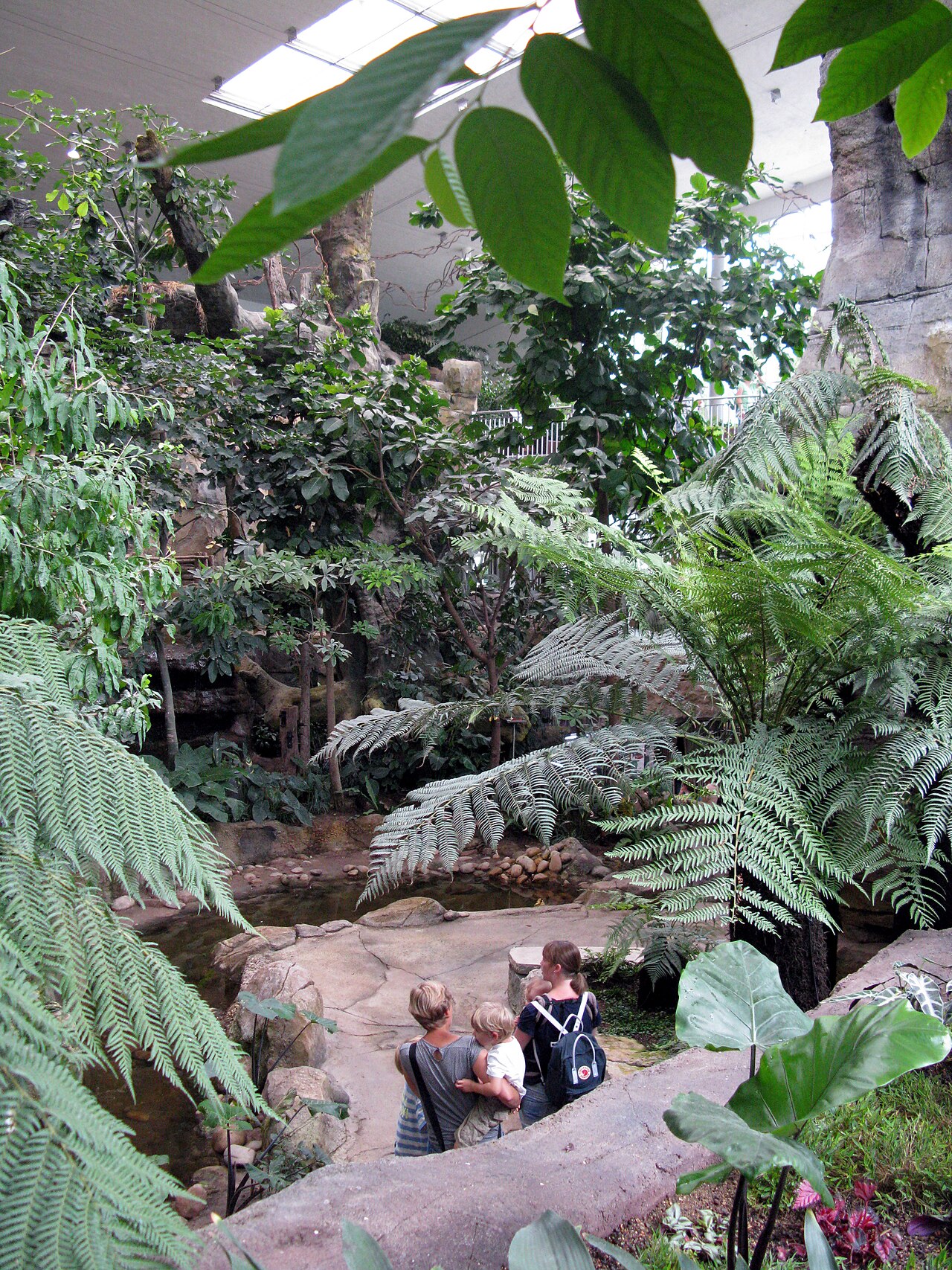
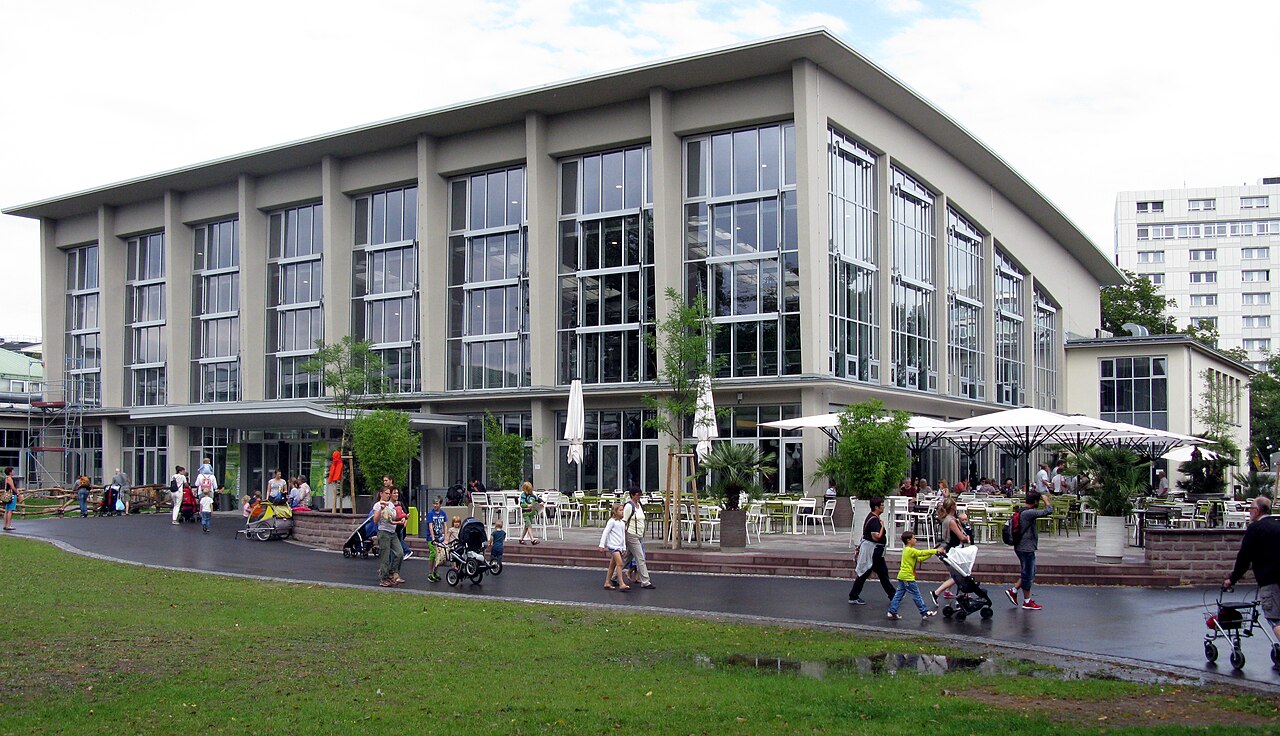
In the north-east of Karlsruhe's Stadtgarten, the Exotenhaus occupies the former Tullabad, an indoor swimming pool opened in 1955 and protected as a heritage monument of Baden-Württemberg. Converted for the zoo between 2012 and 2015, it kept its glass fronts to the west and south and gained three large UV-permeable foil cushions in its roof. In the 14 m high main hall, streams, waterfalls and tropical planting rise over three levels, while free-flying birds and small monkeys move about without netting. The 320 m route also leads down to aquariums, terrariums and a bat cave.
Affiliate links — booking through Verrière helps fund our research, at no extra cost to you.
History
Before it housed birds and monkeys, the building served swimmers. The Tullabad opened in July 1955 in Karlsruhe's Stadtgarten and was then regarded as the most modern indoor pool in Germany. It was built by the municipal building department under Oberbaurat Helmut Stephan. The art historian Clemens Kieser, of the heritage service, links it formally to Erich Schelling's Schwarzwaldhalle, and image captions from the Haus der Geschichte Baden-Württemberg, on Wikimedia Commons, speak of a competition design by Schelling: the sources do not agree on each man's share. The pool was entered in the Baden-Württemberg heritage register, in 1990 according to Kieser and in 1991 according to those captions.
Facing competition from the Fächerbad, which opened in 1982, the Tullabad lost its public during the 1980s. It eventually closed and passed to the zoo. The city's master plan foresaw turning it into an Exotenhaus, and a two-phase competition was judged in April 2007. Design began in December 2007 and construction in October 2012. ZooLex gives the cost as 21 million euros. The project was presented as a flagship of the city's 300th anniversary and a milestone for the zoo's 150th, both in 2015.
The house opened in 2015: on 29 July according to ZooLex and OpenStreetMap, in June according to Karlsruhe's tourist office, which adds that animals began moving in from May.
Architecture and engineering
The Tullabad was a concrete-and-glass building that Kieser calls a light-flooded "Glashaus": 610 m² of glazing and a hall spanned by nine prestressed girders 29 m long, fixed on the stand side and resting on exposed-concrete supports on the window side, below a thin hung ceiling.
The conversion, entrusted to the Stendal Bach Schwarzbrunn Zabries practice, keeps this structure. According to ZooLex, the façades, the roof framing and the upper part of the double-skin roof were renewed; the glass fronts to the west and south remain, and three large UV-permeable foil cushions, installed by Bauer Membranbau, add overhead light. City contracts of 2013 cover windows, doors and façade elements on all four sides, as well as flat-roof waterproofing. Louvred blinds shade the façade and UV lamps hang under the ceiling.
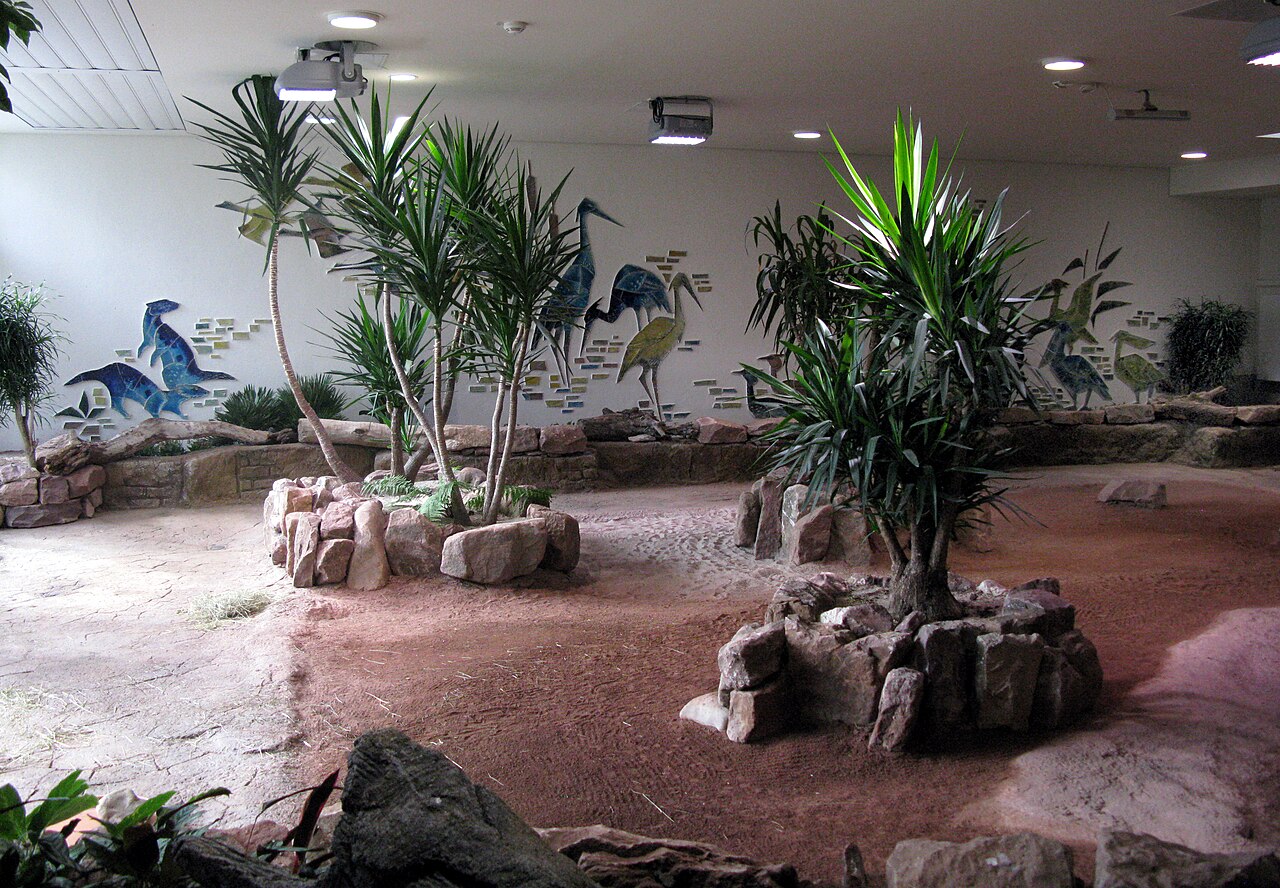
Humidity is capped at 60 per cent to spare the monument; in winter the hall is heated to about 25 °C, and in summer it has no cooling. Rising 14 m, it stacks watercourses, waterfalls and ponds on three levels; the former stands form a raised zone, a gallery runs along the south front and the original entrance hall, decorated with ceramics, serves as an exhibition space.
Plant collections
The theme is the tropical riverbank (Uferlandschaften). Among the hall's plants ZooLex names kentia palm (Howea forsteriana), tree ferns, sea hibiscus (Talipariti tiliaceum), langsat (Lansium domesticum), a radiator plant (Peperomia), an Alocasia and Xanthorhiza simplicissima, a shrub (yellowroot); watering is done by hand. The zoo describes lush, near-natural planting and sends a tropical storm of mist and rain through the house three times a day.
In the main hall, birds (Victoria crowned pigeons, Nicobar pigeons, lorikeets, black-necked stilts) and monkeys, among them, according to Wikipedia, cotton-top tamarins and white-faced sakis, live without barriers. The house also holds pygmy marmosets, two-toed sloths, Goeldi's monkeys, Azara's agoutis, giant tortoises, crocodiles and piranhas. Figures vary: about 2,000 animals in nearly 100 species according to Wikipedia and the tourist office, 37 entries in the ZooLex list.
Visiting
The Exotenhaus stands in the north-east of the Zoologischer Stadtgarten, at Ettlinger Straße 4b; the zoo and the Stadtgarten form a single fenced site that cannot be visited separately. The 320 m route runs over several levels, from the former small pool hall (tortoises, aviary) to the basement (aquariums, bat cave, an underwater view of piranhas) and the gallery, so the hall is never seen from one spot. Two lifts serve every level.
The 2010 plan aimed at a stay of more than two hours and a zoo that works in winter; in summer, with no cooling, the temperature follows the outdoors. The rest of the zoo, founded in 1865, is close by; the glasshouses of Karlsruhe's botanical garden have an entry of their own.
49.00° N, 8.40° E
Greenhouses nearby
More greenhouses — Germany
Do you have a good photo of this greenhouse? Suggest it for this page →
Sources (8)
- zoo-karlsruhe.de/erlebniswelten/exotenhaus
- zoolex.org/gallery/show/1829/
- zoolex.org/gallery/plants/1829/
- de.wikipedia.org/wiki/Zoologischer_Stadtgarten_Karlsruhe
- regionalia.blb-karlsruhe.de/files/90/BLB_Kieser_Karlsruher_Tullabad.pdf
- web1.karlsruhe.de/ris/oparl/bodies/0001/downloadfiles/a/00011787.pdf
- openstreetmap.org/way/362290783
- wikidata.org/wiki/Q137162702
Affiliate links — booking through Verrière helps fund our research, at no extra cost to you.