Schaugewächshäuser of the Karlsruhe Botanical Garden
Karlsruhe, Baden-Württemberg
Entry updated on September 30, 2026
- Year
- 1853–1857
- Architect
- Heinrich Hübsch
- Style
- 19th-century iron-and-glass ensemble with curved glazed forms
- Dimensions
- Three buildings: a raised central palm house and two lower wings
- Status
- Open to the public; restored 2012-2018
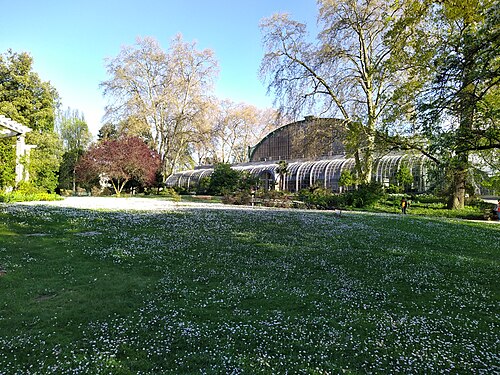
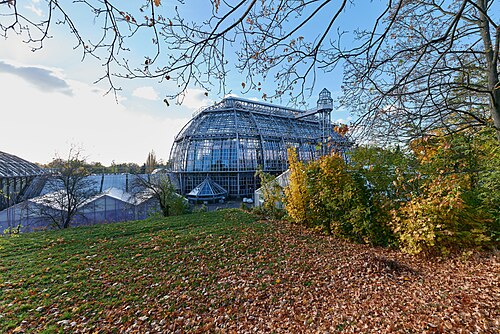
West of Karlsruhe Palace, the show glasshouses of the botanical garden were built between 1853 and 1857 by Heinrich Hübsch for Grand Duke Frederick I of Baden. They consist of a taller central palm house flanked by two lower wings, set against a masonry wall. Largely destroyed by the air raids of winter 1944-1945, they were brought back into use in the 1950s, then restored between 2012 and 2018 following the original plans, with laminated glazing highly transparent to UV light. They shelter tropical plants, palms, cacti and cycads.
Affiliate links — booking through Verrière helps fund our research, at no extra cost to you.
History
1 min
Karlsruhe's botanical garden dates back to the eighteenth century and owes much to Margrave Karl Friedrich, who entrusted its creation to the botanist Carl Christian Gmelin. In 1808 Friedrich Weinbrenner drew up for him a scheme that included an orangery and warm, cold and propagation houses. These timber structures aged quickly. On 9 March 1853 Grand Duke Frederick I ordered a complete rebuilding of the plant houses, entrusted to the architect Heinrich Hübsch; work ran from 1853 to 1857.
Between 1863 and 1871 the deteriorating timber roof structures were replaced with metal ones (the firm Dyckerhoff & Berckmüller is named for this work). In winter 1944-1945 air raids destroyed the glasshouses by bombs and fire; only five plants survived under glass, according to the city's Stadtwiki. Sources differ on the extent of the damage: building-archaeology records state that the steel frame was largely preserved. Reconstruction began around 1948-1950 and continued until 1956; the cactus house was rebuilt in 1952 and the palm house in 1955-1956.
In 1967 the staging of the Federal Garden Show brought alterations, including a reduction of the Italian Garden structure. In the early 2000s a citizens' initiative defended the garden against the expansion of the neighbouring Federal Constitutional Court, which was adapted in 2005. Structural problems later led the State of Baden-Württemberg to launch a major restoration: the work, dated by sources between 2012 (or 2014) and 2018, received a Baden-Württemberg architecture distinction.
Architecture and engineering
1 min
Hübsch designed three building elements: a raised central volume, the palm house, framed by two lower wings. The wrought-iron structure leans on a masonry wall, and the ensemble includes cast-stone walls and decorative figures. The glazed forms are curved, and the circulation intended in the nineteenth century moved from dry to humid and from cool to warm.
The 2012-2018 restoration strengthened the steel frame while preserving its curved design, improved energy efficiency and replaced the 1950s glazing to return to the idea of a pure iron-and-glass construction. About 525 m² of composite laminated glass were produced, with UV transmission of up to 63.2 per cent against roughly 1.2 per cent for ordinary safety glass. Seven hundred and twelve ornamental panes in varied shapes, including triangles, were installed. The architects relied on Hübsch's plans and on archives to restore the original circulation, and recreated the cold-house cascade that had been lost after the war.
Plant collections
1 min
The three principal houses are the cold house, the palm house, where tropical species share space with a water-lily pond, and the warm house, devoted to tropical plants. Nearby stand a cactus and succulent house and aviaries. The garden cultivates plants of particular value for the study of evolution and conservation, such as cycads, Gnetum and ginkgo.
The garden was long known across Europe for rare citrus varieties and for its dahlias. The frame of the former winter garden now serves as a café terrace.
Visiting
1 min
The garden lies west of the palace, a short walk from the Linkenheimer Tor station, and its glasshouses are small but rich in exotic rarities. A visit takes about an hour. Spring and summer favour the open-air beds; in winter the glasshouses offer a heated, exotic refuge.
Several rare nineteenth-century trees extend the walk, and Karlsruhe Palace lies close by. The pergola of the Italian Garden, whose metal structure dates from the 1860s, was dismantled in autumn 2025 for historical restoration, so works may be visible there.
49.01° N, 8.40° E
Greenhouses nearby

More greenhouses — Germany
Do you have a good photo of this greenhouse? Suggest it for this page →
Sources (8)
- bauforschung-bw.de/objekt/id/171586663820/botanischer-garten-schaugewaechshaeuser-und-ital
- ruserundpartner.de/projekt/denkmalgerechte-sanierung-gewaechshaeuser-botanischer-garten-ka
- schollglas.com/referenzen/botanischer-garten-karlsruhe-de/
- german-architects.com/de/architecture-news/praxis/historisch-vorbildlich
- ka.stadtwiki.net/Botanischer_Garten_Karlsruhe
- guide.karlsruhe.de/db/guide-de/botanischer_garten
- en.wikipedia.org/wiki/Botanischer_Garten_Karlsruhe
- de.wikipedia.org/wiki/Botanischer_Garten_Karlsruhe