Wilhelma Historic Glasshouses (Kuppelhäuser)
Stuttgart, Baden-Württemberg
Entry updated on September 30, 2026
- Year
- 1852–1853
- Architect
- Karl Ludwig von Zanth
- Style
- Iron and glass with arabesque ornament in Moorish taste
- Dimensions
- Two domed pavilions of 7 × 7 m and 6.5 m high
- Status
- Open to the public (aviaries, renovated 2017–2019)
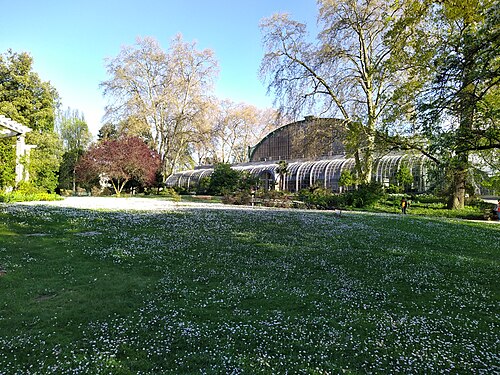
At the heart of the Wilhelma zoological and botanical garden, the historic glasshouses were built in 1852-53 by Karl Ludwig von Zanth, who had studied cast-iron construction and heating in Britain, France and the Netherlands. Their iron-and-glass structure, decorated with oriental-style arabesques, is made of components cast in series, one of the first uses of prefabrication in the Kingdom of Württemberg. Damaged in the bombing of October 1944, they were renovated from 2017 to 2019 and now house aviaries for South American and Australian birds.
Affiliate links — booking through Verrière helps fund our research, at no extra cost to you.
History
1 min
The historic glasshouses belong to the Moorish ensemble that Karl Ludwig von Zanth designed in Stuttgart from 1837, in a manner inspired by the Alhambra in Granada. They replaced more modest glass structures, among them a pineapple house of 1839, and were built in 1852-53. To prepare them Zanth travelled to Britain, France and the Netherlands to study cast-iron construction and heating techniques. The metal components were cast in series to save cost and time, making the work one of the first systematic uses of prefabrication in the Kingdom of Württemberg.
The houses first served as a winter orangery. In one of the two domed pavilions a heated basin held the giant Victoria water lily. In 1854 cages and perches were installed for parrots presented to King Wilhelm, the first animals of the Wilhelma; a large parrot bought in 1861 was later preserved by the natural history museum.
In the night of 19 to 20 October 1944 Allied bombing devastated the Wilhelma, including its garden and orangery, and the glasshouse roof structure was badly damaged. A thorough restoration from 2017 to 2019 gave the houses a new life as aviaries. The sources consulted differ on dating: English Wikipedia describes neighbouring greenhouses at the Moorish villa as already completed around 1842.
Architecture and engineering
1 min
The structure is iron and glass, decorated with arabesques of oriental character, in keeping with the Moorish taste of the Wilhelma as a whole. The cast-iron parts, produced in series, are among the first systematic uses of prefabrication in the Kingdom of Württemberg; Zanth had prepared the project with a study trip devoted to cast iron and heating.
Two domed pavilions, each measuring 7 m by 7 m and 6.5 m high, form the most conspicuous volumes of the complex. One of them had a cellar that allowed the basin intended for the Victoria water lily to be heated. The roof suffered heavy damage in the 1944 bombing, and the works of 2017-2019 brought the whole ensemble back into condition. The sources consulted do not give the total length of the glazed wings.
Plant collections
1 min
Originally the houses sheltered the orangery in winter and, in one dome, the giant Victoria water lily grown in a heated basin. They also received animals early on: the parrots presented to King Wilhelm in 1854, then a large parrot bought in 1861.
Since the 2017-2019 renovation the domes form aviaries arranged by region. South American rainforest birds include jewel-tanagers, troupials and several doves, while the Australian dry-forest section shows zebra finches, Gouldian finches and budgerigars. The rest of the Wilhelma, including what English Wikipedia calls Europe's biggest magnolia grove, completes the botanical visit.
Visiting
1 min
The glasshouses stand at the heart of the Wilhelma, close to Zanth's Moorish buildings, among them the Moorish villa and the Damascus Hall, whose aviaries have held native birds since the 1990s. A visit fits naturally into a tour of the zoological and botanical garden and its other glasshouses, including the Amazonienhaus, which is a separate entry in the catalogue.
The birds are shown in aviaries; the magnolia grove, cited as the largest in Europe, is another botanical highlight of the park. Half a day is a sensible allowance for the Wilhelma as a whole.
48.80° N, 9.21° E
Greenhouses nearby

More greenhouses — Germany
Do you have a good photo of this greenhouse? Suggest it for this page →