Orangerieschloss (Orangery Palace, Sanssouci)
Potsdam, Brandenburg
Entry updated on September 30, 2026
- Year
- 1851–1864
- Architect
- Friedrich August Stüler and Ludwig Ferdinand Hesse (early studies by Ludwig Persius)
- Style
- Italian Renaissance Revival; plant halls with iron-framed windows
- Dimensions
- Front of about 300 m; plant halls of 103 × 16 m
- Status
- Halls still used to overwinter plants; palace under renovation (Masterplan) according to the Prussian palaces foundation
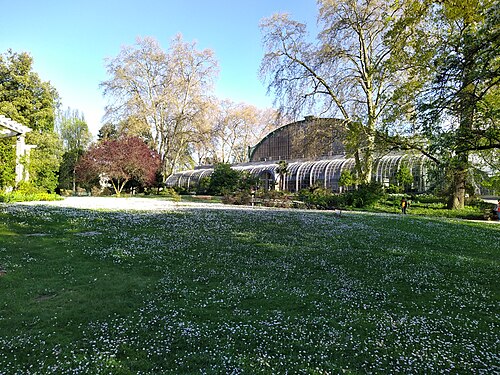
Commissioned by the Italy-loving Frederick William IV of Prussia, the Orangerieschloss was built between 1851 and 1864 by Friedrich August Stüler and Ludwig Ferdinand Hesse from the king's own sketches. Its front of over 300 metres joins a central block with towers, home to the gallery of Raphael copies, to two long 103-metre plant halls flanked by corner pavilions. Heated by channels under the floor, the halls still serve to overwinter the park's potted plants. The palace is currently under renovation according to the Prussian Palaces and Gardens Foundation.
Affiliate links — booking through Verrière helps fund our research, at no extra cost to you.
History
1 min
The project grew out of Frederick William IV's passion for Italy. In the 1840s Ludwig Persius sketched a first scheme for him but died before any building began. According to English Wikipedia, the orangery was meant to form part of a never-completed "Via Triumphalis", halted by the March Revolution and a lack of funds. Earthworks started in the winter of 1848-49, and Friedrich August Stüler and Ludwig Ferdinand Hesse then directed construction from 1851 to 1864, working from numerous sketches by the king.
The western plant hall was raised in 1851 and received its plants from the winter of 1852-53. The central block was begun in 1853 and its exterior finished in 1858; the eastern hall went up between 1854 and 1856. When the king died in 1861 the eastern corner pavilion was still a rough shell. The building was completed in 1864 under William I, and decoration of the façades and terraces continued through the 1870s.
It was largely spared in the fighting of April 1945, unlike the nearby Historic Mill and Belvedere. From 1949 to 2010 the Brandenburg State Archive occupied the eastern hall, and restoration began step by step in 1986. The Orangerieschloss belongs to the UNESCO World Heritage site inscribed in 1990.
Architecture and engineering
1 min
The front, about 300 m long (304 m according to German Wikipedia), combines a central block with two towers, each topped by a belvedere, and two symmetrical wings. The style is Italian Renaissance: the Villa Medici in Rome and the Uffizi in Florence are cited as models. The tower roofs are flat and zinc-clad, and a Palladian motif recurs on the iron-framed casement windows.
Each single-storey plant hall is 103 m long and 16 m wide. On the south side tall windows are separated by piers with niches for statues; inside, coupled pilasters carry a stuccoed ceiling of square and circular motifs. Channel heating under the floor keeps the halls at 6 to 8 °C; it still works in the west hall and coexists with a modern hot-water system.
The upper terrace runs for 240 m, and the three terrace levels absorb a height difference of about 4.5 m over roughly three hectares around the building. At the centre, the Raphael Hall rises through more than two storeys.
Plant collections
1 min
According to German Wikipedia, the halls shelter more than 1,000 potted plants belonging to almost thirty species, a stock described as among the largest in Europe together with those at Vienna and Versailles. They overwinter here and then leave to decorate the park in the warm season, a function the halls have served since the western hall was built.
The gardens around the building carry on the Mediterranean theme. The Sicilian Garden (1857-1860) combines palms, myrtles, laurels, arcades and fountains, the Nordic Garden of the same years is planted with pines, and the Paradise Garden, laid out by Peter Joseph Lenné in 1843-44, brings together exotic flowers and foliage plants. The central block also holds more than fifty copies of Raphael paintings, hung on red silk.
Visiting
1 min
The Orangerieschloss stands in Sanssouci Park and is best seen together with its neighbours: the Sicilian and Nordic gardens, the Historic Mill and the Belvedere. The Prussian palaces foundation states that the palace is being renovated under its Masterplan, with certain events continuing, so access should be checked before a visit.
The upper terrace hosts concerts of the Musikfestspiele Potsdam Sanssouci festival, and each hall can accommodate up to a thousand people at events. The potted plants can be seen in the park during the warm season. Allow one to two hours, more if a walk through the park is added.
52.40° N, 13.03° E
Greenhouses nearby
More greenhouses — Germany
Do you have a good photo of this greenhouse? Suggest it for this page →