Tropical Dome Greenhouse, Odawara Flower Garden (小田原フラワーガーデン トロピカルドーム温室)
Odawara, Kanagawa Prefecture
Entry updated on October 5, 2026
- Year
- 1995
- Architect
- Unknown
- Style
- Domed greenhouse heated by waste heat from an incineration plant
- Dimensions
- 40 m in diameter, 22 m high
- Status
- Open to the public
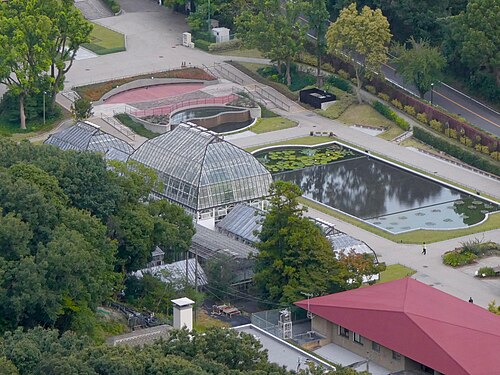
Opened by the city of Odawara in April 1995 on the Kuno hills, this 4.2-hectare botanical park is centred on a domed greenhouse 40 metres across and 22 metres high. It is heated with surplus heat from the city's waste-management centre, an incineration plant next door, and held at around 22 °C. Sources put the planting at between 200 and 300 species of tropical and subtropical flowering trees and fruit trees; the star of the collection is Strongylodon macrobotrys, whose hanging clusters open in spring.
Affiliate links — booking through Verrière helps fund our research, at no extra cost to you.
History
1 min
Odawara Flower Garden opened on 29 April 1995 at Kuno, on high ground 114 metres above sea level. Owned by the city of Odawara, it was created both as a botanical park where flowers could be seen in every season and as a base for promoting urban greening. Its guiding theme was the creation of a way of life rooted in flowers and greenery, with the aim of a pleasant garden that would enrich residents' everyday lives.
The domed greenhouse is the park's principal facility. Its heating relies on a neighbouring municipal facility: the city's waste-management centre, an incineration plant whose surplus heat is recovered.
Since 1 April 2011 the city has entrusted day-to-day operation to designated private managers. According to the Japanese online encyclopedia, a consortium including Seibu Landscape and the Izu-Hakone Railway took over at that point; Seibu Landscape states that it began a fourth five-year term in April 2026, although the membership of the consortium differs from one page to another. In 2013 the park's management won the prize of the Director-General of the City Bureau of the Ministry of Land in the national urban parks competition, in the management and operation category. Since 2014 an educational programme on honeybees has combined beekeeping with the making of honey products, and the flower shop was renovated in 2017.
Architecture and engineering
1 min
The greenhouse takes the form of a dome 40 metres in diameter, rising to 22 metres. The sources consulted name neither its designer nor the type of frame and cladding used; on OpenStreetMap its footprint appears as a nearly circular polygon about fifty metres across.
What sets it apart is its heating. Instead of generating its own heat, the greenhouse draws on surplus energy from Odawara's waste-management centre, the incineration plant next door, which keeps the interior at around 22 °C all year and allows tropical and subtropical plants to be grown there.
According to a gardening magazine, an unhurried tour of the interior takes about half an hour. Around the dome, the 4.2-hectare park is made up of a stream valley planted with plum trees, a pond edged with irises, a rose garden arranged around Arcadia Plaza and a dancing fountain.
Plant collections
1 min
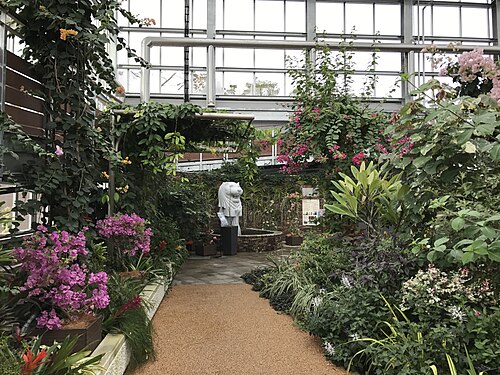
The dome holds flowering trees and fruit trees from tropical and subtropical regions: about 200 species according to the online encyclopedia and a gardening magazine, about 300 according to the park's website and the city. Its signature plant is Strongylodon macrobotrys (ヒスイカズラ), whose hanging clusters, likened by the park to jade, bloom from March to May; a gardening magazine describes more than 300 hanging flower spikes at the peak of flowering. From mid-June to early September, Heliconia rostrata (ヘリコニア・ロストラータ) takes over with bracts that recall birds' beaks.
Outdoors, the plum valley covers roughly half the park, with some 300 varieties and 500 trees according to the park (200 varieties and 480 trees according to the encyclopedia); the rose garden holds about 150 varieties, and the pond some 180 varieties of iris (ハナショウブ), around a thousand plants in all.
Visiting
1 min
The park lies at Kuno, about 1.6 km from Iidaoka Station on the Izu-Hakone Railway, a climb of some twenty minutes on foot; by car it is a quarter of an hour from the Odawara-Higashi interchange. Half an hour is enough for the greenhouse, more for the garden. The Strongylodon flowering, from March to May, is the best time for the dome; it follows the plum blossom of January to March and comes before the roses of May and the irises of June. The roses flower again in October, making autumn a second good season. The prefectural Odawara Suwanohara Park lies close by.
35.28° N, 139.13° E
Greenhouses nearby
More greenhouses — Japan
Do you have a good photo of this greenhouse? Suggest it for this page →