Orangeries of the Immanuel Kant Baltic Federal University Botanical Garden
Kaliningrad, Kaliningrad Oblast
Entry updated on October 5, 2026
- Year
- 1948 (post-war glasshouses); 2017 (new orangery)
- Style
- Group of six glasshouses with a heightened central house
- Dimensions
- ≈800 m² across six orangeries; 12 m central house raised by 5 m
- Status
- Open to the public April to November (orangeries on set days)
Kaliningrad's botanical garden occupies the former municipal nursery of Königsberg, founded in 1904 in the suburb of Maraunenhof by Paul Kaeber, who ran it for more than fifteen years. Its glasshouse collection, some 4,000 names strong by the late 1930s, was entirely lost at the end of the Second World War. In 1948 greenhouses were built and the orangeries repaired; in 1967 the garden passed to Kaliningrad State University, now the Immanuel Kant Baltic Federal University. Six orangeries covering about 800 m² hold its tropical plants, including a Livistona brought from Moscow in 1959, for which the central house was raised.
Affiliate links — booking through Verrière helps fund our research, at no extra cost to you.
History
1 min
The site began in 1904 as the municipal nursery (Stadtgärtnerei) of Königsberg, in the suburb of Maraunenhof. Its creator and first director, Professor Paul Kaeber (1869–1919), also intended it as a base for students' practical training; he ran it for more than fifteen years and worked to acclimatise non-native plants to East Prussian conditions. The nursery was in operation from 1907 on 12.3 hectares, supplying saplings to 80 of the city's schools and plants for its green spaces, and carrying out horticultural trials.
By the late 1930s its glasshouse collection alone numbered some 4,000 names; it was entirely lost at the end of the Second World War. After 1948 the site became a botanical garden under a succession of Soviet bodies. That year greenhouses were built and the orangeries repaired, yet a second inventory in 1958 found only 400 plant names. The orangery was restored in the late 1950s and in 1959 received a Livistona from Moscow.
In 1967 the garden was transferred to Kaliningrad State University, now the Immanuel Kant Baltic Federal University. A new orangery was built there in 2017.
Architecture and engineering
1 min
The glasshouse plants are spread across six orangeries with a combined area of about 800 m². The tallest, at the centre of the group, was 12 metres high; when the Livistona that arrived in 1959 neared 14 metres, the garden crowned the house with a 5-metre extension, adapting the building to its occupant rather than the other way round.
Today's glasshouses are the product of successive campaigns: greenhouses built in 1948 on a site whose pre-war orangeries were repaired, restoration of the orangery in the late 1950s, and a new orangery built in 2017. The sources consulted name neither the architects nor the materials of these campaigns. The orangeries belong to a 13.75-hectare garden in which the arboretum takes up 8.5 hectares and the open-air flower beds 1.5 hectares.
Plant collections
1 min
The garden holds more than 2,500 taxa, including 723 woody species, 85 per cent of them introduced. Under glass it grows between 500 and 600 tropical and subtropical plants, a collection rebuilt entirely after the war: the second inventory, in 1958, found only 400 plant names of all kinds, against some 4,000 names in the glasshouses alone at the end of the 1930s.
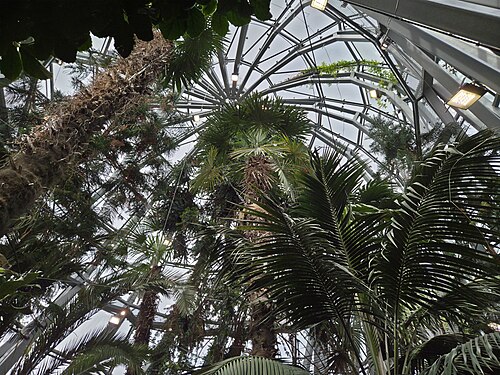
The centrepieces are palms. The Livistona brought from Moscow in 1959, described as 110 years old, stands nearly 14 metres tall and alone accounts for the heightened central house. It grows alongside two date palms of about sixty, one male and one female.
Visiting
1 min
The garden lies in the former suburb of Maraunenhof, on Lesnaya Street in Kaliningrad's Leningradsky district. It opens from April to November; the orangeries can be visited only on certain days of the week and for part of the day, so it is worth checking the garden's calendar before setting out. The warmer months allow the glasshouses to be paired with the 8.5-hectare arboretum and its 723 woody species, then with the open-air flower beds. Under glass, the tall Livistona of the central house and its raised roof are the high point of the indoor circuit.
54.74° N, 20.52° E
Greenhouses nearby
More greenhouses — Russia
Do you have a good photo of this greenhouse? Suggest it for this page →