Appalachian Cove and Cypress Swamp glass-covered habitats, Virginia Living Museum
Newport News, Virginia
No freely licensed photo of this greenhouse yet. Do you have one? Suggest it for this page →
Sources checked October 2026
- Year
- 2004
- Architect
- Aram Mardirosian (The Potomac Group)
- Style
- Two-story glass-covered habitats inside a semicircular, steel-vaulted building
- Dimensions
- Whole building: ≈ 5,800 m² (62,000 sq ft)
- Status
- Open to the public with museum admission, daily except a few holidays
At the Virginia Living Museum in Newport News, the Appalachian Cove and the Cypress Swamp are two-level habitats that the official website describes as glass-covered and walked through on foot. They are part of the 62,000-square-foot building opened in 2004 and designed by architect Aram Mardirosian. The cove recreates a corner of the Blue Ridge with a waterfall, a trout stream and stream-dwelling amphibians; the swamp has cypress and tupelo trunks, with an alligator, fish and turtles. This entry covers these glazed halls, not the whole museum.
Affiliate links — booking through Verrière helps fund our research, at no extra cost to you.
History
The Virginia Living Museum began in 1966 as the Junior Nature Museum and Planetarium, founded by the Junior League of Hampton Roads and the Warwick Rotary Club. It became the Peninsula Nature and Science Center in 1976, then began turning into a "living museum" in 1983; it reopened under its present name in 1987, modelled, according to the Bay Journal, on the Arizona-Sonoran Desert Museum in Tucson. Success was immediate and the museum had to expand: the Coastal Plain Aviary opened in 2001, followed by a new 62,000-square-foot building, about three times the size of the old one.
The building, which cost $22.6 million, opened to the public at the end of March 2004, with a Virginia governor cutting the ribbon. To build it the museum left its former site, hidden in the woods, and moved to the edge of J. Clyde Morris Boulevard, so as to free the rest of its 21 acres for expansion. The Daily Press counted more than 800 visitors in the first hour and, inside the building, more than 750 animals in about fifty displays, including two two-story-tall habitats: the Appalachian Cove and the Cypress Swamp.
Architecture and engineering
The building, by architect Aram Mardirosian of The Potomac Group (McLean, Virginia), sits in the northwest corner of the site "like a giant sundial": a semicircular structure nearly 300 feet (about 90 m) long, with a gently sloping, tent-like roofline, whose interior is described as a vast steel vault. The architect wanted visitors to see the whole first, hence a hanging globe in the stairwell and a view of the outdoor habitats through the rear windows, and then to discover the galleries as a series of grottoes.
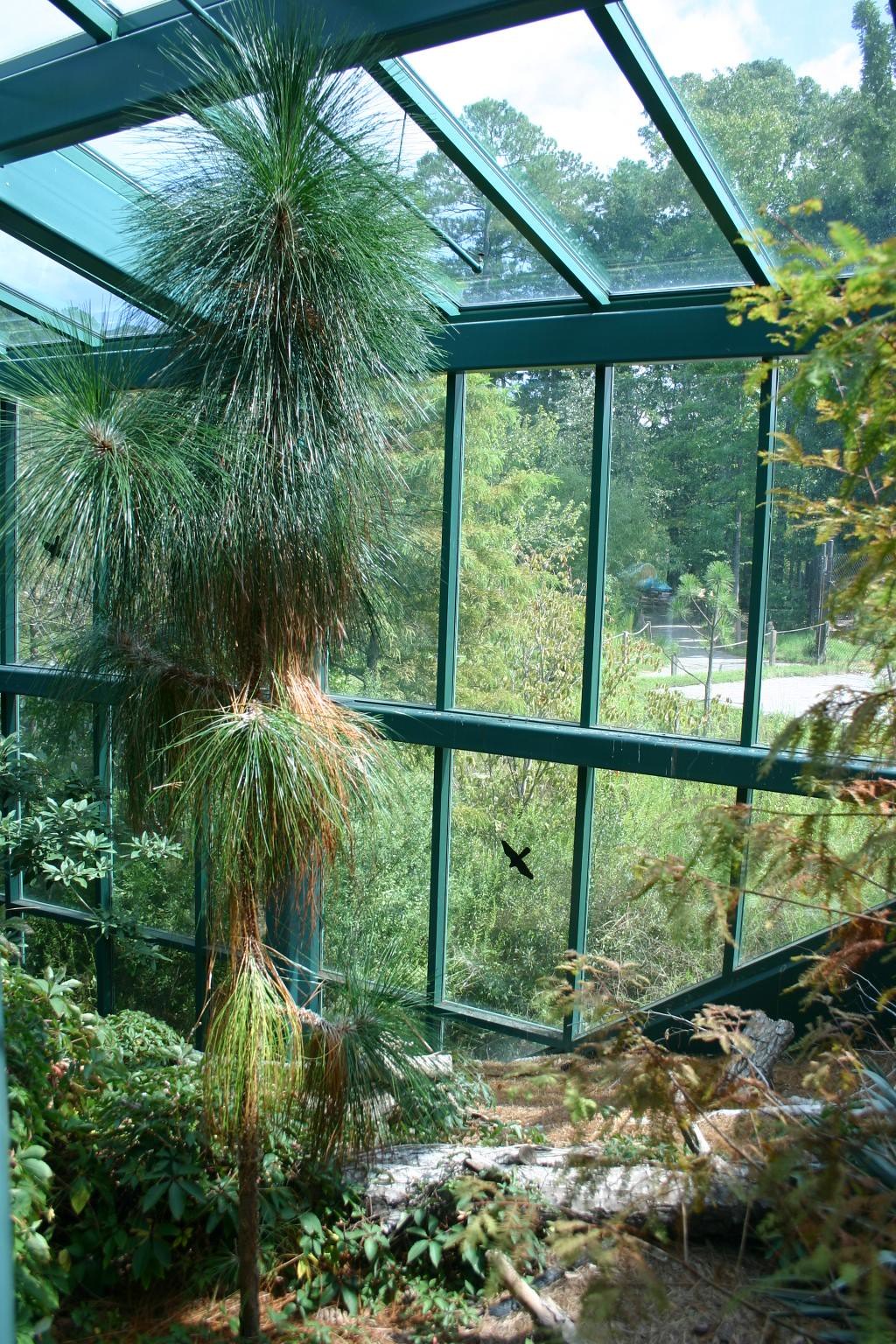
The Appalachian Cove and the Cypress Swamp rise over two levels; the official website describes them as glass-covered, walk-through habitats. A Wikimedia Commons photograph shows a tall hall with glazed roof and walls, green metal mullions, an elevated visitor walkway and broadleaf trees.
Plant collections
The Appalachian Cove recreates a Blue Ridge mountain cove. According to the Bay Journal (2006), a waterfall feeds a stream holding three kinds of trout and more than two dozen other species, including the rare hellbender, a stream-dwelling amphibian; spruce, fir and hemlock grow there and shelter forest birds such as the scarlet tanager, and forest wildflowers brighten the cove in spring. The official website speaks of a waterfall, a fast mountain stream and a lake with mountain fish.
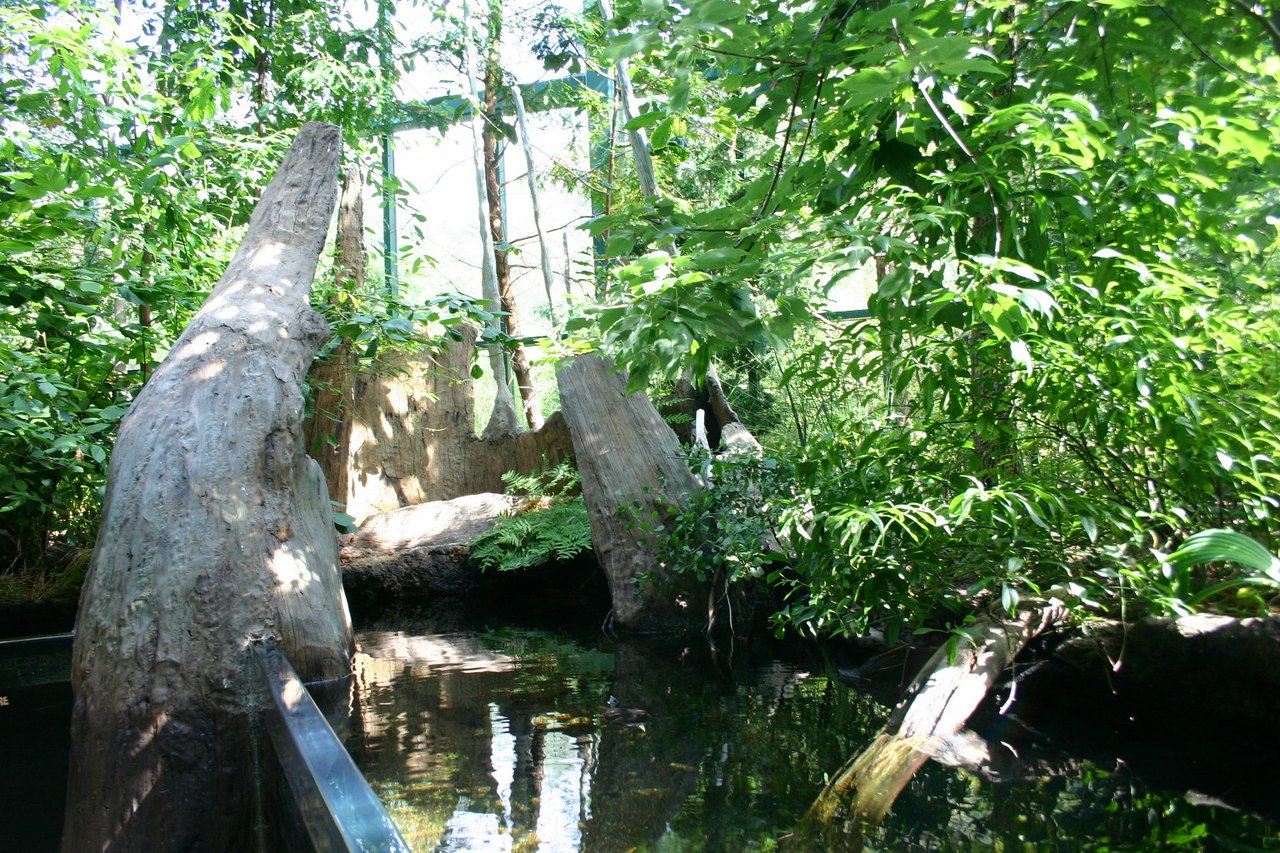
The Cypress Swamp recreates a wetland the museum presents as vital and endangered: the official website cites massive cypress and tupelo trunks within a community of swamp plants, with an alligator, fish and turtles. Inside the building, the Bay Journal reports, almost everything on display is alive, and trees and other plants follow rigorous watering schedules, a daily challenge for the staff.
Visiting
Both habitats are inside the museum building, at 524 J. Clyde Morris Boulevard in Newport News, among the exhibit galleries flanking the large entrance hall. They are visited with museum admission; the museum is open daily except Thanksgiving, 24 and 25 December and 1 January.
The ticket also covers the rest of the museum, which presents more than 250 living species native to Virginia, and an outdoor boardwalk of about three-quarters of a mile (nearly 1.2 km): habitats for river otters, beavers, bobcats and red wolves, a coastal plain aviary and a butterfly garden. A planetarium offers shows for an extra fee.
37.07° N, 76.48° W
Greenhouses nearby
More greenhouses — United States
Do you have a good photo of this greenhouse? Suggest it for this page →
Sources (6)
- thevlm.org/exhibit/appalachian-cove-cypress-swamp/
- thevlm.org/visit/tickets-and-pricing/
- dailypress.com/2004/03/29/nosing-up-to-nature/
- bayjournal.com/travel/virginia-living-museums-visitors-find-themselves-surrounded-by-wildl
- en.wikipedia.org/wiki/Virginia_Living_Museum
- commons.wikimedia.org/wiki/File:Cypress_Swamp_Exhibit_at_the_Virginia_Living_Museum(363361
Affiliate links — booking through Verrière helps fund our research, at no extra cost to you.