Glass House, Government Botanical Garden
Ooty (Udhagamandalam), Tamil Nadu

Sources checked September 2026
- Year
- 1912
- Style
- Colonial Victorian conservatory in iron and glass
- Dimensions
- Part of a group of several greenhouses spread across gardens founded in 1848
- Status
- Open to the public, with occasional closures for restoration
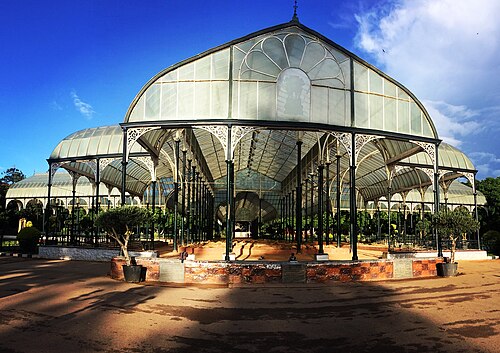
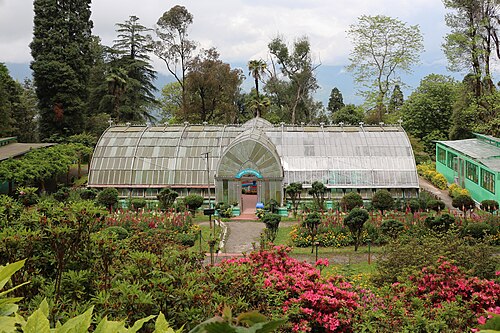
The Government Botanical Garden in Ooty, founded in 1848 by superintendent William McIvor high in the Nilgiris, replaced its first makeshift greenhouse in 1912 with a more fitting conservatory, today regarded by local heritage groups as a landmark structure. Built to shelter begonias, ferns, cacti, orchids and bulbous plants destined for the garden's flower beds, the site now comprises several greenhouses. The garden, world-famous for its May 'Flower Show', which draws tens of thousands of visitors a day, remains one of the most-visited heritage sites in Tamil Nadu.
Affiliate links — booking through Verrière helps fund our research, at no extra cost to you.
History
Ooty's botanical garden grew out of an initiative by the European community settled in the Nilgiris. When a subscription scheme to supply affordable vegetables collapsed in early 1847, donations were raised to form a horticultural society and a public garden. The Marquis of Tweeddale drew up the first layout in the late 1840s, and William Graham McIvor, a Kew-trained gardener, arrived in March 1848 to take charge. He spent about ten years turning the forested upper section and the swampy lower section into a landscaped garden. The year 1848 is the usual founding date, although some sources give 1842.
The public conservatory was built in 1912 to bring the garden's flowering display plants together under one roof. The garden kept growing afterwards: the Italian Garden was laid out during the Second World War by Italian prisoners of war, and a 1.58-hectare arboretum of native trees was added in 1992.
The great flower show, first held in 1896, came under government management in 1980. The garden is now maintained by the Tamil Nadu Horticulture Department.
Architecture and engineering
The garden covers about 22 hectares on the lower slopes of Doddabetta, at an altitude of 2,250 to 2,500 metres. It is divided into six sections: the Lower Garden, the New Garden, the Italian Garden, the Conservatory, the Fountain Terrace and the Nurseries.
The conservatory is thus a section in its own right, designed as a showcase for plants in bloom, with an adjoining bog garden for moisture-loving species. The production glasshouses lie in the nurseries, some 100 metres above the lower lawns, where eight glasshouses are set among a series of terraces.
Plant collections
The conservatory shows flowering annuals and perennials that change with the seasons, among them cineraria, schizanthus, calceolaria, balsam, cyclamen, gloxinia, tuberous begonias, coleus, geraniums, chrysanthemums and primulas. Much of this material is raised in the eight nursery glasshouses, which grow begonias, ferns, cacti, succulents, orchids and bulbous plants for display. The terraces alongside produce cut flowers, seed and trial plants.
Across the whole garden there are around a thousand exotic and native species. A fern house holds 127 fern species, and the rose garden brings together some three hundred varieties of hybrid teas, floribundas and polyanthas.
Visiting
The entrance opens onto broad lawns, from which paths climb towards the conservatory, the Italian Garden and the nurseries. At the centre of the garden lies a fossilised tree trunk estimated at 20 million years old, presented by the Geological Survey of India, and a Toda mund recalls the traditional dwellings of the Todas, the Nilgiris' original inhabitants. The fern house stands beside the road to Raj Bhavan. Two hours are enough for a full visit. In May the annual flower show, lasting two to five days, transforms the garden and draws very large crowds.
11.41° N, 76.71° E
Greenhouses nearby
More greenhouses — India
Do you have a good photo of this greenhouse? Suggest it for this page →
Affiliate links — booking through Verrière helps fund our research, at no extra cost to you.