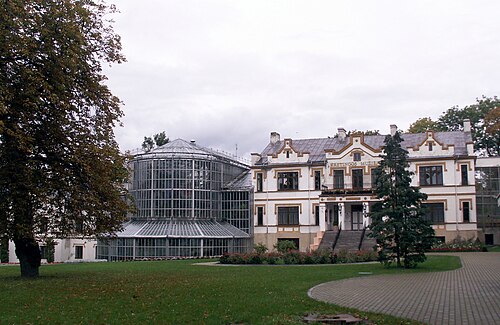
Oranžerija of the Kaunas Botanical Garden
Kaunas

Sources checked September 2026
- Year
- 1923–1925
- Style
- Interwar-era orangery with four climate-controlled sections
- Dimensions
- 1,093 m², the largest greenhouse in Lithuania
- Status
- Open to the public
On July 8, 1923, Lithuanian president Aleksandras Stulginskis laid the cornerstone of the orangery at the Kaunas Botanical Garden, in what was then the provisional capital of independent Lithuania. Completed in 1925, the structure originally had four temperature-controlled sections and a pool for tropical plants, housing 1,770 different species from its opening. At its current 1,093 m², it remains the largest orangery in Lithuania and still holds more than 1,000 plant species today; the garden surrounding it celebrated its centenary in 2023.
Affiliate links — booking through Verrière helps fund our research, at no extra cost to you.
History
Kaunas Botanical Garden was founded in 1923 by the university's Faculty of Mathematics and Natural Sciences on the former Aukštoji Freda manor estate, at a time when Kaunas was Lithuania's provisional capital. Its first director, the botanist Konstantinas Regelis — grandson of Eduard Regel, who had run the botanical garden in St Petersburg — prepared the project by touring botanical gardens in seven Western European countries in the summer of 1922.
On 8 July 1923, the day the garden was formally consecrated, President Aleksandras Stulginskis laid the orangery's foundation stone. According to the garden, the building went up between 1923 and 1925; it then had four sections held at constant temperatures and a pool for tropical plants, housed 1,770 species and drew 5,000 visitors in its first year. The Universal Lithuanian Encyclopaedia gives a slightly different sequence: tropical plants were grown in two greenhouses built in 1925, and a 12.2-metre orangery for palms, with a pool, was added in 1937.
The Second World War took a heavy toll, and many of the orangery's plants died. The garden passed to the Academy of Sciences in 1941, became an independent institution in 1990 and joined Vytautas Magnus University in 1992. It celebrated its centenary in 2023.
Architecture and engineering
The orangery covers 1,093 square metres, which the garden says makes it the largest in Lithuania. From the outset it was divided into sections each kept at a constant temperature, with a pool for tropical aquatic plants; the Universal Lithuanian Encyclopaedia records a tall palm house, 12.2 metres high, built in 1937.
Today's route runs through distinct climate sections: cool subtropics, warm subtropics, tropical forest, tropics, humid tropics, and deserts and semi-deserts. Organising the display by habitat allows plants with very different needs to be shown side by side. Experimental greenhouses with laboratories were added elsewhere in the garden between 1983 and 1986.
Plant collections
The orangery now holds more than 1,000 plant species, represented by some 1,300 accessions. Plants singled out include the banyan (Ficus benghalensis), date palm, Japanese loquat, papaya, banana, the cycad Dioon edule and an Amorphophallus. One section is given over to Australian plants such as araucarias, bamboos, casuarinas and ferns.
A Sabal palm, 74 years old in 2023, is among the long-standing residents. In the centenary year an agave flowered — a notable event for a plant that blooms only once. Victoria water lilies and sacred lotus were already being grown in the pool in the early years.
Visiting
The garden covers 62.5 hectares at Aukštoji Freda in Kaunas, taking in the old manor, its park and part of a former military fortification; it holds some 14,700 species, varieties and forms. In cold weather the orangery is the heart of a visit.
In the warmer months it pairs with the outdoor collections, the sensory garden created in 1997 for blind and partially sighted visitors, with Braille labels, and the insect house opened in 2013, the first in Lithuania. The garden also runs an educational programme on the orangery's exotic plants.
54.87° N, 23.91° E
Greenhouses nearby
Do you have a good photo of this greenhouse? Suggest it for this page →
Sources (7)
- botanika.vdu.lt/oranzerija
- botanika.vdu.lt/apie-mus/botanikos-sodo-istorija
- botanika.vdu.lt/kolekcija/oranzerijos-kolekcijos
- vle.lt/straipsnis/vytauto-didziojo-universiteto-botanikos-sodas/
- lrt.lt/naujienos/kultura/12/1960145/vdu-botanikos-sodas-svencia-simtmeti-pirmaji-oranzerij
- ltvirtove.lt/verta_pamatyti.php?lt=kauno_botanikos_sodas
- openstreetmap.org/way/261201788
Affiliate links — booking through Verrière helps fund our research, at no extra cost to you.